
AAC blocks are now widely used in residential and commercial construction. They are chosen not because they are new, but because they solve long-standing problems related to weight, speed, accuracy, and energy efficiency.
However, many decisions around AAC blocks are still made without fully understanding how block size and thickness affect a building. This often leads to overuse of material, reduced carpet area, or unnecessary cost.
This article is written to explain AAC block sizes in a clear and practical way. It focuses on how dimensions work, why thickness matters, and how the right choice improves construction quality and long-term performance. The goal is not promotion, but clarity so that walls are designed with intent, not habit.
Understanding the Anatomy of an AAC Block
Why AAC block dimensions are more precise than red bricks?
AAC blocks are made in factories and cut with precision wires after curing, so each block keeps almost the same size. Typical dimensional tolerances for AAC units are very tight manufacturers and standards cite tolerances on the order of about ±1.5 mm for modern AAC products. This accuracy lets masons use very thin mortar joints (2–3 mm) and produces straighter walls with less plastering and fewer onsite adjustments. (See IS 2185 Part 3 and industry datasheets for dimensional guidance.)
The BigBloc Advantage: Consistency in NXTBLOC Manufacturing
BigBloc AAC blocks, such as NXTBLOC formats, are produced in larger sizes while maintaining the same dimensional accuracy. Larger blocks reduce the number of joints in a wall, which helps lower mortar usage and speeds up construction. Consistent block sizing also improves wall alignment and reduces on-site corrections.
The Standard AAC Block Size Chart (2026)
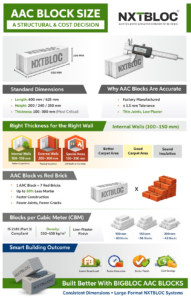
AAC blocks are produced in standard modular sizes so that wall planning, estimation, and execution remain predictable across projects. Unlike bricks, where size variation is common, AAC block dimensions are fixed and repeatable. This makes them easier to design with and easier to execute on site.
The length and height of AAC blocks are mostly standard across manufacturers. The real design choice lies in the thickness, which decides how the wall will perform.
Below is a clean and scannable AAC block size chart, based on sizes commonly used in India.
Standard AAC Block Dimensions (in mm)
|
Parameter |
Available Sizes |
Practical Note |
|
Length |
600 mm (standard) / 625 mm |
600 mm is most widely used and easiest for planning |
|
Height |
200 mm / 240 mm / 250 mm |
Selected based on floor height and modular planning |
|
Thickness (Width) |
75, 100, 125, 150, 200, 230, 250, 300 mm |
Most critical variable for wall performance |
Also Read: Benefits of Using AAC Blocks
How to Read This Size Chart Correctly?
The length (600 mm) remains constant in most projects. This helps reduce cutting and wastage.
The height is chosen mainly to align with floor-to-floor height and reduce horizontal joints.
The thickness, however, is a design decision. It directly affects:
- Wall application (internal or external)
- Thermal insulation
- Sound performance
- Carpet area
- Cost per square foot
For example, a 100 mm AAC block may be sufficient for internal partitions, while a 200 mm block is more suitable for external walls where insulation and durability matter.
This is why thickness should never be selected casually. It must match the function of the wall, not just follow site habit.
How to Choose the Right Thickness for Your Wall (The Selection Logic)
Choosing the right AAC block thickness is not about using the thickest block available. It is about understanding what the wall is supposed to do. Internal walls, external walls, and service areas all have different performance requirements. AAC blocks allow this flexibility because thickness can be selected based on function.
Internal Partition Walls (4″ to 6″ / 100–150 mm)
Internal partition walls are non-load-bearing. Their main purpose is to divide spaces while using minimum floor area. For this reason, AAC blocks with a thickness of 100 mm to 150 mm are most commonly used.
A 100 mm AAC block helps maximise carpet area, which is especially important in residential apartments, hotels, and office buildings. Despite being thin, AAC blocks still provide good stability due to their uniform structure. After plastering, these walls also offer acceptable sound insulation for normal indoor use. Using thicker blocks for internal partitions usually does not improve performance but increases cost and reduces usable space.
External / Outer Walls (8″ to 12″ / 200–300 mm)
External walls form the building envelope and are exposed to heat, rain, wind, and noise. These walls play a major role in controlling indoor comfort and energy consumption. For this reason, AAC blocks with a thickness of 200 mm to 300 mm are recommended.
Thicker AAC blocks contain more air pockets, which improves thermal insulation. This reduces heat transfer from outside to inside, lowering the load on air-conditioning systems and helping save energy over the life of the building. A 200 mm AAC block wall is often considered a balanced choice, offering good insulation without excessive material use. In high-end or climate-sensitive projects, thicker blocks may be used for better performance.
Special Applications: Parapet Walls, Lift Ducts, and Fire-Rated Shafts
Certain parts of a building have specific safety and performance requirements. Parapet walls need stability against wind loads, lift shafts require straight and accurate alignment, and fire-rated shafts must resist high temperatures for extended periods.
In these areas, AAC block thickness is selected based on design and safety codes, usually ranging from 150 mm to 300 mm. AAC blocks are well suited for such applications because they offer excellent fire resistance, dimensional accuracy, and ease of construction. Thicker AAC blocks can provide fire ratings of several hours, making them suitable for fire separation walls and service shafts.
AAC Block and Red Brick Comparison Table
|
Parameter |
AAC Block (NXTBLOC / Large Format) |
Traditional Red Brick |
|
Typical Unit Size |
600 × 200 × 200 mm |
~230 × 110 × 75 mm |
|
Wall Coverage per Unit |
Covers large wall area |
Covers small wall area |
|
Replacement Ratio |
1 AAC block ≈ 7 red bricks |
7 bricks needed |
|
Number of Units per m² |
Very low |
Very high |
|
Number of Joints |
Minimal |
High |
|
Mortar Joint Thickness |
2–3 mm |
10–12 mm |
|
Mortar Consumption |
Up to 60% lower |
High |
|
Construction Speed |
Faster wall completion |
Slower due to more units |
|
Alignment & Finish |
Better alignment, smoother walls |
Uneven, needs |
Also Read: AAC Block vs Red Brick
What does this comparison mean in Practice?
Because one large AAC block replaces around seven red bricks, the total number of masonry units required on site reduces sharply. Fewer units mean fewer joints, and fewer joints mean less mortar, less water, and less time spent on alignment.
In traditional brickwork, thicker mortar joints are used to adjust size variations between bricks. AAC blocks do not need this adjustment because of their dimensional accuracy. Thin joints improve wall strength consistency and reduce cracking risk.
From a site execution point of view, this is why AAC block masonry progresses much faster than brick masonry. From a cost point of view, savings come from lower mortar usage, reduced labour time, and faster project timelines.
Technical Specifications & IS 2185 Standards
AAC blocks in India are manufactured as per IS 2185 (Part 3), which defines requirements for size accuracy, strength, and overall quality. These standards ensure that AAC blocks perform consistently on site and deliver predictable results.
Dimensional Tolerances and “Zero-Plaster” Finishes
AAC blocks are produced with tight dimensional tolerances, typically around ±1.5 mm. This high level of accuracy allows blocks to be laid using thin jointing mortar, keeping walls straight and aligned. Because of this, plaster thickness can be reduced significantly, and in some cases, only a thin skim coat is required. Lower plaster thickness reduces material use, labour cost, and the risk of surface cracks.
Compressive Strength vs. Density (Grade 1 vs. Grade 2)
IS 2185 classifies AAC blocks based on density and compressive strength. Higher-density blocks (Grade 1) offer better strength and are chosen where rigidity and impact resistance are important. Lower-density blocks (Grade 2) are lighter and provide better thermal insulation, making them suitable for non-load-bearing walls where energy efficiency is a priority.
Selecting the right grade helps balance strength, insulation, and overall construction cost.
Calculating Your Requirements: Blocks per Cubic Meter (CBM)
Estimating AAC block quantity correctly is important for cost control and site planning. Because AAC blocks are uniform in size, the calculation is straightforward and reliable.
The basic formula is:
Number of blocks per CBM = 1 ÷ (Length × Height × Thickness in meters)
For example, a standard AAC block with dimensions 600 × 200 × 200 mm has a volume of 0.024 cubic meters. Dividing one cubic meter by this volume gives approximately 42 AAC blocks per CBM.
Using the same method:
- 100 mm thick AAC blocks require roughly 83 blocks per CBM
- 150 mm thick AAC blocks require roughly 56 blocks per CBM
- 200 mm thick AAC blocks require roughly 42 blocks per CBM
This calculation helps readers estimate material quantities accurately, reduce over-ordering, and plan deliveries more efficiently. Since AAC blocks have minimal size variation, actual site consumption usually matches these estimates closely.
Also Read: How to Build Walls Using AAC Blocks?
Build with Confidence Using Bigbloc AAC Blocks
Choosing the right AAC block size is only effective when the blocks themselves are consistent, certified, and reliable. This is where Bigbloc Construction stands out.
Bigbloc AAC Blocks are manufactured under strict quality controls, ensuring accurate dimensions, consistent density, and dependable performance across every batch. With large-format NXTBLOC systems, Bigbloc helps projects reduce joints, speed up construction, and achieve better finish quality with lower material consumption.
If your project demands precision, efficiency, and long-term performance, Bigbloc Construction offers AAC block solutions designed for modern building requirements.
Explore Bigbloc AAC Blocks and NXTBLOC systems to build smarter, faster, and more efficiently.