
Most construction problems don’t look like problems at the start.
They look like small compromises.
A delayed reply.
A vague answer.
A quote that feels “manageable” but not fully clear.
By the time cracks appear, money is already spent and decisions are locked.
When people talk about return on investment in construction, they usually talk about land price, design, or material quality. Very few talk about the contractor.
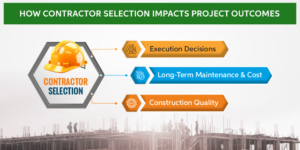
On site, the contractor decides how drawings are interpreted, how materials are used, how labour works, and how problems are handled when things don’t go as planned. These daily decisions decide whether a project stays controlled or slowly slips out of hand.
A skilled contractor protects your money quietly.
An unprepared one burns it slowly.
That is why choosing the right construction contractor is not a formality. It directly decides your timelines, long-term maintenance cost, and peace of mind.
Step 1: Verify Credentials and Legal Compliance (The Non-Negotiables)
This step is often skipped because it feels administrative. In reality, it sets accountability.
Checking for GST registration and local licenses
A legitimate contractor should be able to clearly share:
- GST registration in the same name as the contract
- Valid local or municipal contractor license
- Business registration details
These documents are not about formality. They ensure traceability. If disputes arise, delays happen, or work stops midway, you need to know that the contractor legally exists and can be held responsible.
Verifying Workman’s Compensation and Liability Insurance
Construction sites carry risk. Accidents happen even on well-managed projects.
Ask for proof of:
- Workman’s compensation insurance
- Third-party liability insurance
Without insurance, any accident on site can legally and financially fall on the property owner. Contractors who take safety and insurance seriously usually manage sites more responsibly overall.
Step 2: Evaluate Technical Expertise and Material Knowledge
Experience alone is not enough. What matters is how well the contractor understands materials and execution.
A capable contractor should be able to explain:
- How structural integrity is maintained during execution
- How material wastage is controlled
- Why certain materials are chosen for specific applications
Does the contractor have experience with sustainable materials?
Modern residential construction increasingly uses:
- Lightweight blocks
- Precision mortars
- Ready-to-use plasters
Ask practical questions:
- How are these materials stored on site?
- What installation mistakes are commonly made and how are they avoided?
- How does workmanship affect long-term performance?
Clear answers show real site experience. Vague answers usually mean trial-and-error execution.
Step 3: The “Apples to Apples” Quote Comparison
Many homeowners choose contractors based on the final number. This is where trouble begins.
Two quotes with the same total can be very different in reality.
How to spot hidden costs in a low-ball bid
Hidden costs usually hide behind:
- Unclear material specifications
- Missing thicknesses, grades, or coverage details
- Broad phrases like “as required” or “standard practice”
A reliable quote clearly defines:
- What materials are used
- How much is used
- What is excluded
The goal is not the cheapest quote. It is the quote with the least ambiguity.
Step 4: Site Visits and Portfolio Audits
Photos show finished surfaces. Sites show behaviour.
What to look for at an active construction site
When visiting a live site, observe quietly:
- Cleanliness and material stacking
- Safety practices
- Labour supervision
- Order of work execution
A disorganised site usually produces disorganised results, no matter how good the drawings are.
Questions to ask their previous clients
Client conversations reveal what contracts don’t.
Ask:
- Were timelines respected?
- How were cost changes handled?
- How did the contractor respond when mistakes happened?
Listen carefully. Hesitation often says more than complaints.
Step 5: Finalizing the Construction Agreement
Once you are confident in the contractor, the agreement locks expectations.
Defining payment milestones (linked to progress, not dates)
Payments should be tied to:
- Completion of construction stages
- Verified measurements
- Quality checks
Date-based payments reduce leverage. Progress-based payments protect quality.
Including a material specification clause
The agreement should clearly mention:
- Material type and grade
- Approved alternatives, if any
- Approval process for substitutions
This clause prevents silent downgrades during execution and ensures consistency from start to finish.
Also Read: How to Calculate Construction Cost in India?
Common Red Flags to Watch Out For
Some warning signs appear early and should not be ignored.
Be cautious if a contractor:
- Requests large cash advances before work starts
- Does not have a permanent office or traceable address
- Hesitates to provide a written contract
These are not minor issues. They usually indicate deeper operational problems.
Also Read: What Permissions and Approvals Are Needed Before Starting Construction?
Conclusion: Building Your Future on a Strong Foundation
Good construction does not feel dramatic.
It feels controlled.
That control comes from:
- Clear contracts
- Transparent material usage
- Skilled execution
- Responsible site management
When the contractor is chosen carefully, problems reduce, decisions become easier, and construction becomes predictable.
Great materials + skilled contractor = stress-free build.
And that combination is what truly defines a successful construction project.
Explore how BigBloc Construction approaches smarter, system-driven construction.