
POP vs Wall Putty: Which Is Better for Your Walls in India?
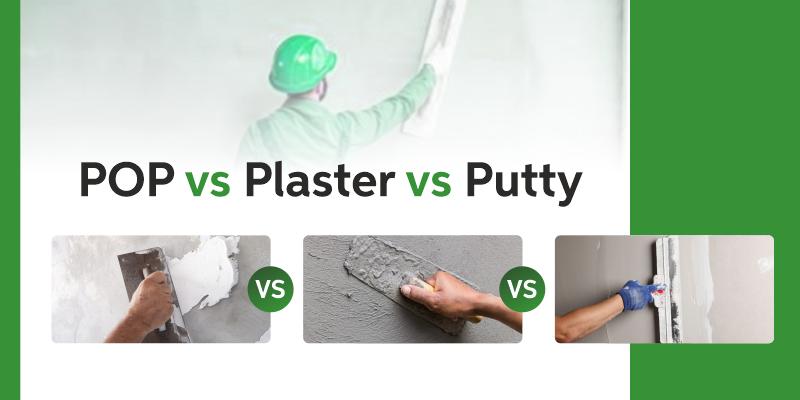
For most Indian homes, wall putty is the better choice because it offers better durability, moisture resistance, and paint adhesion. POP performs better when you want an ultra-smooth decorative finish for dry interior spaces. In premium interiors, many contractors use POP for levelling and wall putty as the final finishing layer before painting.
Introduction
Ask three people whether you should use POP or wall putty, and you’ll probably get three different answers.
A painter may recommend POP because it creates an exceptionally smooth finish. A contractor may prefer wall putty because it lasts longer. An interior designer might suggest using both to achieve the best result. None of them is necessarily wrong; the problem is that each recommendation is based on a different requirement.
This is why so many homeowners get confused.
At first glance, POP and wall putty look almost identical. Both are white powders mixed with water and applied before painting. But that’s where the similarity ends. They are made from different materials, serve different purposes, and perform very differently when exposed to India’s climate.
The decision isn’t just about getting smooth walls. It also affects how well the paint adheres, how the surface handles moisture, how often maintenance is needed, and how your walls look years after construction is complete.
Another factor that is often overlooked is the quality of the surface underneath. Even the best finishing material cannot perform well if it is applied over a poorly prepared base. If you’re planning a new home or commercial project, understanding what Ready Mix Plaster is will help you see why the plaster layer is just as important as the finishing coat that goes over it.
This guide takes an honest look at POP vs wall putty. Instead of declaring one material as the winner, we’ll explain where POP genuinely performs better, where wall putty has a clear advantage, and when using both together gives the best results. By the end, you’ll know which option is right for your project, not just which one is more popular.
What Is POP (Plaster of Paris)?
Plaster of Paris, commonly known as POP, has been used in the construction industry for decades to create smooth, even wall surfaces before painting. It is a gypsum based material produced by heating natural gypsum to form calcium sulphate hemihydrate. When mixed with water, it quickly turns into a workable paste and usually sets within 10 to 25 minutes, making it suitable for interior finishing work.
Unlike cement based materials, POP is not designed to strengthen a wall. Its primary purpose is to improve the surface finish. Contractors commonly use it to level uneven plaster, fill deep undulations, prepare walls before applying a finishing coat, and create decorative elements such as false ceilings, cornices, mouldings, and wall features. Depending on the application, POP is generally applied in a thickness ranging from 2 mm to 12 mm.
One of POP’s biggest advantages is the exceptionally smooth finish it creates. This is why it continues to be a preferred choice for premium interiors where appearance is a priority. However, this advantage also comes with an important limitation. Since POP is gypsum based, it has very low resistance to moisture. Prolonged exposure to dampness can weaken the material and affect the paint finish over time.
For this reason, POP should only be used in dry interior spaces. It is not recommended for exterior walls, bathrooms, kitchens, balconies, utility areas, or any location that is regularly exposed to moisture or high humidity.
What Is Wall Putty?
Wall putty is a finishing material applied over plaster to create a smooth, uniform surface before painting. It fills small pores, minor surface imperfections, and hairline cracks, helping the paint spread evenly while improving its adhesion and durability. A properly applied layer of wall putty also reduces paint absorption, resulting in a more consistent finish.
The most commonly used wall putty in India is white cement based putty, made from white cement, polymers, and fine mineral fillers. It forms a hard, durable surface that performs well on both interior and exterior walls, making it the preferred choice for most new residential and commercial construction projects.
Leading brands in India, including Birla White, JK Wall Putty, and Asian Paints TruCare, manufacture white cement based putties for residential and commercial projects.
Another type is acrylic wall putty, a water based product known for its flexibility and ease of application. It is generally used for repair work, repainting projects, or surfaces where minor movement is expected. However, for fresh plastered walls, white cement putty is more widely used because it provides better strength and long term performance.
Wall putty is usually applied in two thin coats, with each coat measuring about 1 to 3 mm. When used over a properly cured plaster surface, it creates a strong base for primer and paint, improves the final appearance of the wall, and helps the paint finish remain intact for years.
POP vs Wall Putty: Head-to-Head Comparison
Choosing between POP and wall putty isn’t about deciding which material is universally better. Each has its own strengths, limitations, and ideal applications. Understanding how they compare across the factors that matter most will help you choose the right finishing material for your project.
|
Parameter |
POP |
Wall Putty |
|
Composition |
Gypsum-based (Calcium Sulphate Hemihydrate) |
White cement, polymers, and fine mineral fillers |
|
Suitable For |
Dry interior walls, false ceilings, decorative work |
Interior and exterior walls, including wet areas after plaster |
|
Finish Quality |
Ultra smooth finish |
Smooth and uniform finish |
|
Moisture Resistance |
Low |
High |
|
Durability |
Performs well in dry interiors |
Better suited for long term use in most Indian conditions |
|
Application Thickness |
2 to 12 mm |
1 to 3 mm per coat (usually two coats) |
|
Approximate Cost (2026) |
₹15 to ₹35 per sq. ft. |
₹15 to ₹30 per sq. ft. |
|
Best Used For |
Decorative finishes and levelling uneven surfaces |
Creating a durable base before painting |
Cost Disclaimer: The prices above are indicative for 2026 and may vary depending on the city, product brand, labour charges, wall condition, and project size.
1. Composition: Why It Matters
The biggest difference between POP and wall putty begins with what they are made of. POP is a gypsum based material that sets quickly and produces a smooth, lightweight finish. This makes it easy to shape and ideal for decorative applications. However, gypsum is naturally more sensitive to moisture, which limits its use to dry interior spaces.
Wall putty, on the other hand, is made from white cement, polymers, and fine mineral fillers. Once it cures, it forms a harder and denser surface that offers better resistance to moisture and everyday wear. This is why wall putty is commonly used as the final preparation layer before painting in both residential and commercial buildings.
While both materials improve the appearance of a wall, their composition determines where they perform best. POP is designed to enhance the finish, whereas wall putty is designed to improve both the finish and the long term performance of painted walls.
2. Where Each Can and Cannot Be Used
Choosing the right finishing material isn’t just about getting a smooth wall. It’s about using the material in an environment where it can perform well for years. This is where many homeowners make expensive mistakes.
POP is designed for dry interior spaces where moisture is not a concern. It is widely used in living rooms, bedrooms, dining areas, and hallways because it creates a smooth, elegant surface that enhances the final paint finish. It is also the preferred material for decorative applications such as false ceilings, cornices, mouldings, and feature walls, where its ability to be shaped and finished with precision is a major advantage.
However, POP should not be used on exterior walls, bathrooms, kitchens, balconies, or utility areas. Since it is made from gypsum, prolonged exposure to moisture can gradually weaken the material. Over time, this may lead to paint blistering, damp patches, hairline cracks, or deterioration of the surface.
Wall putty offers much greater flexibility because it is cement based. Once applied over a properly cured plaster surface, it can be used on both interior and exterior walls, including kitchens, bathrooms, balconies, and other areas where humidity levels are higher. Its stronger resistance to moisture makes it a more reliable choice for walls that experience seasonal weather changes.
It’s equally important to understand where wall putty should not be applied. It should never be used directly on raw brickwork, AAC blocks, or any unplastered masonry surface. It also should not be applied over damp walls or areas affected by active water leakage. Before applying wall putty, the plaster must be properly cured and free from moisture. Otherwise, even the best finishing material may fail prematurely.
India’s climate makes this decision even more important. In coastal cities such as Mumbai, Chennai, Kochi, and Goa, high humidity is present for much of the year. Even interior walls are exposed to regular moisture fluctuations. In such conditions, wall putty generally performs more reliably than POP because it is better equipped to withstand changes in humidity over the long term.
Understanding how moisture damages wall finishing in Indian buildings also helps explain why problems such as peeling paint, damp patches, and surface cracks often occur. In many cases, the issue is not the paint itself but the condition of the wall underneath.
3. Finish Quality: Which Gives Smoother Walls?
When it comes to achieving a perfectly smooth wall, POP has a clear advantage. This is one area where it continues to be the preferred choice for many painters, interior designers, and craftsmen, especially for premium interior projects.
Because POP is made from gypsum, it spreads easily and can be finished to an exceptionally smooth surface. Once sanded, it creates a naturally white, almost velvet-like finish that enhances the appearance of premium paints. This is why POP is commonly used in luxury homes, hotel interiors, high-end retail stores, and decorative spaces where every detail matters.
Wall putty also produces a smooth finish, but its purpose is slightly different. Rather than creating decorative perfection, it prepares the wall for painting by filling tiny pores and minor imperfections left in the plaster. After proper sanding, it provides a clean and uniform surface that allows the primer and paint to bond evenly.
For most residential projects, however, the difference is difficult to notice once the painting is complete. A well-applied wall putty, followed by a quality primer and paint, delivers a finish that meets the expectations of most homeowners. Unless you’re aiming for a premium decorative interior or intricate design work, the visual difference between the two is often minimal.
This is why the choice should not be based on finish quality alone. If appearance is your only priority, POP remains the better option. But if you also want durability, moisture resistance, and lower maintenance, wall putty offers a more balanced solution for most Indian homes.
4. Moisture Resistance
For Indian homes, moisture resistance is often the deciding factor when choosing between POP and wall putty. A wall may look perfectly finished on the day it’s painted, but its ability to withstand humidity, dampness, and seasonal weather changes determines how well it performs over the years.
POP is made from gypsum, a material that creates a smooth finish but has very little moisture resistance. When exposed to repeated humidity or damp conditions, it gradually absorbs moisture. Over time, this can lead to paint blistering, dark patches, peeling, and hairline cracks. These problems are more common in homes where ventilation is poor, or rooms remain closed for long periods.
Wall putty performs differently because it is cement-based. Once cured, it forms a dense surface that resists moisture far better than gypsum. Polymer-modified wall putties further improve water resistance and help maintain a stable surface for primer and paint. This makes wall putty suitable for both interior and exterior walls, including kitchens, bathrooms, balconies, and other areas where moisture exposure is higher.
This difference becomes especially important in India. Most regions experience several months of high humidity during the monsoon, while coastal cities such as Mumbai, Chennai, Kochi, and Kolkata remain humid for much of the year. Even interior walls in these locations are exposed to regular moisture fluctuations. In many tier two and tier three cities, where air conditioning is not used throughout the day, walls also experience frequent cycles of heat and humidity. Under these conditions, POP may begin showing signs of deterioration within a few monsoon seasons, whereas a properly applied wall putty system generally continues to perform reliably for much longer.
It’s also important to remember that the finishing material is only one part of the system. Poor waterproofing, leaking pipes, roof seepage, or rising damp can damage any wall finish, regardless of the product used. Understanding how moisture damages wall finishing in Indian buildings helps identify the root cause of these problems and highlights why preventing water ingress is just as important as choosing the right finishing material.
5. Durability: Which Lasts Longer?
When homeowners compare POP and wall putty, they often focus on how the wall looks immediately after painting. A more important question is how well that finish will hold up over the next five to ten years.
In most Indian conditions, wall putty offers better long-term durability. Its white cement-based composition creates a hard and stable surface that resists minor impacts, surface wear, and moisture more effectively than POP. It also provides a stronger base for primer and paint, helping the paint retain its appearance for a longer period with minimal maintenance.
POP performs well in dry interior spaces where humidity remains low, and temperature changes are limited. In air-conditioned bedrooms, living rooms, or office interiors, a properly applied POP finish can continue to look good for years. However, because gypsum is more brittle than cement-based materials, it is more likely to develop hairline cracks when exposed to repeated expansion and contraction caused by changes in temperature or moisture. This is one of the reasons why POP is generally not recommended for areas that experience frequent humidity or dampness.
Under normal Indian conditions, a properly finished wall with quality wall putty can support a paint system that performs well for seven to ten years, depending on the quality of workmanship, the paint used, and exposure to weather. In comparison, POP finishes applied in non-air-conditioned spaces or humid regions may require repairs or refinishing within three to five years, particularly if the walls are exposed to seasonal moisture.
It’s also worth remembering that the durability of any wall finish depends on more than the finishing material alone. The strength of the plaster underneath, proper curing, and correct application methods all influence how well the wall performs over time. Understanding what makes a plaster durable helps explain why a well-prepared base is essential for achieving a long lasting finish, regardless of whether you choose POP or wall putty.
6. Cost Comparison: What Each Costs in India (2026)
Cost is often the deciding factor when choosing between POP and wall putty. However, comparing only the material price can be misleading. The total cost of finishing a wall depends on the material, labour, application method, and the maintenance required over the years.
POP generally costs ₹5 to ₹10 per sq. ft. for the material. Since it requires skilled application to achieve a smooth and even finish, labour charges are usually higher, ranging from ₹10 to ₹25 per sq. ft. This brings the total installation cost to approximately ₹15 to ₹35 per sq. ft., depending on the complexity of the work and local labour rates.
Wall putty is typically applied in two thin coats. Material costs usually range from ₹5 to ₹12 per sq. ft., while labour charges are around ₹10 to ₹18 per sq. ft. The overall application cost generally falls between ₹15 and ₹30 per sq. ft. Although the initial cost is similar to POP, wall putty is often more economical because it requires less specialised labour and provides a durable base for paint.
The real difference becomes visible over the life of the building. In many Indian homes, a well-applied wall putty system lasts longer and reduces the need for frequent repairs or repainting. POP, particularly in humid or non air conditioned environments, may require maintenance sooner, increasing the overall cost of ownership. Over time, the reduced maintenance requirements of wall putty can result in noticeable savings, especially for larger residential and commercial projects.
If you’re estimating the complete wall finishing budget, it’s also important to consider the plaster beneath the finishing coat. Understanding How Much Does Ready Mix Plaster Cost provides a clearer picture of the total cost involved, from plastering to the final paint finish.
Cost Disclaimer: The prices mentioned above are indicative for 2026 and may vary depending on the city, project size, product quality, labour charges, wall condition, and market fluctuations.
Can You Use Both POP and Wall Putty on the Same Wall?
Yes. In fact, many experienced contractors use both POP and wall putty on the same wall to combine the strengths of each material. The idea isn’t to replace one with the other but to use each where it performs best.
A common practice in premium residential interiors is to apply POP first to level the plaster surface and remove minor undulations. Once the POP has fully set and the surface has been prepared, a thin layer of wall putty is applied before primer and paint. This creates a wall that is not only smooth but also provides better paint adhesion and improved resistance to everyday wear.
This approach works particularly well in living rooms, master bedrooms, and formal spaces where homeowners want a premium finish without compromising on durability. By combining the smoothness of POP with the strength of wall putty, contractors are able to achieve a surface that looks refined and remains easier to maintain over time.
That said, this combination is not necessary for every project. For exterior walls, bathrooms, kitchens, balconies, coastal regions, and standard residential construction, wall putty applied over a properly cured plaster surface is usually the more practical choice. These areas are exposed to higher levels of moisture, making long term durability more important than achieving an ultra smooth decorative finish.
POP, on the other hand, continues to be the preferred material for false ceilings, cornices, mouldings, and decorative wall features. Its ability to be shaped and finished with precision makes it difficult to replace in these applications. However, using POP as the only finishing layer on large wall surfaces, especially in humid Indian conditions, is generally not recommended because of its limited resistance to moisture.
In the end, the decision depends on the purpose of the space. If your priority is a premium interior finish, using both materials together can deliver excellent results. For most homes, however, a quality wall putty system provides the right balance of appearance, durability, and long term performance.
POP vs Wall Putty on AAC Block Walls: What BigBloc Recommends
AAC blocks have become a preferred walling material for residential, commercial, and industrial projects because they are lightweight, dimensionally accurate, and offer good thermal insulation. However, achieving a durable and long lasting paint finish on AAC block walls depends on more than just choosing between POP and wall putty. The entire wall finishing system needs to work together.
The first step is to create a strong and uniform base. For AAC block walls, this is achieved by applying a quality cement based plaster before any finishing material is used. A properly plastered surface improves adhesion, reduces surface irregularities, and provides the right foundation for the layers that follow. If you’re working with AAC blocks for the first time, understanding How to Apply Ready Mix Plaster correctly can help ensure better surface preparation and consistent results.
Once the plaster has cured, wall putty is generally the preferred finishing material for AAC block walls. It fills minor surface imperfections, creates a smooth base for primer and paint, and offers better resistance to moisture than gypsum based finishes. This makes it suitable for both interior and exterior walls, especially in regions that experience seasonal humidity or frequent weather changes.
POP can still be used in buildings constructed with AAC blocks, but its role is different. Rather than being applied across large wall surfaces, it is better suited for decorative features such as false ceilings, cornices, mouldings, and feature walls where its smooth finish and ease of shaping offer clear advantages. Limiting POP to these applications helps retain its aesthetic benefits while avoiding the durability concerns associated with moisture exposure.
A complete wall finishing system using AAC blocks, ready mix plaster, wall putty, primer, and paint provides better long term performance than treating each layer as an independent product. Every stage of the process influences the final result, from the quality of plastering to the application of the finishing coat. Being aware of Common Ready Mix Plaster Problems and following the correct application practices can also help minimise issues such as cracks, poor bonding, or uneven surfaces later in the life of the building.
For most AAC block projects, this systematic approach delivers walls that not only look better on the day they are painted but also retain their appearance and performance for years to come.
Quick Decision Guide
After comparing POP and wall putty across different parameters, the choice becomes much simpler. The right material depends on where it will be used and what you expect from the finished wall.
Choose POP if you’re working on decorative interior spaces where achieving an exceptionally smooth finish is the priority. It remains the preferred material for false ceilings, cornices, mouldings, and feature walls because it is easy to shape and creates a refined surface that enhances premium paint finishes.
Choose wall putty if you’re preparing walls for long term durability. It is better suited for interior and exterior walls, kitchens, bathrooms, balconies, and buildings located in humid or coastal regions. Its cement based composition provides better resistance to moisture while creating a strong base for primer and paint.
If you’re building with AAC blocks or using ready mix plaster, wall putty is generally the recommended finishing layer because it complements the plaster system and supports better paint performance over time. Choosing the right plaster is equally important, especially when different parts of a building are exposed to different environmental conditions. Our guide on Ready Mix Plaster for Interior vs Exterior Walls explains how selecting the correct plaster can improve the performance of the entire wall finishing system.
For most residential and commercial projects in India, wall putty offers the best balance of durability, appearance, and long term value. POP continues to play an important role in decorative applications, but it should be used where its strengths can be fully utilised rather than as a universal solution for every wall.
Conclusion
Choosing between POP and wall putty is not about deciding which material is better in every situation. It’s about selecting the material that best suits your project, the environment, and the performance you expect over the years.
POP continues to be an excellent choice for decorative interiors where achieving a perfectly smooth finish is the priority. Its ease of application and ability to create detailed architectural features make it a preferred material for false ceilings, cornices, mouldings, and premium living spaces.
For most residential and commercial buildings, however, wall putty offers a more practical solution. Its cement based composition provides better moisture resistance, stronger paint adhesion, and improved durability, making it suitable for both interior and exterior walls. When applied over a properly prepared plaster surface, it creates a stable foundation that helps maintain the appearance of the paint finish for years.
If you’re building with AAC blocks, the best results come from treating the wall as a complete system rather than focusing on a single finishing layer. A combination of AAC blocks, quality ready mix plaster, wall putty, primer, and paint works together to improve durability, reduce maintenance, and deliver a consistent finish across the building.
To achieve the best results on AAC block walls, explore NXTPLAST Ready Mix Plaster and learn how a complete wall finishing system can improve construction quality and long term performance.
Frequently Asked Questions
No. POP is a gypsum-based material designed for dry interior applications. It has low moisture resistance and should not be used on exterior walls, bathrooms, kitchens, balconies, or other areas exposed to rain or regular humidity. For these locations, a cement-based wall putty applied over a properly cured plaster surface is a more suitable choice.
Yes. For most homes, wall putty can be used as the finishing layer before painting. It provides a smooth surface, improves paint adhesion, and offers better durability in Indian conditions. However, if you’re aiming for a premium decorative finish or creating false ceilings and mouldings, POP remains the preferred material because of its superior finishing characteristics.
Yes. Many contractors use POP and wall putty together, especially in premium interior projects. POP is first used to level the surface and achieve a smooth finish, after which a thin coat of wall putty is applied before primer and paint. This approach combines the finishing quality of POP with the durability and paint adhesion offered by wall putty.
The initial application costs for both materials are broadly similar and depend on the product, labour charges, and the condition of the wall. However, wall putty often proves more economical over the long term because it provides a durable base for paint and generally requires less maintenance than POP in humid conditions.
For AAC block walls, wall putty applied over a properly cured cement-based plaster is generally the recommended finishing system. It offers better moisture resistance, stronger paint adhesion, and improved long-term durability. POP is best reserved for decorative applications such as false ceilings, cornices, and feature walls rather than as the primary finishing layer for large wall surfaces.