
Ready Mix Plaster vs Site-Mixed Plaster
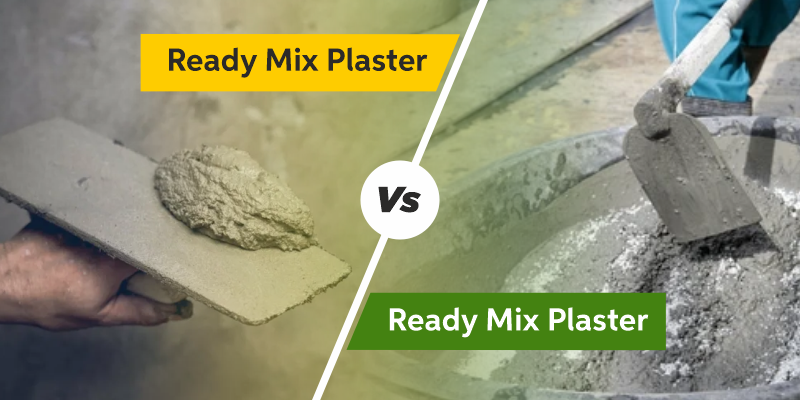
Plastering is one of the last activities before project handover. It directly affects wall finish, paint quality, and long-term durability.
It is also one of the most common points where quality starts to slip.
In site-mixed plaster, the mix is prepared manually using cement, sand, and water. The outcome depends on how accurately the materials are measured and how consistently they are mixed. In practice, this varies from batch to batch.
A mix that is too wet can lead to shrinkage cracks. A mix that is too dry affects bonding with the wall surface. On large projects, even different floors can end up with different plaster quality.
This is the core limitation of site mixing – consistency cannot be guaranteed.
Ready mix plaster addresses this at the factory level. Each batch is produced with controlled proportions, processed sand, and performance additives. The mason only adds water and applies.
As a result, builders are shifting towards ready mix plaster. The shift is driven by the need for predictable quality, faster execution, and better control over material usage.
What Is the Difference Between Ready Mix Plaster and Site-Mixed Plaster?
|
Feature |
Ready Mix Plaster (NXTPLAST) |
Site-Mixed Plaster |
|
Composition |
Factory: processed sand, cement, polymer additives |
Site: cement, sand, water mixed manually |
|
Quality Consistency |
Same quality every bag, every day |
Varies with mason, sand moisture, water proportion |
|
Sand |
Pre-graded, already in the bag. No separate procurement |
River sand must be sourced, stored, sifted on site |
|
Coverage per 40kg Bag |
15 to 20 sq. ft. at 10 to 12mm thickness |
Varies by sand moisture and mix proportions |
|
Crack Resistance |
Minimum cracks. Accurately proportioned factory mix |
Higher crack risk from inconsistent mixing |
|
Surface Finish |
Smooth and even. Ready for putty or paint |
Depends on mason skill and mix quality |
|
Water Resistance |
Better. Polymer additives reduce water absorption |
Standard. May need extra waterproofing treatment |
|
Wastage |
Minimum. No sifting waste, no over-mixing loss |
Wastage from sand sifting, spillage, and excess mixing |
|
Wall Compatibility |
AAC blocks, clay bricks, fly ash blocks, RCC, and stone |
Clay bricks, RCC. Less effective on smooth AAC surfaces |
Also Read: Ready Mix Plaster vs Traditional Plaster
Why Are Builders in India Choosing Ready Mix Plaster?
Consistent Quality
One of the biggest challenges with site-mixed plaster is inconsistency. Small variations in sand moisture or cement ratio can affect bonding strength and lead to cracks.
Ready mix plaster eliminates this issue. Since it is produced in a factory, every batch maintains the same composition. This ensures uniform strength and finish across the entire project, reducing the chances of defects and rework.
Faster Construction
Time is a critical factor in construction. Site-mixed plaster requires multiple preparation steps before application even begins. Sand needs to be procured, stored, and sifted. Each batch takes time to mix, which slows down progress.
Ready-mix plaster simplifies the process. The mason only needs to add water and mix for a few minutes. This reduces preparation time significantly and increases daily output.
In practical terms, projects using ready-mix plaster can achieve up to 25–30% faster plastering progress compared to traditional methods.
Reduced Material Wastage
Material wastage is one of the hidden costs in construction.
In site-mixed plaster, losses occur during sand sifting, transportation, spillage, and unused mixed material. These losses can add up to 15–20% of total material.
Ready mix plaster minimizes this problem. Since it is pre-measured and controlled, wastage is typically less than 2%. This not only reduces cost but also improves material planning and inventory management.
Lower Labour Dependency
Traditional plastering depends heavily on skilled labour. The mason must judge the correct mix ratio and consistency. Any error can affect the final result.
Ready mix plaster reduces this dependency. The mix is already optimized, which allows even semi-skilled workers to achieve consistent results. This is especially important in today’s construction environment, where skilled labour availability is a challenge.
Improved Wall Finish
The quality of plaster directly impacts the final finish of the wall.
Ready mix plaster contains additives that improve workability and bonding. This results in a smoother and more even surface. In many cases, the wall requires minimal correction before painting or putty application.
In contrast, site-mixed plaster often leads to uneven surfaces due to inconsistent mixing, increasing the need for additional finishing work.
You may also read: How to Apply Ready Mix Plaster?
How Does the Cost of Ready Mix Plaster Compare to Site-Mixed Plaster?
Material Cost
At a basic level, site-mixed plaster appears more economical because cement and sand are purchased separately at lower unit costs. However, this does not account for variations in consumption and wastage.
Site-mixed plaster typically requires thicker application and suffers from higher material loss due to inconsistent mixing and handling. This increases the effective material consumption per square foot.
Ready mix plaster, while higher in per-bag cost, offers fixed coverage and minimal wastage. This leads to more predictable consumption and often reduces the overall material requirement when evaluated across the project.
Labour Cost
Labour cost in traditional plastering extends beyond application. It includes time spent on sand handling, sifting, batching, and continuous supervision to maintain mix consistency.
These additional steps increase labour hours and reduce productivity.
Ready mix plaster reduces labour involvement in preparation activities. Since the mix is pre-designed, workers can focus on application rather than material handling. This improves labour efficiency and can reduce overall labour cost, especially in projects with tight timelines.
Construction Speed
Construction speed has a direct impact on project cost, particularly in terms of overheads and project financing.
Site-mixed plaster introduces delays due to preparation time and workflow interruptions. These delays accumulate and affect subsequent stages of construction.
Ready mix plaster improves execution speed by eliminating preparation bottlenecks and enabling continuous application. Faster plastering allows earlier commencement of finishing activities, reducing the overall project duration.
When viewed from a project management perspective, this time saving translates into tangible cost benefits.
You may also read: How Much Does Ready Mix Plaster Cost?
Applications of Ready Mix Plaster
Ready mix plaster is suitable for a wide range of construction applications. It is commonly used in residential developments such as apartments, villas, and housing projects where consistent finish quality is essential.
In commercial construction, including offices, malls, and hospitality projects, it supports large-scale execution with uniform results. Its performance is particularly advantageous in high-rise buildings, where maintaining consistency across multiple floors is critical.
It also integrates effectively with modern construction materials such as AAC blocks, making it a preferred choice in contemporary building systems.
Conclusion
The comparison between ready mix plaster and site-mixed plaster is no longer limited to material differences it reflects a shift in construction approach.
Traditional plastering relies on site-level variables that are increasingly difficult to control. As projects scale up, these variables introduce inefficiencies in quality, time, and cost.
Ready mix plaster addresses these challenges by bringing standardization into the process. It improves consistency, reduces wastage, and enhances execution speed.
For builders focused on predictable outcomes and efficient project delivery, ready mix plaster represents a more structured and reliable solution.
Planning your next project?
Partner with BigBloc Construction to access AAC blocks, ready mix plaster, and block jointing mortar that help reduce cost, save time, and deliver consistent results at scale.
Frequently Asked Questions
Ready mix plaster offers a more controlled and consistent output compared to traditional plaster. Since it is factory-manufactured with precise proportions, it reduces variability caused by on-site mixing. This leads to better bonding strength, fewer cracks, and a more uniform finish across the project.
A standard 40 kg bag of ready mix plaster typically covers around 1.4 to 1.9 square meters at a thickness of 10–12 mm. The exact consumption may vary depending on surface condition and application thickness, but it remains far more predictable than site-mixed plaster.
While the upfront material cost is higher, the overall project cost is often lower. This is due to reduced wastage, lower labour involvement in mixing, faster construction speed, and minimal rework. When evaluated on a per-square-foot basis, it can be more cost-efficient.
Yes, ready mix plaster is designed to fully replace site-mixed plaster in most construction applications. It simplifies the process by eliminating on-site proportioning and ensures consistent quality, making it suitable for both residential and commercial projects.