
In AAC block construction, walls rarely fail because of the block itself.
They fail because of what holds the blocks together.
Block jointing mortar is a precision material. It is designed to work in thin joints, deliver high bonding strength, and maintain wall stability for years. Yet, on many construction sites, this mortar is treated as a routine consumable, handled and stored with little attention.
The result is predictable: weak joints, hairline cracks, plaster failures, and costly rework.
This blog explains why block jointing mortar storage is critical, how poor storage damages it at a chemical level, and what disciplined material handling really looks like on a professional site.
Why “Good Enough” Storage Isn’t Enough for AAC Mortar?
AAC block jointing mortar is a thin-bed adhesive, not conventional cement mortar. It is designed to work in a joint thickness of 2–3 mm and achieve high bond strength through polymer-modified cement chemistry. Because of this formulation, storage conditions directly affect performance.
The Science: How Moisture Destroys the Polymers That Give NXTFIX Its Superior Grip
Polymer-modified AAC mortars such as NXTFIX rely on dry, stable polymers that activate only when water is added during mixing. These polymers improve adhesion, reduce shrinkage, and help the joint absorb minor movements in the wall.
When moisture enters the bag during storage through humid air, damp floors, or condensation—cement particles begin premature hydration. This early reaction damages the polymers and changes the internal chemistry of the mortar.
Even if the powder appears usable, the adhesive strength is already reduced.
This is a chemical change, not a physical one. Breaking lumps or remixing cannot restore the original bond performance.
The Cost: Why Lumpy Mortar Leads to Wall Cracks and Project Delays
Lumpy mortar does not spread evenly. This results in:
- Uneven joint thickness
- Reduced contact area between AAC blocks
- Weak stress distribution
Over time, these weaknesses appear as hairline cracks, joint separation, plaster cracks, and hollow sounds. Since these defects usually surface after construction, they cause rework, delays, and loss of trust.
Step-by-step guide on how to Store Block Jointing mortar
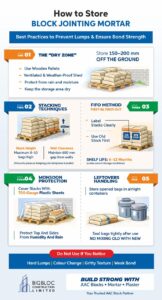
Step 1: The Ideal Storage Environment (The “Dry Zone”)
Correct storage begins with controlling moisture exposure.
The Golden Rule: Keep It 150mm–200mm Off the Ground Using Wooden Pallets
Concrete floors constantly release moisture through capillary action. Even dry-looking floors can transfer moisture into bags placed directly on them.
Raising mortar bags 150mm–200mm above ground using wooden pallets breaks this moisture path and is a universally recommended site practice for polymer-modified mortars.
Plastic sheets placed directly on the floor do not provide sufficient protection.
Ventilation vs. Drafts: Why a Well-Ventilated but Weather-Proof Shed Is Mandatory
AAC mortar must be protected from rain but not trapped in humid air. Completely sealed rooms often retain moisture, especially during monsoon.
The ideal storage area is:
- Weather-proof
- Shaded
- Well ventilated
Avoid storing mortar near curing tanks, water pipelines, toilets, or freshly washed floors, as these increase ambient moisture.
Step 2: Strategic Stacking Techniques
Storage damage is not caused by moisture alone. Excessive pressure also affects mortar quality.
Stacking Height: Why You Should Never Go Above 8–10 Bags
When bags are stacked too high, the lower bags experience continuous compression. Over time, this pressure compacts the powder into hard masses inside the bag. This phenomenon, often called pressure lumping or “warehouse pack,” occurs even in dry conditions.
Limiting stacking height to 8–10 bags preserves the free-flowing nature of the mortar and prevents internal hardening.
Wall Clearance: Maintaining a 600mm Gap From Exterior Walls
Exterior walls often transmit dampness and experience temperature variation. Storing bags directly against walls allows slow moisture transfer.
Maintaining a minimum 600mm clearance improves air circulation and reduces moisture exposure, especially during monsoon and winter.
Also Read: How to Use Block Jointing Mortar?
Step 3: Implementing the FIFO Method (First-In-First-Out)
How to Label and Organize Stacks by Delivery Date
Each pallet should be clearly marked with the delivery date and batch number. Older stock must be placed in front and consumed first, while newer deliveries are stored behind.
This simple system prevents expired or weakened mortar from being used unknowingly.
Understanding the Typical 6–12 Month Shelf Life of AAC Adhesive
Most AAC block jointing mortars have a shelf life of 6–12 months, assuming unopened bags and correct storage conditions. Poor storage can significantly shorten this period.
Using mortar beyond its shelf life results in inconsistent bonding, poor workability, and unpredictable setting behaviour.
Step 4: Protecting Mortar During Monsoon & High Humidity
Using 700-Gauge Polythene Covers
High humidity can damage mortar even without direct rain. During monsoon, stacks should be covered with heavy-duty (700-gauge or higher) polythene sheets.
Covers must protect the top and sides but should not seal the stack airtight. Limited airflow prevents condensation buildup inside the cover.
The “Double-Wrap” Technique for Opened Bags
Once a bag is opened, moisture absorption increases sharply. Opened bags should be tightly folded, wrapped again in plastic, and stored inside airtight containers or drums. Such material should be used as early as possible.
Step 5: Handling Leftovers and Partial Bags
Re-Sealing Techniques Using Airtight Containers
Leftover mortar must be immediately transferred to airtight containers to limit exposure to humid air.
Why You Should Never Mix Old Leftover Powder With a Fresh Batch
Old or partially damaged mortar weakens fresh mixes. Even a small quantity can reduce overall bond strength and cause joint failure. If the condition of leftover mortar is doubtful, discarding it is the safer option.
Professional Red Flags: When to Discard Mortar
The “Thumb Test” for Lumps
If lumps do not break easily under finger pressure, the mortar has undergone chemical degradation and should not be used.
Color Changes and Grit Texture
Dull colour, gritty texture, poor spreadability, or weak initial grab are clear signs that the mortar has lost its designed properties.
Also Read: How to Calculate Block Jointing Mortar Consumption for AAC Blocks?
Conclusion: Quality Storage Equals Quality Walls
AAC block masonry performance depends on joint strength, and joint strength depends on mortar condition. Even the best AAC blocks cannot compensate for poorly stored mortar.
Final Tip:
Your wall is only as strong as the mortar holding it together. Do not let poor storage weaken your structure.
Why Builders Trust Bigbloc Construction
This focus on correct material behaviour is why leading projects choose Bigbloc Construction.
Bigbloc does not only supply AAC blocks. It delivers a complete masonry system, including high-performance block jointing mortar and technical guidance on storage, handling, and application.
By working with Bigbloc, you get:
- Consistent AAC block quality
- Reliable block jointing mortar engineered for thin-bed masonry
- Practical site guidance that reduces cracks and rework
- Long-term wall performance, not short-term fixes
If you want AAC block construction that performs as designed, Bigbloc Construction is the right partner.
Also Read: Key Features of High-Performance Block Jointing Mortar