
How to Waterproof AAC Block Walls: Guide to Prevent Dampness & Water Seepage
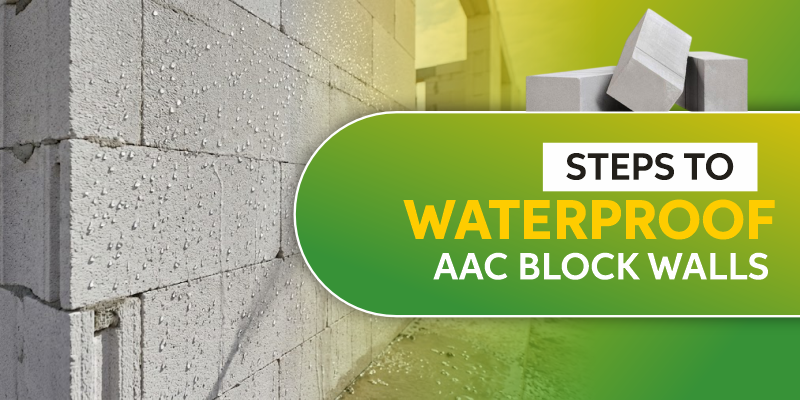
AAC block walls are water-resistant, not waterproof, on their own. Their porous structure absorbs moisture up to roughly 10% of dry weight, so exterior walls, bathrooms, terraces, and parapets need a proper plaster system, waterproof coating, and sealed joints to stay dry during monsoon exposure.
Introduction
Dampness in AAC block walls rarely appears as an obvious problem when construction is completed. It may show up months after handover as a damp patch near a windowsill, a stain creeping down from a parapet or a musty bathroom corner that never quite dries out.
On many sites, the block itself is not the problem. The waterproofing system around it is. Poor jointing, inadequate plaster, untreated cracks, exposed parapets and badly sealed window or door junctions can all create paths for water to enter the wall.
This is why AAC wall waterproofing needs to be considered as a complete system rather than as a coating applied at the end. The blocks, jointing mortar, plaster, exterior coating, roof, parapet and openings all have a role to play.
Before looking at waterproofing methods, it is useful to understand the material itself. Our guide to What Are AAC Blocks explains its composition, properties and common construction applications.
This guide covers what waterproof actually means for AAC block walls, where waterproofing matters most, how to protect the wall during construction, the mistakes that commonly lead to seepage, and how to maintain the wall after construction.
Are AAC Block Walls Waterproof?
AAC block walls are water-resistant rather than fully waterproof. The cellular structure that gives AAC its lightweight and insulating properties also contains pores that can absorb water when the block is exposed to it.
Waterproof means a material prevents water from passing through under sustained exposure. Water-resistant means it slows water absorption without completely stopping it, while moisture-resistant generally refers to resistance to humidity and moisture-related effects rather than direct water exposure.
This distinction matters because AAC blocks are sometimes described as waterproof when discussing their performance. The block itself does not provide a complete waterproofing system. The finished wall depends on the jointing mortar, plaster, exterior coating and sealing around openings and junctions.
If you are comparing common claims about AAC performance, see AAC Blocks Myths before choosing a walling system.
AAC and traditional brick masonry also behave differently in terms of weight, thermal performance and moisture absorption. A closer AAC Block vs Red Brick comparison helps put the differences into context.
Why AAC Block Walls Need Proper Waterproofing?
AAC block walls face moisture from several directions, but rain is one of the biggest concerns for exterior walls, particularly during India’s monsoon months. Prolonged rainfall, high humidity and direct exposure can leave an unprotected wall in contact with moisture for extended periods.
The risk is not limited to exterior walls. Bathroom walls face regular water and humidity, while terraces and roof slabs can develop problems when rainwater does not drain properly. Parapet walls are also highly exposed because rain can reach their outer faces and top surfaces.
AAC itself can perform well when the wall is constructed correctly. The difference often comes from the construction system around the block, including jointing, plaster, curing and external protection. For a broader look at AAC’s thermal, lightweight and other construction advantages, read Benefits of AAC Blocks.
That is the important difference: AAC performance and construction quality are not the same thing. A properly jointed, plastered and protected AAC wall can perform very differently from one where these details are overlooked.
Step-by-Step Guide to Waterproof AAC Block Walls
Waterproofing an AAC block wall works best as a complete system, rather than as a single coating applied after construction. The jointing material, plaster, crack treatment, exterior coating and detailing around the roof and openings all have to work together.
Use High-Quality Block Jointing Mortar
AAC blocks should be laid with a suitable thin-bed block jointing mortar, generally applied at around 2–3 mm. Using thick cement-sand mortar in the same way it is used for traditional brickwork can increase water absorption at the joints and create differential shrinkage between the mortar and AAC block. Over time, these differences can contribute to hairline cracks that become pathways for seepage.
Thin-bed jointing mortar is specifically suited to AAC masonry because it works with the dimensional accuracy of the blocks and keeps the joint thin. Understanding what block jointing mortar also helps explain why the same thick mortar used for conventional brickwork should not simply be carried over to AAC construction.
The difference becomes particularly important when considering Block Jointing Mortar vs Cement Mortar, because joint thickness affects material consumption, shrinkage and the behaviour of the wall junction.
Apply Proper Cement Plaster
AAC walls need a plaster system that is compatible with the block rather than a generic plaster mix simply carried over from brickwork. The plaster needs to bond properly with the AAC surface and accommodate its characteristics, including its relatively low absorption and higher shrinkage compared with conventional brick.
The source draft recommends approximately 8–10 mm for internal plaster and 12–15 mm for external plaster when using a suitable ready-mix system formulated for AAC substrates. The exact specification should follow the plaster manufacturer’s technical guidance and the project requirements.
The plaster system needs to suit the AAC substrate rather than simply follow the same specification used for brickwork. That is why understanding What is Ready Mix Plaster becomes relevant when deciding how the wall should be finished.
The specification can also change depending on where the plaster is being applied, since external walls face rain and humidity while internal walls have different exposure conditions. The distinction is explained in Ready Mix Plaster for Interior vs Exterior Walls.
Use Waterproof Additives
Waterproofing compounds can be incorporated into cement-based plaster or mortar where the system requires additional resistance to water penetration.
The source draft refers to IS 2645 for integral waterproofing compounds and recommends using the manufacturer’s specified dosage rather than adding an arbitrary quantity to the mix. The compound works by reducing permeability through the cement-based layer as it cures.
The additive is therefore one part of the waterproofing system. It should not be treated as a substitute for proper plastering, crack treatment or exterior protection.
Seal Cracks and Joints
Cracks and junctions deserve particular attention because water can enter through these points more easily than through an intact wall surface.
Pay special attention to corners, wall joints and the junction between AAC masonry and RCC columns or beams. These materials can move differently with temperature and settlement. A suitable flexible sealant or sealant tape can accommodate minor movement better than a rigid treatment that cracks again.
Cracks at corners, joints and AAC-to-RCC junctions can become entry points for water. Good joint detailing and movement control therefore matter not only for appearance but also for moisture protection, which is closely connected to How to Avoid Crack in AAC Block.
Apply Exterior Waterproof Coating
The exterior coating provides another layer of protection against rainwater reaching the wall.
A breathable elastomeric or cementitious coating can help shed rainwater while allowing moisture vapour within the wall to escape. This matters because a completely impermeable coating can trap moisture that has already entered the wall, potentially leading to peeling or efflorescence.
The coating should therefore be selected for the wall’s exposure, substrate and existing plaster system rather than simply choosing the thickest or most impermeable product available.
Ensure Proper Roof and Parapet Waterproofing
A damp patch on an AAC wall does not always mean that water entered through the wall face. The source can be above the wall.
Poorly waterproofed terraces, roof slabs and parapets can allow rainwater to enter and travel downward before appearing as a damp patch somewhere else on the wall. This is why treating only the visible stain can fail to solve the underlying problem.
Terrace waterproofing, proper drainage slopes and suitable treatment of the parapet top should be completed before assuming that the wall below is the source of the leakage. The parapet coping and junctions also need proper detailing to prevent water from entering from above.
Protect Window and Door Junctions
Window and door openings create another common path for water because the junction between the frame and AAC wall is more vulnerable than an uninterrupted wall surface.
The frame perimeter should be properly sealed, and the window sill should have suitable detailing to prevent water from tracking back into the masonry. The source draft specifically recommends a backer rod and sealant at the frame perimeter, along with a proper sill drip line below windows.
A damp patch around a window does not necessarily mean the AAC wall itself is absorbing water excessively. Poor frame sealing, sill detailing and nearby cracks can all create an entry point, which is why identifying the Causes of Dampness and Water Leakage in Buildings is important before treating the affected surface.
Common Waterproofing Mistakes to Avoid
Most AAC wall seepage problems do not start with the block itself. They often develop because one part of the waterproofing system has been skipped or poorly executed. The same wall can perform very differently depending on the quality of jointing, plastering, curing and detailing.
Skipping the DPC
A damp-proof course at plinth level helps prevent moisture from the ground from rising into the wall through capillary action. Waterproofing the wall surface cannot compensate for a missing or poorly executed DPC where rising damp is the actual source of moisture.
Using Ordinary Thick Mortar
Using conventional thick cement-sand mortar instead of suitable thin-bed jointing mortar can increase water absorption at the joints and contribute to shrinkage cracking. These cracks can later become pathways for water.
For the correct jointing method, see What is Block Jointing Mortar.
Poor Curing
Rushing the curing of plaster or waterproofing coats can affect adhesion and increase the risk of early cracking. Waterproofing materials need to be applied and cured according to their product specifications rather than being rushed to meet the next construction activity.
Using Low-Quality or Unsuitable Plaster
A plaster system needs to be compatible with the AAC substrate. A poorly matched or low-quality plaster can have inadequate bond strength and may crack or detach, creating opportunities for moisture to reach the wall.
Ignoring Movement Joints
AAC masonry can meet RCC columns, beams and other structural elements with different movement characteristics. Ignoring the need for appropriate movement or joint detailing at these interfaces can result in cracking.
Waterproofing Only From the Inside
Painting an interior wall with a waterproofing product may hide a damp patch temporarily, but it does not necessarily stop the source of water. If rain is entering through the exterior wall, parapet, roof or window junction, the source needs to be identified and treated.
The source draft specifically cautions against treating dampness only from the interior while the exterior continues to absorb water.
If you are trying to identify where the water is actually coming from, see Causes of Dampness and Water Leakage in Buildings.
Expert Tip: If an AAC wall develops a damp patch, do not assume the visible patch is the entry point. Check the exterior wall, roof, parapet, window junction and nearby plumbing before applying another coat of waterproofing on the inside.
Best Waterproofing Materials for AAC Block Walls?
No single waterproofing material is suitable for every part of an AAC wall. The right choice depends on whether the surface is exposed to rain, needs crack flexibility, requires treatment at a joint, or needs additional protection at the plaster stage.
|
Material |
Best Use |
What It Does |
|
Cementitious Coating |
Exterior walls |
Provides a rigid water-resistant layer and bonds to a sound plaster substrate |
|
Elastomeric Paint |
Rain-exposed facades |
Provides a flexible coating that can accommodate minor hairline cracks |
|
Waterproof Plaster with Integral Compound |
External wall base coat |
Reduces water absorption through the plaster layer |
|
Crack and Joint Sealant |
Joints, corners and frame junctions |
Accommodates minor movement while maintaining the seal |
A cementitious coating can work well on a sound, properly prepared substrate, but rigid coatings can crack if the underlying surface moves. An elastomeric coating offers greater flexibility and is useful on rain-exposed facades where minor surface movement needs to be accommodated.
Waterproof plaster can provide additional resistance to water absorption when an appropriate integral waterproofing compound is used at the manufacturer’s recommended dosage. Crack and joint sealants serve a different purpose and are better suited to movement-prone areas such as wall-to-RCC junctions and window or door frames.
The important point is that none of these materials makes an AAC wall permanently waterproof by itself. Their performance depends on correct surface preparation, application, curing and how the different layers work together.
How to Maintain Waterproof AAC Walls for Long-Term Performance?
Waterproofing should not end when the wall is plastered and painted. Exterior coatings and sealants gradually wear with exposure to rain, sunlight, humidity and temperature changes, so the wall should be inspected regularly rather than waiting for dampness to appear.
A practical maintenance routine for AAC walls includes:
- Inspect exterior walls and parapets after every monsoon for hairline cracks, peeling or worn coatings.
- Check window and door junctions for gaps, cracked sealant or areas where water can enter.
- Re-seal joints and frame junctions if the sealant has shrunk, lifted or deteriorated.
- Recoat exterior finishes according to the manufacturer’s recommended maintenance cycle rather than waiting for visible leakage.
- Keep terrace drainage clear so rainwater does not remain standing near parapet walls.
- Trace interior damp patches back to their source before repainting the affected area.
For homeowners, the most useful habit is to inspect the wall after the monsoon, when small cracks, failed sealants and coating damage are easier to identify before they develop into larger seepage problems.
Regular inspection also makes financial sense. Identifying a failed sealant or small crack early is very different from repairing a wall after prolonged seepage, when plaster, paint and other finishes may already be affected. Waterproofing should therefore be considered as part of the broader Cost of Building a House in India, rather than as an isolated finishing expense.
Conclusion
AAC block walls can perform well in Indian conditions, but waterproofing cannot be treated as a property of the block alone. Rain, humidity and prolonged exterior exposure can introduce moisture, while bathrooms, terraces, parapets, windows and door junctions create additional points that need careful detailing.
The most reliable approach is to treat waterproofing as a complete wall system. Proper thin-bed jointing, compatible plaster, adequate curing, sealed cracks and junctions, suitable exterior coatings, and correct roof and parapet waterproofing all contribute to the final performance of the wall.
Most importantly, dampness should not automatically be blamed on AAC blocks. Poor workmanship, unsuitable mortar, inadequate plaster, cracks or water entering through the roof and openings can all create seepage. Regular inspection after the monsoon helps identify these problems before they become larger repairs.
If you are planning AAC construction, explore BigBloc Construction‘s AAC walling solutions and choose the right materials and application system for your project.