
How to Mix Block Jointing Mortar Correctly: Step-by-Step Guide for Site Masons
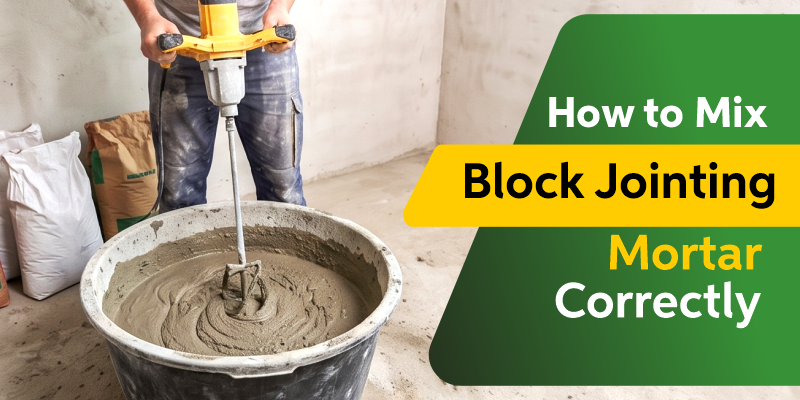
Mixing block jointing mortar correctly is one of the simplest steps in AAC block construction, but it directly affects how easily the blocks lay and how consistent the joints are.
Never add water by assumption, and never add more water once the mortar starts to stiffen.
Block jointing mortar is a factory-made dry mix of cement, fine sand and polymer additives. It is used to lay AAC (autoclaved aerated concrete) blocks with thin joints, usually 2 to 4 mm, instead of the 10 mm joints used with site-made cement-sand mortar. If you are new to the product, start with what block jointing mortar is, and for a side-by-side comparison, see block jointing mortar vs cement mortar. Because the joint is so thin, small mixing errors matter more.
Here is how much less mortar a thin joint holds. Take a 200 mm thick wall built with 600 × 200 mm blocks:
- 10 mm joints: each square metre of wall holds about 12.6 litres of mortar.
- 3 mm joints: the same square metre holds about 3.9 litres, roughly a third as much.
These figures come from our calculations based on block and joint sizes, ignoring wastage.
With so little material in each joint, there is little room for error. A litre of extra water that would go unnoticed in a conventional mix can push a thin-bed mortar outside its tested range.
This guide covers each mixing step and why it matters. It also covers how much water different brands actually ask for, how to judge the mix before it goes on the wall, how long mixed mortar stays usable, and the mistakes that most often cause weak joints.
What You Need Before Mixing Block Jointing Mortar
Get everything ready before you open the bag. Once the powder meets water, the working time starts. If you haven’t picked a product yet, read how to choose the right mortar for AAC block and the key features to check in an AAC block jointing mortar first.
Block jointing mortar. The bag should be sealed, dry and free of hard lumps. Hard lumps mean the powder has taken in moisture. See how to store block jointing mortar to avoid this.
- A clean mixing bucket or tray. Old, set mortar stuck to the sides can break off into the new mix.
- Clean water. Drinking-quality water is the safe choice. Water with oil, salts or organic matter can affect how cement-based products set.
- A measuring container with clear markings. A 1-litre jug or a bucket marked at known volumes.
- A mixer. A drill with a mixing paddle, a forced-action mixer or, where the maker allows it, a hand tool. More on this under Step 4.
- A weighing scale. You only need this if you plan to mix part of a bag.
- A notched trowel of the size the product recommends.
- Gloves, a dust mask and eye protection. The company warns that contact with wet cement can cause both dermatitis and burns. The dry powder is dusty.
- A clean, shaded work area close to where the wall is being built.
Site tip: Measure the water. Don’t guess it. Mark your bucket at the exact water level for one bag, once, and use that same bucket every time. That single habit prevents most mixing problems.
How to Mix Block Jointing Mortar Step by Step
Step 1: Read the product instructions before anything else
Every brand sets its own water quantity, mixing time, rest time, pot life and joint thickness. The figures on one bag do not carry over to another, even if both bags say “block jointing mortar.” Before mixing, check the bag or TDS for:
- Water quantity (per bag, per kg or as a percentage)
- Mixing method: by machine only, or by hand allowed
- Mixing time and rest time
- Pot life (how long the mixed mortar stays usable)
- Recommended joint thickness and trowel
- Whether the blocks should be dampened first
If a site is switching brands, brief the masons. A team used to one product will carry its habits into the next.
Step 2: Measure the water exactly
Pour the stated quantity of clean water into the bucket first. Use a measuring jug or a pre-marked bucket, not a mug or a rough “half bucket.”
Here is why precision matters. Brand A specifies a water-to-powder ratio of 0.22 to 0.24 by weight, which is 6.6 to 7.2 litres for a 30 kg bag. The whole allowed band is 0.6 litres. One extra litre in that bag takes the ratio to about 0.27, which is well outside what the maker tested.
Do not add extra water because the mix looks thick in the first minute. Most of these mortars loosen as the polymers dissolve during mixing and resting.
Step 3: Add the powder to the water gradually
Most makers ask you to add powder into water. Brand B’s data sheet says it directly: “add material into water and not vice versa”.
There are practical reasons for this:
- Powder added slowly into water wets evenly and forms fewer lumps.
- Water poured onto a heap of powder leaves dry pockets at the bottom and corners of the bucket.
- It is easier to hit the exact water quantity when the water goes in first.
Add the powder in stages while mixing at low speed. Don’t tip the whole bag in at once.
Step 4: Mix until smooth and lump-free
Mix until the paste is even in colour, smooth, and free of dry lumps. Scrape the sides and bottom of the bucket at least once.
Mixing method and time vary by brand:
- Brand A: a forced-action mixer, or a drill and paddle below 500 rpm, for at least 3 minutes.
- Brand B: stir continuously for 3 to 5 minutes, with a mechanical stirrer or by hand.
- Bigbloc NXTFix: mix for 5 to 10 minutes, by hand or with an electric mixer.
Keep the drill speed low. A high-speed drill traps air in the paste, which weakens the joint and makes the mortar harder to spread.
Can block jointing mortar be mixed by hand? Only if your product’s data sheet allows it. Several do. Hand mixing takes longer and leaves lumps more easily, so it suits small batches. For full bags, a drill and paddle give a more even mix.
Step 5: Let the mortar rest
Leave the mixed mortar to stand for the time the maker states. During this rest, the additives in the powder dissolve fully and trapped air bubbles rise out. Skip the rest, and you get a paste that feels right at first but changes on the trowel.
Rest times differ:
- Brand A: at least 5 minutes, until bubbles disperse
- Brand B: 2 to 5 minutes
- Brand C: about 10 minutes
- Bigbloc NXTFix: 5 minutes
Step 6: Remix briefly, then use
Remix after the rest. Brand A asks for 15 seconds, Brand B and Brand C about 2 minutes, and NXTFix 2 to 3 minutes. Then check the consistency (see the table further down).
If the mix now looks slightly stiffer than before the rest, that is normal. Remix it. Don’t add water. If it is clearly too stiff to spread, the water was probably under-measured at Step 2. Fix the measurement for the next batch rather than guessing a top-up for this one.
Block Jointing Mortar Water Ratio: Why It Changes From Brand to Brand
Many online guides give one ratio, such as “1 part water to 3 parts powder,” as if it applied to every product. It doesn’t. Manufacturers use different binders, fillers and polymers, and each one sets its water demand through its own testing.
Here is what five products sold in India specify: Bigbloc NXTFix and four other widely sold brands, shown as Brands A to D.
|
Product |
Water specified |
Water for 40 kg of powder |
Mixing |
Rest, then remix |
Pot life |
Joint / bed thickness |
|
Brand A |
22–24% by weight |
8.8–9.6 L (6.6–7.2 L per 30 kg bag) |
Machine or drill, 3 min minimum |
5 min minimum, then 15 sec |
90 min |
Consumption quoted at 3 mm average |
|
Brand B |
300–350 ml per kg (30–35%) |
12–14 L |
Machine or hand, 3–5 min |
2–5 min, then about 2 min |
Over 30 min |
3–4 mm |
|
Brand C |
200–300 ml per kg (20–30%) |
8–12 L |
Machine or hand, 3–5 min |
About 10 min, then about 2 min |
Over 30 min |
2–3 mm |
|
Brand D |
35% |
14 L (10.5 L per 30 kg bag) |
Not stated on product page |
Not stated on product page |
About 1.5–2 hours |
2–3 mm |
|
Bigbloc NXTFix |
25–30% |
10–12 L |
Hand or electric mixer, 5–10 min |
5 min, then 2–3 min |
Depends on weather |
2–3 mm |
The table shows two things:
- Water demand ranges from about 20% to 35% across brands. A mason who switches from Brand A (22–24%) to Brand D (35%) and keeps the old habit will make a mix far too stiff. A mason who goes the other way will make it far too wet.
- Some ranges are narrow. Brand A’s full allowance is two percentage points. In a 40 kg batch, 2 percentage points is just 0.8 litres, less than one ordinary mug.
How to work out water for any bag: multiply the bag weight in kg by the water percentage. For a 40 kg bag at 25%, that is 40 × 0.25 = 10 litres. If the TDS gives millilitres per kg, multiply by the bag weight and divide by 1,000.
Mixing NXTFix? Bigbloc’s instructions for NXTFix are:
- Water: 25–30% of the powder’s weight, which is 10–12 litres for every 40 kg of powder.
- Mixing: 5–10 minutes by hand or with an electric mixer.
- Rest and remix: let the mix stand for 5 minutes, then remix for 2–3 minutes.
- oints: 2–3 mm thick.
- Curing: not essential, because the polymers in the mix hold water.
- After laying: leave the wall undisturbed for at least 24 hours.
Mark these on your mixing bucket and in the checklist below.
Start at the lower end of the maker’s range. Use the upper end only if the mix is still too stiff after resting and remixing, and then make that the fixed quantity for every batch on that site.
What Properly Mixed Block Jointing Mortar Should Look Like
Check the mortar after the remix and before it goes on a block.
|
Check |
Correct mix |
Too wet |
Too dry |
|
Look |
Smooth, even colour, no lumps |
Shiny surface, water collecting on top |
Crumbly, dull, visible dry specks |
|
On the trowel |
Holds its shape, spreads easily |
Slides or drips off |
Tears or drags, doesn’t spread evenly |
|
Notched ribs on the block |
Ribs stand up and keep their shape |
Ribs slump and flatten |
Ribs break up, leaving gaps |
|
When the next block is pressed on |
Spreads evenly, a little squeezes out |
Too much squeezes out, block may slide |
Poor contact, gaps in the joint |
|
Likely result |
Full, even bond |
Sagging joints, excess material, lower strength than the maker tested |
Incomplete coverage, weak spots, hollow-sounding joints |
Why “add water until it feels right” is wrong: The right feel is a result of the right water quantity. It is not a way to find it. Feel changes with temperature, with how long the mix has stood and with the mason’s own habit. A measured quantity doesn’t change. If the correct water gives a mix that looks wrong, check the powder (old stock, lumps, damp storage) and the rest time before changing the water. For more checks you can run at the mixing point, see how to test jointing mortar quality on site.
Pot Life: How Long Mixed Block Jointing Mortar Stays Usable
Pot life is the time after mixing during which the mortar can still be used as intended. After that, the cement has begun to set. The mortar may still look workable, but it will not bond properly.
Pot life varies widely. Brand A gives 90 minutes, Brand D about 1.5 to 2 hours, and Brand B and Brand C “more than 30 minutes.” Bigbloc notes that setting time for NXTFix depends on climatic conditions. Heat, direct sun and wind shorten working time. Brand A’s data sheet limits application to air and surface temperatures between 5°C and 45°C.
What this means on site:
- Don’t re-temper. Adding water to mortar that has started to stiffen (called re-tempering) breaks the early set and dilutes the mix. The joint may look fine but will be weaker. Remixing without water within the pot life is acceptable. Adding water is not.
- Mix only what you can lay within the pot life. If your team’s laying pace is unknown or slow, weigh out half a bag and use half the water.
- Keep mixed mortar in the shade in summer, and keep the bucket covered between loads.
- Throw away mortar that has passed its pot life. It costs less than repairing a cracked wall.
How to Apply Mixed Mortar to AAC Blocks
Mixing and laying go together, so here are the key points in short. For the full laying method, see our guides on how to use block jointing mortar and how to build walls using AAC blocks.
- Prepare the block surface. Remove dust, loose particles and grease. Most data sheets ask you to dampen the block, with excess water drained off, so it doesn’t pull water out of the thin mortar bed. Some data sheets call this saturated surface dry: damp through, but with no standing water.
- Spread the mortar with the recommended notched trowel on the bed and the vertical faces, as the product specifies.
- Keep to the stated thickness. It is usually 2–3 mm or 3–4 mm, depending on the product. For example, Bigbloc NXTFix and Brand C specify 2–3 mm, Brand B specifies 3–4 mm, and another major brand quotes coverage for its AAC block adhesive at a 3 mm bed. Don’t treat 3 mm as a universal figure.
- Place the next block and press it gently into position. Tap with a rubber mallet if needed.
- Check line and level with a spirit level while the mortar is still workable.
- Scrape off squeezed-out mortar before it hardens.
Bigbloc advises that a wall built with NXTFix should not be disturbed for at least 24 hours after laying.
Curing is another point of difference. Bigbloc says curing is not essential for NXTFix because its polymers hold water in the mortar, and Brand B says no curing is needed. Brand D, on the other hand, requires curing joints by sprinkling water for at least 7 days. A site using more than one brand should follow each product’s instructions rather than one habit for all.
To work out how many bags a wall will need, see how to calculate block jointing mortar consumption for AAC blocks.
A note on standards: IS 6041:1985, the BIS code of practice for autoclaved cellular concrete block masonry, was written for cement-lime-sand mortar with joints about 10 mm thick. It does not cover thin-bed polymer mortars. For mixing and applying block jointing mortar, follow the manufacturer’s TDS. Some TDSs also list the test standards used, such as IS 4031 for cement testing (Brand B) or EN 1015-11 and EN 1348 for strength and adhesion (Brand A).
7 Block Jointing Mortar Mixing Mistakes That Weaken Joints
- Adding water by eye. This is the most common cause of joints that are too wet or too dry. Measure every batch.
- Using dirty water or an unwashed bucket. Residue and contaminants affect how the new mix sets. Wash the bucket between batches.
- Tipping the whole bag in at once. This creates lumps and dry pockets that short mixing won’t fix. Add powder gradually.
- Cutting the mixing time short. The additives need time to disperse. A mix that looks done at 60 seconds usually isn’t.
- Skipping the rest period. The mortar then changes consistency on the trowel, and masons respond by adding water, which leads to mistake 6.
- Adding water after the mix stiffens. This is re-tempering. It weakens the bond even when the joint looks normal.
- Mixing more than the team can use. Mortar left past its pot life gets either wasted or re-tempered. Batch to your laying pace.
Two related issues often show up alongside these. One is using a very fast drill, which traps air. The other is using powder from bags stored on damp floors. Store bags on pallets, off the ground and away from moisture. For problems that appear after laying, see how to avoid cracks in AAC block.
Quick Site Checklist for Mixing Block Jointing Mortar
Print this and keep it at the mixing point.
Before mixing
☐ Read the bag or TDS for this product: water, mixing time, rest time, pot life
☐ Water measured with a marked jug or bucket
☐ Bucket and paddle clean
☐ Water clean
☐ Powder dry and free of hard lumps
☐ Gloves, mask and eye protection on
During mixing
☐ Water in first, powder added gradually
☐ Drill at low speed, sides and bottom scraped
☐ Mixed for the full stated time, no lumps left
☐ Rested for the stated time
☐ Remixed, with no water added
Before application
☐ Mix time noted, so the team knows when pot life ends
☐ Blocks clean and dampened as the TDS specifies
☐ Correct notched trowel ready
☐ Joint thickness agreed with the masons
What Good Mixing Comes Down To
Good block jointing mortar depends on three controls: the right water quantity for that specific product, enough mixing and rest time for the additives to work, and using the batch within its pot life. Almost every mixing problem on site traces back to one of these.
The mortar is only half of the joint. Thin-bed mortar works best with blocks that have accurate dimensions, so it makes sense to plan the two together. For example, you could pair NXTFix with Bigbloc’s NXTBLOC AAC blocks. If your site is planning a block and mortar order, or your masons are moving to thin-bed jointing for the first time, you can contact the Bigbloc Construction team with your questions.
Supervisors should check two things. First, is water being measured the same way for every batch? Second, has the team been briefed on the data sheet of the brand they are using now, not the one they used on the last job?
Recent Post:
Frequently Asked Questions
Use the exact quantity on your product’s bag or data sheet. It varies by brand, from about 20% to 35% of the powder’s weight. For example, Brand A specifies 6.6 to 7.2 litres for a 30 kg bag, Brand D specifies 35% (10.5 litres for a 30 kg bag), and Bigbloc NXTFix specifies 25–30%, which is 10 to 12 litres for 40 kg.
There is no single correct ratio across brands. The right ratio is the one your manufacturer tested. A ratio from another brand, or a generic “3:1,” can leave your mix too wet or too dry.
Add the powder to the water, gradually, while mixing. This is the sequence most makers specify, because it reduces lumps and dry pockets.
Usually 3 to 10 minutes, depending on the product, followed by a rest of 2 to 10 minutes and a short remix. Check your bag for the exact times.
It depends on the product. Some brands, including Bigbloc NXTFix and Brand B, say curing is not needed. Others, such as Brand D, ask for water curing for at least 7 days. Check the data sheet of the product you are using.
No. Once mortar starts to stiffen, adding water (re-tempering) weakens the bond. You can remix without water within the pot life. If it is past the pot life, discard it.
It depends on the product and the weather. Stated pot life ranges from just over 30 minutes to about 2 hours among common brands, and hot or windy conditions shorten it. Mix only what your team can lay in that time.