
What Is Compressive Strength in AAC Blocks? Grades, Testing & Why It Matters
Key Takeaways
- Compressive strength is the load a block carries per unit area before it fails. It is expressed in N/mm², which is numerically the same as MPa.
- Under IS 2185 (Part 3), the minimum strength depends on both density band and grade. The specified range is 1.5 to 7.0 N/mm² across Grade 1 and Grade 2.
- Grade 1 does not mean one fixed strength. For example, the minimum is 4.0 N/mm² in the 551–650 kg/m³ band and 6.0 N/mm² in the 751–850 kg/m³ band.
- Compressive strength testing is carried out in accordance with IS 6441 (Part 5):1972. The method is based on test specimens prepared from AAC units and tested under controlled conditions.
- Block strength is not the same as wall or building capacity. Structural design also considers the wall system, mortar or adhesive, dimensions, workmanship, loading and the building’s structural system.
“Are AAC blocks strong enough for my building?” is usually the first question homeowners and builders ask about AAC blocks. AAC stands for autoclaved aerated concrete. The blocks are much lighter than clay bricks, and many people assume light means weak.
Compressive strength gives that question a measurable answer. It tells you how much crushing load a block can take before it fails. For AAC blocks sold in India, BIS standard IS 2185 (Part 3):1984 sets the minimum values. That standard does not give one fixed number. The required strength depends on the block’s density and its grade.
This guide explains what the number means, how it is tested, what the IS grades require, and what to check on a supplier’s documents. It also explains what compressive strength cannot tell you about a wall. If you are new to the material, start with what are AAC blocks?
What Is Compressive Strength in AAC Blocks?
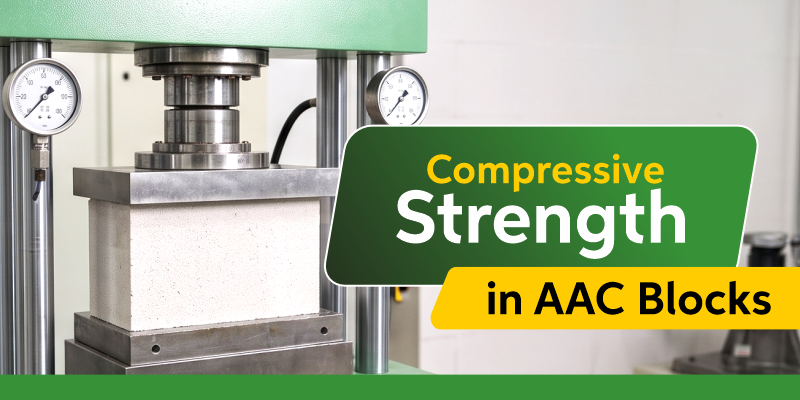
Compressive strength of an AAC block is the maximum load a test specimen can carry before it fails, divided by the area over which the load is applied. It is expressed in newtons per square millimetre (N/mm²). A higher value means the material can withstand greater compressive pressure before failure.
- N/mm² and MPa are the same unit. A block with a compressive strength of 4 N/mm² has a strength of 4 MPa.
- Older test reports may use kgf/cm². As a quick conversion, 1 N/mm² is about 10.2 kgf/cm².
- Failure occurs when the specimen can no longer carry the increasing load and begins to crush. Use the highest load reached in the test to calculate the compressive strength.
This value helps compare products and check whether a block meets the applicable minimum requirement for its density band and grade. It should not be read as a direct statement of how much load a finished wall can carry.
How Is AAC Block Compressive Strength Tested?
IS 2185 (Part 3) refers to IS 6441 (Part 5):1972 for the determination of compressive strength. The test controls how samples are selected, prepared, conditioned, and loaded so results can be compared consistently.
- Select representative samples: IS 2185 (Part 3) provides for a sample of 24 blocks from a lot of up to 10,000 blocks. Use 12 for compressive-strength testing, and allocate the remaining samples to other tests and possible retesting.
- Prepare the test specimens: The compressive-strength method uses cube specimens prepared from the AAC units. The test method specifies 150 mm cube specimens.
- Condition the specimens: The specimens are conditioned to the moisture range required by the test method. Moisture matters because AAC strength can vary with moisture content.
- Place the specimen in the testing machine: The prepared cube is placed so that the load is applied correctly and the loaded faces are suitably prepared.
- Apply the load until failure: The load is increased steadily until the specimen fails. The highest load reached is recorded.
- Calculate compressive strength: The compressive strength is calculated by dividing the failure load by the loaded area. The report records the individual results and the average, along with relevant density and moisture information.
Moisture condition matters when comparing reports. Two samples from similar products can produce different results if they are tested under different moisture conditions. A useful supplier report should therefore show the test method and the conditions used.
IS 2185 (Part 3) also uses a conformity calculation that considers the spread of the strength results, not only the average. This helps prevent a batch with a high average but excessive variation from being treated as automatically compliant.
AAC Block Grades and Compressive Strength as per IS 2185
IS 2185 (Part 3):1984 classifies autoclaved cellular aerated concrete blocks into Grade 1 and Grade 2 according to compressive strength. The minimum strength is then specified separately for each oven-dry density band.
|
Oven-dry density (kg/m³) |
Grade 1 minimum compressive strength (N/mm²) |
Grade 2 minimum compressive strength (N/mm²) |
Maximum thermal conductivity in air-dry condition (W/m·K) |
|
451–550 |
2.0 |
1.5 |
0.21 |
|
551–650 |
4.0 |
3.0 |
0.24 |
|
651–750 |
5.0 |
4.0 |
0.30 |
|
751–850 |
6.0 |
5.0 |
0.37 |
|
851–1000 |
7.0 |
6.0 |
0.42 |
What the table tells you:
- A grade means nothing without a density band. Grade 1 needs only 2.0 N/mm² at 451–550 kg/m³ but 6.0 N/mm² at 751–850 kg/m³.
- Grade 1 is always the stronger grade, 0.5 to 1.0 N/mm² above Grade 2 in each band.
- Heavier blocks insulate less. Allowed thermal conductivity rises with density, which is the main trade-off in choosing a block.
Grade 1 also has a tighter drying shrinkage limit: 0.05%, against 0.10% for Grade 2. Drying shrinkage is how much a block shrinks as it loses moisture, and lower shrinkage means less risk of cracks in the finished wall. Workmanship matters just as much, as our guide on how to avoid cracks in AAC block walls explains.
Most AAC blocks sold for walls in India are declared in the 551–650 kg/m³ band, where the minimums are 4.0 N/mm² for Grade 1 and 3.0 N/mm² for Grade 2. Labels such as “M3” or “M4,” used on some websites, don’t appear in IS 2185 (Part 3). If a supplier uses them, ask for the IS grade and density band too.
Does higher density mean higher strength?
Usually, within the same process, denser AAC has more solid material and fewer pores, so it tends to be stronger, which is why the IS minimums rise band by band. But raw materials, mix design, aeration control and autoclaving also affect strength, so always check tested values.
Two blocks of the same density from different plants can test differently, which is why the standard specifies strength and density separately.
|
Oven-dry density |
Approx. dry weight per block |
Grade 1 minimum |
|
550 kg/m³ |
13.2 kg |
2.0 N/mm² |
|
650 kg/m³ |
15.6 kg |
4.0 N/mm² |
|
750 kg/m³ |
18.0 kg |
5.0 N/mm² |
|
850 kg/m³ |
20.4 kg |
6.0 N/mm² |
|
1,000 kg/m³ |
24.0 kg |
7.0 N/mm² |
Density also decides weight. For a standard 600 × 200 × 200 mm block (0.024 m³), the oven-dry weight at the top of each band works out as follows:Calculated as block volume × density. Delivered blocks weigh more because they still hold moisture.
Moving from the 551–650 band to the 751–850 band adds about 30% to each block’s weight and raises the Grade 1 minimum by 2 N/mm². Whether that is worth it depends on what the wall must do. Other lightweight blocks make the same trade differently, and the comparison of AAC blocks vs CLC blocks shows how.
Why Does Compressive Strength Matter in Construction?
Block strength confirms that a block meets its IS minimum and lets you compare suppliers. It doesn’t tell you how much load a finished wall can carry, which depends on mortar, joints, wall size, workmanship and the structural design.
What the number helps with:
- Confirming the block meets IS 2185 (Part 3) for its declared density and grade
- Comparing suppliers on the same basis
- Meeting project specifications, which often state a minimum strength and density band
- Handling on site, since stronger blocks chip less during transport, cutting and fixing
Strength is only one reason builders choose AAC. Lower weight, better heat insulation and faster construction also count, and the benefits of AAC blocks cover them in detail.
What the number doesn’t tell you:
- How much load the whole wall can carry. Masonry capacity depends on block strength together with mortar type, joint quality, wall height and thickness, and how the load is applied. BIS covers unreinforced masonry design in IS 1905.
- Whether the building is safe. That depends on the structural design as a whole.
A measured example of the gap
In a 2025 study at ICFAI University Tripura, researchers made AAC blocks with an oven-dry density of about 690 kg/m³. The blocks tested at 5.01 N/mm². When built into masonry prisms, which are short test walls with mortar joints, they carried about 3.66 N/mm², roughly 73% of the block’s own strength (Paul, Dey and Dhar, 2025). Joints and the way load passes between blocks reduce what the wall can take, which is why engineers design with masonry strength, not block strength alone.
Infill walls vs load-bearing walls
In most multi-storey buildings in India, a reinforced concrete frame carries the building’s weight, and AAC blocks form infill walls that carry only their own weight. In a load-bearing design, walls carry floors and roofs directly and must be designed by a structural engineer, who checks block grade, mortar and wall dimensions together.
The practical rule: use compressive strength to check and compare blocks, and let the engineer decide what strength and density the design needs. Once the grade is fixed, laying practice matters just as much, and our guide on how to build walls using AAC blocks covers it step by step.
How do you choose AAC blocks based on compressive strength?
Get the required strength and density band from your engineer, then ask suppliers for the IS grade, density band, a recent batch test certificate, BIS licence details and dimensional tolerances. Compare tested values, not brochure figures.
AAC isn’t the only block you may be weighing up for a project, and if you are still deciding between block types, see AAC blocks vs hollow concrete blocks. Once AAC is chosen, check these points before ordering:
|
Check |
What to look for |
Why it matters |
|
Declared compressive strength |
A value in N/mm², backed by a test report |
Confirms the strength class |
|
IS grade |
Grade 1 or Grade 2 under IS 2185 (Part 3) |
Grade 1 has higher strength and lower shrinkage |
|
Oven-dry density band |
A range such as 551–650 kg/m³ |
Needed to read the grade correctly |
|
Test standard |
IS 2185 (Part 3), tested to IS 6441 |
Shows the figures follow the standard method |
|
Test certificate |
Recent, from an accredited or independent lab, naming batch, date, method, individual results, moisture and density |
Separates tested values from claims |
|
BIS licence |
ISI mark for IS 2185 (Part 3) |
Certification includes factory checks by BIS |
|
Factory quality control |
In-house lab, batch testing, autoclave records |
Less variation between deliveries |
|
Dimensional accuracy |
Within ±5 mm on length and ±3 mm on height and width |
Allows thin joints and even walls |
|
Intended use |
Infill, external, partition or load-bearing |
The engineer’s requirement sets the minimum |
Block sizes affect both strength checks and quantities, and the AAC block size chart lists the standard lengths, heights and thicknesses.
How published figures compare with the standard
Declared values only make sense against the IS table. Here is how three published sets of figures read:
|
Source |
Declared density |
Declared strength |
IS 2185 (Part 3) requirement in that band |
|
Another Indian AAC manufacturer (published specifications) |
550–650 kg/m³ |
4 N/mm² |
Grade 1: 4.0 · Grade 2: 3.0. Sits exactly at the Grade 1 minimum. |
|
Bigbloc NXTBLOC |
550–650 kg/m³ |
3–4.5 N/mm² |
Grade 1: 4.0 · Grade 2: 3.0. Spans both grades, so confirm the grade of your batch. |
|
Lab-made AAC, ICFAI University Tripura study (2025) |
About 690 kg/m³ |
5.01 N/mm² |
Grade 1: 5.0 · Grade 2: 4.0. Just clears Grade 1. |
A declared strength means little without its density band, and a value close to the band minimum leaves little margin, so the batch test report matters more than the brochure.
This is also why NXTBLOC’s specification is published as a range. The NXTBLOC lists a dry density of 550–650 kg/m³ and compressive strength of 3–4.5 N/mm², made in line with IS 2185 (Part 3). When ordering, share your engineer’s specified grade and density band so the batch can be matched to it.
Common buying mistakes
- Checking strength without density. 3.5 N/mm² can’t be judged until you know the band.
- Accepting a brochure figure instead of a test report. Brochures show typical values; reports show what a batch achieved.
- Choosing the densest block by default. Denser blocks are heavier and insulate less.
- Using an old test report for a new delivery. Ask for reports that match recent production.
- Ignoring dimensional accuracy. Uneven blocks need thicker joints and more mortar. Accurate blocks allow 2–3 mm thin-bed joints with a jointing mortar such as Bigbloc’s NXTFix.
Mortar choice follows directly from that last point, and our guide on how to choose the right mortar for AAC blocks explains the options.
What are the common myths about AAC block strength?
The main myths are that light blocks must be weak, that the densest block is always best, that a strong block means a strong wall, and that Grade 1 always means 4 N/mm². Each is contradicted by the IS standard or by test data.
|
Myth |
Fact |
|
“AAC blocks are light, so they must be weak.” |
Strength is specified separately from weight. The lowest class of common burnt clay brick under IS 1077:1992 is 3.5 N/mm², while a Grade 1 AAC block in the 551–650 kg/m³ band must reach 4.0 N/mm², at less than a third of clay brick’s density (about 2,130 kg/m³ in the Tripura study). |
|
“The densest block is always best.” |
Denser blocks are stronger but heavier and insulate less. The right choice depends on the design and wall type. |
|
“A strong block means a strong wall.” |
Wall capacity depends on block, mortar, joints, workmanship, wall size and design together. |
|
“Grade 1 AAC blocks are 4 N/mm².” |
Only in the 551–650 kg/m³ band. Grade 1 ranges from 2.0 to 7.0 N/mm² across bands. |
The comparison with clay brick is the one buyers ask about most. Weight, insulation, cost and speed of construction all differ too, and AAC block vs red brick compares them side by side.
What should you check before you specify or buy AAC blocks?
Read compressive strength together with density band, IS grade and a batch test certificate. Get the requirement from your engineer, compare suppliers on tested values, and check dimensional accuracy for thin-bed laying.
- Get the required strength and density band from your architect or structural engineer.
- Ask suppliers for the grade, density band and a recent batch test certificate.
- Check dimensional accuracy for thin-bed laying.
- Compare the full wall cost, not just the block price.
That last step often changes the decision, because block price, mortar, labour and plaster all add up differently. Our guide on how much AAC blocks cost in India breaks down the factors.
The same logic applies to strength itself: specify what the design needs, not the highest figure on offer. A stronger, denser block than the wall requires adds weight and cost without adding safety.
Bigbloc makes NXTBLOC AAC blocks in line with IS 2185 (Part 3), with installed capacity of 1.3 million cubic metres a year across Gujarat and Maharashtra, according to Construction World (April 2026). If you are finalising a block specification, talk to the Bigbloc team about the grade, density and quantities your project needs.
Recent Post:
Frequently Asked Questions
There is no single minimum value for every AAC block. Under IS 2185 (Part 3):1984, the minimum depends on density and grade. Grade 1 ranges from 2.0 N/mm² in the 451–550 kg/m³ band to 7.0 N/mm² in the 851–1000 kg/m³ band. Grade 2 ranges from 1.5 to 6.0 N/mm². In the 551–650 kg/m³ band, the minimums are 4.0 N/mm² for Grade 1 and 3.0 N/mm² for Grade 2.
The test follows IS 6441 (Part 5):1972. Representative AAC units are sampled, test specimens are prepared and conditioned to the specified moisture range, and the specimens are placed in a compression-testing machine. Load is increased until failure. Strength is calculated by dividing the failure load by the loaded area.
Higher density generally goes with higher compressive strength because a denser block contains more solid material and fewer pores. The IS 2185 table also shows higher minimum strengths as the density band rises. Density is not a substitute for a test result, however, because mix design, aeration and autoclaving also affect strength.
Check the product or batch identification, IS grade, oven-dry density, compressive-strength results, test method, moisture condition and test date. The key is to make sure the result can be connected to the material being supplied and compared with the correct density and grade requirement.
Start with the wall’s intended use and the project specification. Compare suppliers using compressive strength, IS grade, density band, dimensions and test evidence. For load-bearing or other structural masonry, the required block strength and wall design should be confirmed by the project’s structural engineer.