
AAC Blocks vs Hollow Concrete Blocks - Comparison Guide 2026
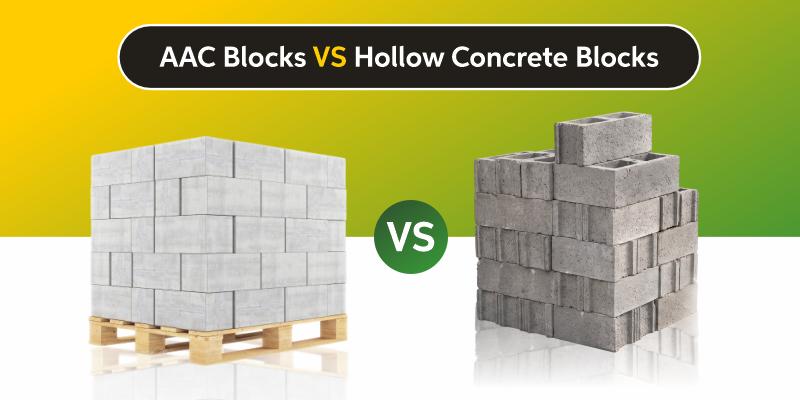
For most residential and commercial RCC-frame buildings in India, AAC blocks are a better choice than hollow concrete blocks because they are lighter, offer better thermal insulation, reduce structural load, and help speed up construction. However, hollow concrete blocks remain a practical option for boundary walls, compound walls, and certain low-rise projects where insulation is not a priority. The right choice depends on your building type, budget, climate, and overall construction cost—not just the price of a single block.
Introduction
For decades, hollow concrete blocks have been a familiar choice on Indian construction sites. They are widely available, contractors know how to work with them, and their lower price per block often makes them appear to be the more economical option.
Over the last few years, however, AAC blocks have become the preferred walling material for many residential, commercial, and industrial projects. Their lightweight structure, faster installation, and energy-saving properties have made them increasingly popular among builders, architects, and developers. If you’re new to the material, it’s helpful to understand what AAC blocks are and how they are manufactured before comparing them with conventional alternatives.
The challenge is that many builders compare these two materials only on price per block, which can lead to the wrong decision.
A wall is much more than the blocks used to build it. The total cost depends on factors such as block weight, mortar consumption, labour productivity, plaster thickness, thermal insulation, transportation, structural design, and long-term maintenance. Looking only at the purchase price often hides these additional costs.
This guide provides an honest comparison of AAC blocks vs hollow concrete blocks across ten key parameters that matter in real construction projects. Whether you are building an independent home, an apartment, a commercial building, or an industrial facility, this comparison will help you choose the material that offers the best value for your project.
What Are Hollow Concrete Blocks?
Hollow concrete blocks are precast masonry units made from Portland cement, sand, aggregates, and water. The mixture is compacted using vibration and pressure inside steel moulds to produce blocks with hollow cavities that typically occupy 25% to 50% of the block’s cross-sectional area. These hollow cores reduce the overall weight of the block while maintaining sufficient strength for many construction applications.
In India, hollow concrete blocks are manufactured according to IS 2185 (Part 1): Concrete Masonry Units – Hollow and Solid Concrete Blocks. This standard specifies requirements for dimensions, compressive strength, density, water absorption, and manufacturing tolerances.
The standard classifies hollow concrete blocks into different grades based on their density and compressive strength.
|
Grade |
Dry Density |
Minimum Compressive Strength |
|
Grade A |
1,500 kg/m³ and above |
3.5 N/mm² |
|
Grade B |
Below 1,500 kg/m³ |
2.0 N/mm² |
|
Grade C |
Above 1,000 kg/m³ |
1.5 N/mm² |
The most commonly used sizes in India include:
- 400 × 200 × 200 mm
- 400 × 200 × 150 mm
- 400 × 200 × 100 mm
Because they are durable and relatively economical, hollow concrete blocks are commonly used for:
- Boundary walls
- Compound walls
- Garden walls
- Non-load-bearing infill walls
- Low-rise residential buildings
- Utility structures
Their widespread availability and the familiarity of masons with conventional cement mortar construction have made them a common choice across India.
What Are AAC Blocks?
Autoclaved Aerated Concrete Blocks are lightweight precast building materials manufactured using fly ash or sand, cement, lime, gypsum, aluminium powder, and water. During production, aluminium powder reacts with the mixture to create millions of tiny air pockets. These air pockets reduce the density of the material without compromising its structural performance.
The expanded mixture is wire-cut into accurate dimensions and cured inside an autoclave at approximately 180°C under 10–12 bar pressure. This controlled manufacturing process produces blocks with consistent strength, dimensional accuracy, and excellent thermal performance.
AAC blocks supplied in India are manufactured according to IS 2185 (Part 3): Autoclaved Cellular (Aerated) Concrete Blocks, which specifies limits for density, compressive strength, dimensional tolerances, and water absorption.
Standard AAC blocks generally have:
- Density between 550 and 800 kg/m³
- Compressive strength ranging from 3 to 5 N/mm², with higher-density variants reaching around 7 N/mm²
Their larger size also reduces the number of joints required during construction. The most commonly used standard AAC block sizes range from 600 × 200 × 75 mm to 600 × 200 × 230 mm.
AAC blocks are widely used in:
- Residential buildings
- Commercial complexes
- High-rise developments
- Hospitals
- Schools and colleges
- Hotels
- Industrial buildings
- Internal partition walls
- External walls in RCC-frame structures
NXTBLOC AAC Blocks, manufactured by BigBloc Construction Limited, are available in density grades of 550, 600, and 650 kg/m³, allowing engineers to select the appropriate grade for different applications while complying with IS 2185 (Part 3).
AAC Blocks vs Hollow Concrete Blocks: 10 Key Differences
Choosing between AAC blocks and hollow concrete blocks becomes easier when you compare them across the factors that directly affect construction cost, speed, structural design, and long-term building performance.
The table below provides a quick comparison, followed by a detailed explanation of each parameter.
|
Parameter |
AAC Blocks |
Hollow Concrete Blocks |
|
Manufacturing Process |
Autoclaved, wire-cut cellular concrete |
Vibrated and compacted concrete |
|
IS Standard |
IS 2185 (Part 3) |
IS 2185 (Part 1) |
|
Density |
550–800 kg/m³ |
1,000–1,500+ kg/m³ |
|
Compressive Strength |
3–5 N/mm² (up to 7 N/mm² for higher-density grades) |
1.5–3.5 N/mm² depending on grade |
|
Weight per Block |
Approximately 8–18 kg |
Approximately 14–24 kg |
|
Thermal Conductivity |
Around 0.16–0.24 W/mK |
Around 0.7–1.3 W/mK |
|
Fire Resistance |
Up to 4–6 hours* |
Around 2–4 hours* |
|
Water Absorption |
Typically within IS 2185 (Part 3) limits |
Higher than AAC in most applications |
|
Mortar Requirement |
Thin-bed block jointing mortar |
Conventional cement-sand mortar |
|
Approximate Cost (2026) |
Higher per block, lower overall system cost |
Lower per block, but total wall cost depends on mortar, plaster, labour, and structural design |
Price Disclaimer: Prices are indicative for 2026 and vary by city, manufacturer, order quantity, transportation distance, and project specifications.
Difference 1: Manufacturing Process
AAC blocks are manufactured using a highly controlled autoclaving process, while hollow concrete blocks are produced through vibration and compaction.
The manufacturing process has a direct impact on the quality, dimensional accuracy, and consistency of a building block.
AAC blocks are made by mixing fly ash (or sand), cement, lime, gypsum, aluminium powder, and water. The aluminium powder creates tiny air pockets throughout the material. Once the mixture expands, it is wire-cut into precise dimensions and cured in an autoclave at about 180°C under 10–12 bar pressure. This process produces blocks with uniform density, smooth surfaces, and accurate dimensions.
Hollow concrete blocks, on the other hand, are manufactured by compacting a mixture of cement, sand, aggregates, and water inside vibrating moulds. Although the process is reliable, the final quality can vary depending on the raw materials, machine calibration, and manufacturing practices followed by individual manufacturers.
For projects where dimensional accuracy and consistent quality are important, AAC blocks generally offer an advantage.
Difference 2: IS Standards and Quality Control
Both materials have Indian Standards, but they are governed by different specifications.
One common misconception is that AAC blocks are regulated while hollow concrete blocks are not. In reality, both materials have dedicated BIS standards.
AAC blocks are manufactured according to IS 2185 (Part 3): Autoclaved Cellular (Aerated) Concrete Blocks, which specifies requirements for density, compressive strength, dimensional tolerance, drying shrinkage, and water absorption.
Hollow concrete blocks follow IS 2185 (Part 1): Concrete Masonry Units – Hollow and Solid Concrete Blocks, which covers dimensions, density, strength, and manufacturing requirements.
Regardless of the material, builders should always ensure that blocks are sourced from manufacturers who comply with the relevant IS standard and maintain consistent quality control.
For large residential projects, commercial developments, government buildings, and RERA-registered projects, using products that comply with BIS standards helps improve construction quality and consistency.
Difference 3: Weight and Structural Dead Load
AAC blocks are significantly lighter than hollow concrete blocks, which reduces the dead load on a building.
This is one of the biggest reasons why AAC blocks are widely used in modern RCC-frame construction.
A typical AAC block has a density of 550–800 kg/m³, while hollow concrete blocks generally range from 1,000 to over 1,500 kg/m³. As a result, an AAC wall can weigh 30–50% less than a wall built using hollow concrete blocks, depending on the block size and grade.
A lighter wall places less permanent load on beams, columns, and foundations. For multi-storey buildings, this can help optimise the structural design and reduce the quantity of concrete and reinforcement steel required. The savings become more noticeable as the height and scale of the project increase.
For example, in a G+10 residential building in Ahmedabad or Surat, reducing wall weight across every floor can contribute to lower structural loads and improved construction efficiency. The exact savings depend on the structural design and should always be calculated by the project’s structural engineer.
Besides structural benefits, lighter blocks are easier to handle on site, reducing worker fatigue and improving productivity. These are among the key Benefits of AAC Blocks, especially for large residential and commercial developments.
Difference 4: Compressive Strength
Both AAC blocks and hollow concrete blocks provide sufficient strength for non-load-bearing walls, but the required grade depends on the application.
Many people assume that heavier blocks are always stronger. In practice, compressive strength depends on the manufacturing quality and grade rather than weight alone.
Standard AAC blocks generally offer compressive strengths between 3 and 5 N/mm², while higher-density variants can achieve around 7 N/mm².
Hollow concrete blocks are available in different grades:
- Grade A: Minimum 3.5 N/mm²
- Grade B: Minimum 2.0 N/mm²
- Grade C: Minimum 1.5 N/mm²
In most RCC-frame buildings, external and internal walls are non-load-bearing. In these applications, AAC blocks provide adequate strength while offering the additional benefit of lower weight.
However, for certain low-rise load-bearing structures designed specifically for hollow concrete blocks, a structural engineer may recommend Grade A hollow concrete blocks. The choice should always be based on structural calculations rather than assumptions.
Difference 5: Thermal Insulation
AAC blocks provide much better thermal insulation than hollow concrete blocks because of their cellular structure.
One of the biggest advantages of AAC blocks is the presence of millions of microscopic air pockets inside the material. Since air is a poor conductor of heat, these pockets slow down heat transfer through the wall.
This helps indoor spaces remain comparatively cooler during hot summers and warmer during colder months.
This difference becomes especially important in cities such as Ahmedabad, Surat, Jaipur, Delhi, and other parts of Rajasthan, where summer temperatures regularly exceed 40°C. Buildings constructed with AAC blocks often require less energy for cooling, contributing to improved comfort and lower electricity consumption.
Hollow concrete blocks also contain hollow cavities, but they have a much higher density and thermal conductivity than AAC blocks. As a result, they transfer heat more quickly, making them less effective as thermal insulators.
For homeowners planning long-term occupancy or developers aiming to improve the energy performance of their projects, How AAC Blocks Boost Energy Efficiency explains how wall materials influence cooling loads and operational costs.
Difference 6: Fire Resistance
AAC blocks offer higher fire resistance than hollow concrete blocks, making them suitable for buildings where fire safety is a priority.
Fire resistance is an important consideration for residential towers, hospitals, schools, commercial buildings, warehouses, and industrial facilities. The wall material should help slow the spread of fire, giving occupants more time to evacuate and emergency teams more time to respond.
Thanks to their cellular structure and inorganic composition, AAC blocks can provide fire resistance of up to 4–6 hours, depending on the wall thickness and construction system. They do not emit toxic fumes when exposed to high temperatures and are widely used in buildings where enhanced fire performance is required.
Hollow concrete blocks also provide good fire resistance because they are made from non-combustible materials. However, their performance is generally lower than that of AAC blocks for walls of similar thickness, typically ranging from 2–4 hours, depending on the block design and wall assembly.
For projects such as hospitals, data centres, manufacturing units, and high-rise developments where higher fire ratings are specified, AAC blocks are often the preferred choice.
Difference 7: Water Absorption
Both AAC blocks and hollow concrete blocks absorb water, but proper manufacturing and construction practices are more important than the material itself.
Water absorption is often misunderstood. Many people believe AAC blocks absorb excessive water simply because they are lightweight. In reality, water absorption depends on the quality of manufacturing, compliance with IS standards, and correct construction practices.
AAC blocks manufactured as per IS 2185 (Part 3) have specified limits for water absorption and dimensional stability. When laid using block jointing mortar and finished with a suitable plaster system, they perform well in both dry and humid climates.
Hollow concrete blocks can also perform well, but variations in raw materials and manufacturing quality may lead to inconsistent water absorption across different manufacturers.
Regardless of the walling material, poor workmanship, inadequate waterproofing, or improper plaster application can lead to seepage issues. Proper detailing around windows, expansion joints, and external finishes is equally important. You can learn more about preventing moisture-related issues in our guide on How to Stop Water Seepage in Brick Walls.
In coastal regions like Mumbai or areas with heavy monsoon rainfall, selecting quality materials and following recommended construction practices is more important than relying on the block type alone.
Difference 8: Mortar Requirement
AAC blocks require thin-bed block jointing mortar, while hollow concrete blocks are typically laid using conventional cement-sand mortar.
The type of mortar used directly affects material consumption, construction speed, and the overall quality of the wall.
AAC blocks are manufactured with tight dimensional tolerances, allowing them to be installed using a 2–3 mm layer of block jointing mortar. The thin joints reduce material consumption, improve bonding, and help create a more uniform wall surface.
Hollow concrete blocks generally have larger dimensional variations and are laid using 10–12 mm thick cement-sand mortar joints. While this method is familiar to most masons, it requires more mortar, more water, and additional time during construction.
For projects using AAC blocks, choosing the right mortar is equally important. A compatible system such as Block Jointing Mortar vs Cement Mortar can improve bonding strength, reduce material wastage, and help achieve a smoother wall finish.
Difference 9: Cost Comparison
Although hollow concrete blocks are usually cheaper per block, AAC blocks often deliver better overall value when the complete wall system is considered.
This is where many buying decisions go wrong.
Comparing only the price of an individual block does not reflect the actual cost of constructing a wall. Builders should evaluate three different cost levels before making a decision.
1. Cost Per Block
Hollow concrete blocks generally cost less per unit because they are manufactured using conventional concrete and are widely available across India.
AAC blocks have a higher purchase price due to the autoclaving process, precision manufacturing, and lighter material.
However, the purchase price represents only one part of the total construction cost.
2. Cost Per Square Foot of Wall
The cost of a completed wall depends on much more than the price of the block itself.
Factors include:
- Mortar consumption
- Labour productivity
- Plaster thickness
- Transportation
- Material wastage
- Finishing requirements
Because AAC blocks are larger and lighter, fewer blocks are required to cover the same wall area. Their accurate dimensions also reduce mortar consumption and often require thinner plaster, helping offset the higher purchase price.
For current market trends and pricing considerations, you can refer to How Much Do AAC Blocks Cost in India.
3. Total System Cost
The total system cost includes every expense associated with the wall—not just the masonry units.
It considers:
- Block cost
- Mortar
- Labour
- Structural impact
- Transportation
- Handling
- Finishing
- Long-term energy performance
In multi-storey RCC buildings, the lower weight of AAC blocks can reduce the dead load on the structure. Depending on the project design, this may allow optimisation of concrete and reinforcement quantities, contributing to overall project savings.
For independent homes and small low-rise projects, the difference in structural savings may be limited. However, as the building height increases, the benefits of lighter walling materials become more significant.
Price Disclaimer: Material prices vary by city, manufacturer, transportation distance, project size, and market conditions. Always obtain quotations from local suppliers before making a purchasing decision.
Difference 10: Construction Speed and Productivity
AAC blocks generally help complete masonry work faster because they are larger, lighter, and require fewer joints.
Construction speed has become increasingly important as developers work to meet project timelines and RERA commitments.
A standard AAC block covers a larger wall area than a hollow concrete block. This means fewer blocks need to be handled, aligned, and installed for the same section of wall.
Their lighter weight also makes them easier to lift and position, reducing worker fatigue during long working hours.
Another advantage is the use of thin-bed block jointing mortar, which simplifies the masonry process and reduces curing time compared to conventional cement-sand mortar.
Hollow concrete blocks remain a practical choice for smaller projects where construction speed is not a major concern or where contractors are already equipped to work with conventional masonry methods.
For large residential developments, commercial buildings, hospitals, and industrial projects, the faster installation of AAC blocks can contribute to shorter construction schedules and improved labour productivity.
AAC Blocks vs Hollow Concrete Blocks: Which Should You Choose?
After comparing both materials across technical specifications, cost, thermal performance, and construction efficiency, the next step is choosing the right one for your project.
There isn’t a single material that’s best for every application. The right choice depends on your building type, structural design, project location, budget, and performance requirements.
Choose AAC Blocks When:
1. You’re Building a G+2 or Taller RCC Structure
For multi-storey buildings, reducing the dead load can improve structural efficiency. Since AAC blocks are significantly lighter than hollow concrete blocks, they reduce the load transferred to beams, columns, and foundations.
This can help structural engineers optimise concrete and reinforcement quantities, particularly in apartment buildings, commercial complexes, hotels, hospitals, and office buildings.
- Thermal Comfort Is a Priority
If your project is located in hot regions such as Ahmedabad, Surat, Rajkot, Jaipur, Jodhpur, Delhi, or Nagpur, wall insulation can make a noticeable difference to indoor comfort.
AAC blocks slow down heat transfer because of their cellular structure, helping interiors remain cooler during summer and reducing the dependence on air conditioning.
For developers constructing premium homes, offices, schools, or hospitals, better thermal performance can also contribute to lower operating costs over the building’s life.
- You Need Faster Construction
Project delays increase labour costs, equipment expenses, and financing costs.
Because AAC blocks are larger, lighter, and installed using thin-bed block jointing mortar, masonry work can generally be completed faster than with conventional hollow concrete blocks.
This makes AAC blocks a practical choice for:
- RERA-regulated residential projects
- Commercial developments
- Industrial buildings
- Fast-track construction projects
- Your Project Requires IS 2185 (Part 3) Compliant AAC Blocks
Many government, institutional, and professionally managed projects specify compliance with Indian Standards.
Choosing AAC blocks manufactured according to IS 2185 (Part 3) helps ensure consistency in dimensions, density, compressive strength, and quality.
- Higher Fire Resistance Is Required
Buildings such as hospitals, schools, hotels, data centres, and manufacturing facilities often have stricter fire safety requirements.
AAC blocks provide excellent fire resistance while also offering thermal insulation, making them suitable for projects where both safety and energy performance are important.
- You’re Using a Complete Walling System
Modern masonry performs best when compatible materials are used together.
For example, combining NXTBLOC AAC Blocks, NXTFIX Block Jointing Mortar, and NXTPLAST Ready Mix Plaster creates a walling system where each product is designed to work with the others. This helps improve bond strength, surface finish, and construction consistency.
Choose Hollow Concrete Blocks When:
AAC blocks are suitable for many modern buildings, but hollow concrete blocks continue to be the right choice in several situations.
1. You’re Constructing a Boundary Wall or Compound Wall
Boundary walls usually do not require high thermal insulation.
Instead, builders often prioritise durability, local availability, and lower upfront material costs. Hollow concrete blocks continue to perform well for these applications.
- Your Project Is in a Remote Area
Although AAC blocks are now available in many parts of India, transportation costs can become significant in remote or difficult-to-access locations.
If freight charges outweigh the benefits of lightweight construction, locally manufactured hollow concrete blocks may offer better overall value.
- You’re Building a Load-Bearing Wall Designed for Hollow Concrete Blocks
Some low-rise buildings still use load-bearing masonry instead of RCC frame construction.
In such cases, a structural engineer may specify Grade A hollow concrete blocks based on the building’s structural design.
The decision should always follow the engineer’s calculations rather than the assumption that one material is universally better than the other.
- Your Project Is Small and Budget Is the Primary Concern
For a small project such as:
- A garden wall
- A storage room
- A utility building
- A single-storey structure under approximately 1,000 sq. ft.
the lower upfront cost of hollow concrete blocks may be more important than long-term operational savings.
Our Verdict
For more than 80% of residential and commercial RCC-frame buildings in India, AAC blocks provide better long-term value than hollow concrete blocks.
While the purchase price of an AAC block is usually higher, the overall project benefits often outweigh the initial investment. Lower structural load, reduced mortar consumption, improved thermal insulation, faster construction, and better fire performance contribute to the total value of the building rather than just the cost of individual blocks.
That said, hollow concrete blocks continue to be a practical and economical choice for boundary walls, compound walls, selected low-rise load-bearing structures, and projects where AAC supply is limited.
Instead of asking “Which block is cheaper?”, builders should ask:
“Which material delivers the best overall performance and value for my specific project?”
Answering that question usually leads to a better construction decision.
Why NXTBLOC AAC Blocks Are a Strong Choice for Indian Builders?
Choosing the right AAC block manufacturer is just as important as choosing the right walling material. Consistent product quality, reliable supply, and technical support all contribute to better construction outcomes.
NXTBLOC AAC Blocks are manufactured by BigBloc Construction Limited in compliance with IS 2185 (Part 3), ensuring consistent density, compressive strength, dimensional accuracy, and quality across every batch.
To suit different construction requirements, NXTBLOC AAC Blocks are available in 550, 600, and 650 kg/m³ density grades, allowing builders and engineers to select the right block for residential, commercial, and industrial projects.
Manufactured at BigBloc’s Gujarat facilities, NXTBLOC is well-positioned to serve customers across Gujarat, Maharashtra, and Rajasthan, helping reduce transportation time and ensuring dependable supply.
For better wall performance, BigBloc also offers a complete walling system comprising NXTBLOC AAC Blocks, NXTFIX Block Jointing Mortar, and NXTPLAST Ready Mix Plaster. Using compatible materials improves bonding, reduces material wastage, and helps achieve a smoother wall finish.
Beyond supplying materials, BigBloc’s technical team supports builders with product selection, quantity estimation, and application guidance to help ensure the right solution for every project.
If you’re still evaluating walling materials, explore why modern Indian builders are switching to AAC blocks to understand how lightweight construction, faster execution, and improved energy efficiency are influencing construction decisions across the country.
Conclusion
Both AAC blocks and hollow concrete blocks have an important place in modern construction. The right choice depends on the type of project, structural system, local climate, budget, and long-term performance expectations.
For most RCC-frame residential and commercial buildings, AAC blocks offer clear advantages through lower dead load, improved thermal insulation, faster construction, and better fire performance. These benefits often translate into better overall project value rather than simply a lower material cost.
Hollow concrete blocks, however, continue to be a dependable solution for boundary walls, compound walls, and certain low-rise applications where insulation and structural weight are less critical.
Before making a decision, consider the complete wall system, including structural implications, mortar requirements, construction speed, maintenance, and lifecycle costs—not just the purchase price of a single block.
A well-informed material choice at the beginning of a project can improve construction quality, reduce long-term costs, and contribute to a more efficient building.
Frequently Asked Questions
Hollow concrete blocks are generally cheaper than AAC blocks when you compare the price of a single block. However, the cost of a wall depends on more than just the block price. Factors such as mortar consumption, labour, transportation, plaster, structural load, and construction speed also affect the overall project cost. For many RCC-frame residential and commercial buildings, AAC blocks often provide better long-term value despite their higher initial purchase price.
Yes, hollow concrete blocks are often a practical choice for boundary walls, compound walls, and garden walls where thermal insulation is not a priority. They are widely available, economical, and provide adequate strength for these applications. However, for residential and commercial RCC-frame buildings where weight reduction, thermal insulation, and faster construction are important, AAC blocks are generally the preferred option.
Yes. Hollow concrete blocks manufactured in India are governed by IS 2185 (Part 1): Concrete Masonry Units – Hollow and Solid Concrete Blocks. This standard specifies requirements for dimensions, density, compressive strength, water absorption, and manufacturing tolerances. When purchasing hollow concrete blocks, builders should ensure the manufacturer complies with this standard to maintain consistent quality.