
AAC Block Manufacturing Process: From Factory to Finish
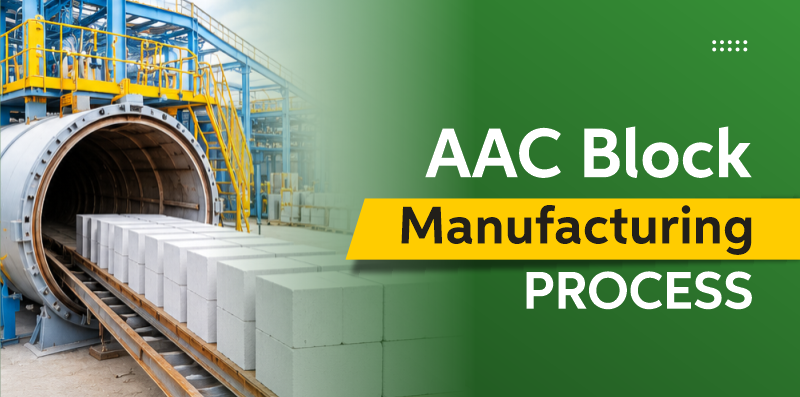
AAC blocks are made by mixing a silica-rich material (fly ash or sand) with cement, lime, gypsum, water and a small amount of aluminium powder. The aluminium reacts and makes the slurry rise like dough, forming millions of tiny cells. The firm “green cake” is cut into blocks with wires, then hardened in a high-pressure steam chamber called an autoclave
AAC blocks look simple, pale, light and neatly cut, but they are made through a precise industrial process. Autoclaved aerated concrete is a lightweight building product that goes through mixing, aeration, moulding, cutting, and autoclaving before it reaches a site. If you are new to the material, our guide on what AAC blocks are is a good place to start.
This article follows the complete production journey inside a manufacturing facility, step by step, and explains why each stage is there..
Key takeaways
- AAC is not “cement blocks with air added”. Its strength comes from a calcium-silicate structure that forms during autoclaving.
- The air pockets come from a chemical reaction. Aluminium reacts in the alkaline mix and releases hydrogen gas, which leaves behind the cells.
- Blocks are cut while the cake is still soft, before autoclaving, and not after
- Autoclaving is different from ordinary curing or drying. It uses pressurised steam.
- Exact formulations, temperatures and cycle times differ from plant to plant.
The AAC block manufacturing process, in seven steps
What raw materials are used to manufacture AAC blocks?
AAC blocks are made from a silica-bearing material, cement, lime, gypsum, water and aluminium powder or paste. Each plays a different role, and none of them is a filler. There is no coarse aggregate in AAC. The main ingredients all take part in the chemistry.
|
Ingredient |
Its role |
|
Fly ash or silica sand |
The silica-bearing component that reacts with lime during autoclaving |
|
Cement |
Binds the mix and helps it stiffen in the early stage |
|
Lime |
Supplies calcium for the reactions and helps the mix become alkaline |
|
Gypsum |
Helps regulate the reactions and setting behaviour |
|
Water |
Used to prepare the slurry and mix |
|
Aluminium powder or paste |
The aerating agent that creates the cells |
The exact formulation and proportions depend on the manufacturing process and the product specification, so you will not find a single universal recipe.
Plants use one of two silica routes. Fly-ash-based AAC uses fly ash, a by-product of coal power stations, as the silica source, while sand-based AAC uses ground silica sand. The two are made the same way after the raw material stage. If you want to understand how the choice shows up in the finished block, see our guide on fly ash vs sand-based AAC blocks.
How are AAC blocks manufactured step by step?
The steps below follow the actual order of production.
Step 1. How are raw materials prepared for AAC block manufacturing?
Raw materials are prepared separately before they meet. Fly ash is mixed with water into a slurry, while silica sand is generally ground with water in a ball mill until it is fine enough to react. Cement, lime and gypsum are handled and stored separately.
Consistency matters from this first step. If the fineness or moisture of the silica component varies from batch to batch, the later reactions vary too, and so does the finished block.
Step 2. How are raw materials mixed and batched?
The ingredients are weighed to the production formulation, then the prepared slurry and the powdered materials are transferred into a mixer. Aluminium powder or paste is added at a controlled stage, and mixing produces a uniform slurry.
Accurate batching and even mixing are what keep one batch of blocks matching the next. Too little mixing leaves uneven pockets of material, and the cells form unevenly as a result.
Step 3. How does AAC slurry expand inside the mould?
The slurry is poured into moulds, where the aluminium reacts with the alkaline mixture and releases hydrogen gas. The gas forms countless small bubbles throughout the slurry, and the mixture rises like bread dough to form a cellular structure.
One point is often misunderstood. The hydrogen is released during this reaction and escapes. It does not stay in the block as hydrogen-filled pockets. Once the gas has gone, the cells are filled with air, which is why AAC is so light and insulates well.
This is one of several things people get wrong about the material, and our article on AAC block myths clears up others.
Step 4. What happens during AAC block pre-curing?
After the expansion, the moulds stay undisturbed in a controlled pre-curing environment. The expanded mixture gradually stiffens as the cement and lime react until it becomes a semi-solid cake, commonly called a green cake.
The cake must be firm enough to be demoulded and cut without collapsing, but still soft enough for the cutting wires to pass through. Each plant controls pre-curing time and temperature based on its formulation and production conditions.
Note the word “pre-curing” carefully. It is a preparatory stage before autoclaving, and it is not the same as autoclaving.
Step 5. How are AAC blocks cut into required sizes?
The green cake is taken out of the mould, or moved through the plant’s demoulding system, and cut by machines that use tensioned wires. The wires cut the cake horizontally and vertically into blocks of the required dimensions.
Cutting happens now because the cake is soft. After autoclaving the material becomes hard and is much harder to cut with the same accuracy. Cutting before hardening helps produce accurate dimensions and a smooth finish. Where the plant’s system allows it, cutting waste is collected and fed back into the production process.
Because the sizes come from the cutting stage, they are consistent from block to block. The AAC block size chart lists the standard lengths, heights and thicknesses available.
Step 6. Why are AAC blocks autoclaved?
Autoclaving is the stage that turns the soft cut cake into hardened blocks. The cut blocks are loaded onto trolleys and moved into an autoclave, a large steel pressure chamber, where they are exposed to high-pressure saturated steam under controlled temperature and pressure.
Under those conditions, hydrothermal reactions take place between the silica and the lime. They form a hardened calcium-silicate structure, mainly a mineral called tobermorite. This is what gives AAC its final strength, and it is why AAC is more than cement with air in it.
Autoclaving is not ordinary water curing, and it is not simply drying. Water curing lets cement hydrate at normal temperature, whereas autoclaving uses pressurised steam to drive different reactions. The temperature, pressure, and duration of the cycle are set according to the plant’s equipment and the product requirements, so no single cycle applies everywhere.
Step 7. How are finished AAC blocks inspected and packaged?
When autoclaving ends, the blocks are unloaded and separated. They are then inspected, and the manufacturer’s quality-control system checks dimensions, density, compressive strength and other specified properties.
Accepted blocks are stacked on pallets, then strapped or shrink-wrapped for dispatch. BIS product requirements for AAC blocks are covered by IS 2185 (Part 3): 1984.
How is the quality of manufactured AAC blocks checked?
Finished AAC blocks are checked against the requirements in IS 2185 (Part 3): 1984, which sets out the properties that a block must meet. The table below shows what each check helps verify.
|
Quality parameter |
What it helps verify |
|
Dimensions and tolerances |
Whether block sizes meet specifications |
|
Dry density |
The block’s density classification |
|
Compressive strength |
Resistance to compressive loading |
|
Thermal conductivity |
Heat-transfer characteristics |
|
Drying shrinkage |
Dimensional change during drying |
These are among the properties covered by the BIS product requirements for AAC blocks. Testing follows the applicable sampling and inspection requirements, so it is carried out on samples from a lot, not on every individual block.
Bigbloc’s NXTBLOC AAC blocks are made to IS 2185 (Part 3) in the 550 to 650 kg/m³ density range, with compressive strength of 3 to 4.5 N/mm². According to trade reports, Bigbloc’s manufacturing facilities are in Gujarat and use fly ash as a raw material. You can see the product details on the NXTBLOC page.
When you buy blocks, ask the supplier for test results for the batch you will receive. Declared properties on a brochure and results on a batch certificate are not always the same thing.
Check density and compressive strength together. A lighter block usually has more air and lower strength, so the right balance depends on where the block will be used.
If you are weighing AAC against traditional masonry, the process explains a lot of the difference. Our comparison of AAC block vs red brick puts the two side by side on weight, speed and performance.
The bottom line
Making an AAC block takes seven carefully controlled steps: preparing the raw materials, batching and mixing, expansion in the mould, pre-curing, wire cutting, autoclaving, and inspection with packaging. The aluminium reaction creates the cells, and autoclaving creates the strength. Each stage depends on the one before it, which is why consistent raw materials and process control matter so much to the quality of the finished block.
Cutting before hardening, for example, is why AAC walls can be laid to tight tolerances. And the cells created by the aluminium reaction are why AAC is light enough to handle in large units.
Once you understand how the block is made, its properties make more sense. Lightness, insulation and accurate size all come from this process, and the full list is in our guide to the benefits of AAC blocks.
Because the process is controlled, results are repeatable, but only when the plant keeps its raw materials and cycles consistent. That is a fair question to put to any supplier.
It is also worth visiting a plant, or asking for a video walk-through, if you are placing a large order.
If you are planning a project and want to talk about block specifications, contact the Bigbloc team.
Recent Post:
Frequently Asked Questions
Because of a chemical reaction during manufacturing. Aluminium in the slurry produces hydrogen gas, which creates bubbles as the mix rises. The gas then escapes and air takes its place in the hardened cells.
Yes, a great deal. Strength depends on correct batching, controlled expansion and, above all, proper autoclaving, which forms the calcium-silicate structure. Density also matters, since a lighter block has more air and generally lower strength.
Yes. Both are silica sources. Fly ash comes as a by-product from power plants, and sand is ground to the required fineness in a ball mill. The later steps are the same, but the formulation and the finished product can differ.
The calcium-silicate structure does not develop fully, so the blocks may not reach the required strength and may shrink more as they dry. That is why autoclaving is controlled, and why finished blocks are tested against the standard.
By cutting the cake with precision wires while it is still soft, controlling the mix and pre-curing so the cake is uniformly firm, and checking dimensions against tolerances during inspection.