
AAC Wall Panels Vs. AAC Blocks: The 2026 Guide to Faster Construction
Introduction
India’s construction sector is moving fast. The AAC blocks market was valued at USD 4.0 billion in 2025 and is projected to reach USD 9.1 billion by 2034, growing at a CAGR of 9.5%.
That number reflects one clear direction: builders across India are done settling for slow.
The question is no longer what material works, but what builds faster without compromising performance.
For most of the last decade, AAC blocks were the answer to that demand. Lightweight, thermally efficient, fire-resistant, and faster than clay bricks, they replaced traditional masonry on sites.
But a new conversation has started.
AAC wall panels are now entering large-scale residential and commercial projects, cutting construction cycles by 10 to 16 times in specific project conditions compared to conventional block-laying. For developers counting interest costs on capital, that difference matters more than the material price per unit.
This guide breaks down the real difference between AAC blocks and AAC wall panels so you can choose the right solution for your project.
AAC Blocks: The Trusted Workhorse
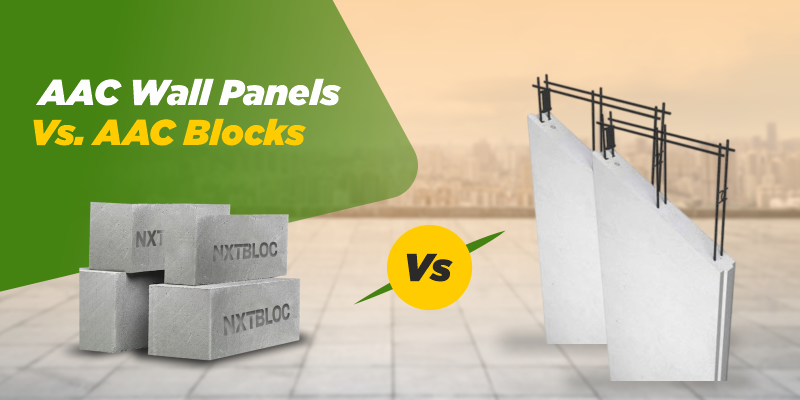
AAC blocks are hand-held masonry units, typically 600mm x 200mm in face size, laid with thin-bed jointing mortar. They are autoclaved, dimensionally precise, and significantly lighter than red clay bricks.
A standard AAC block covers the area equivalent of 8 to 12 clay bricks, which means fewer joints, less mortar, and faster wall-building compared to traditional brick construction.
Where AAC Blocks Work Best
- Small to mid-sized residential projects such as individual houses, villas, and row houses
- Sites with limited or no crane access
- Projects with complex architectural layouts requiring on-site cutting and customization
- Low-rise construction where speed is important but panel installation is not practical
- Infill walls in framed structures at any height
The One Limitation
AAC blocks still rely on what the industry calls ‘wet trades’, meaning plastering is required after laying. The standard plaster coat on AAC block walls is around 10 to 12mm internally. This adds time, material cost, and a curing cycle to the construction schedule.
AAC Wall Panels: The Speed King of Modern Construction
AAC wall panels are factory-made, steel-reinforced walling elements manufactured from the same base material as AAC blocks: cement, lime, silica, gypsum, and aluminium powder. The key difference is scale and structural design.
Panels are produced in floor-to-ceiling heights, up to 4 to 6 metres, with a standard width of 600mm. They are reinforced with an internal anti-corrosion steel cage, which gives them the ability to span full storey heights in a single unit.
The Numbers That Matter
- One panel replaces 12 to 15 AAC blocks, reducing wall joints by up to 80%
- Fire resistance rating: 4 hours at 100mm thickness, with no toxic emissions
- Sound insulation: STC rating of 43 to 44 dB, making them suitable for residential and commercial buildings in urban environments
- Dry-fix installation allows up to 50 square metres per day for a small 3-member crew
- A documented data centre project in India recorded 16x faster construction after switching from 200mm concrete blocks to AAC wall panels
Where AAC Wall Panels Work Best
- High-rise residential towers and commercial complexes
- Industrial warehouses and logistics facilities
- Data centres, airports, healthcare, and hospitality buildings
- Mass housing projects with repeating floor plans
- Any time-critical project where early handover reduces financing cost
AAC Panels vs AAC Blocks: Key Differences at a Glance
Here is a direct comparison of the two systems across the parameters that builders and developers check most often.
|
Feature |
AAC Blocks |
AAC Wall Panels |
|
Primary Unit Size |
Hand-held, 600mm x 200mm |
Story-height, up to 4 to 6 metres |
|
Installation Method |
Masonry laying, course by course |
Crane or manual placement, floor-to-ceiling |
|
Reinforcement |
None |
Welded anti-corrosion steel cage |
|
Labour Requirement |
Higher (skilled masons) |
Lower (small assembly team) |
|
Wall Joints |
Many joints throughout |
Minimal, up to 80% fewer joints |
|
Plastering |
Mandatory (10 to 12mm coat) |
Optional (putty or skim coat only) |
|
Construction Speed |
Standard |
10x to 16x faster |
|
On-site Wastage |
3 to 5% from cutting |
Near zero (custom sized) |
|
Fire Resistance |
Up to 4 hours (thickness-dependent) |
4 hours at 100mm thickness |
|
Sound Insulation (STC) |
Approx. 40 to 42 dB |
43 to 44 dB at 100mm |
|
Best For |
Low to mid-rise, complex layouts, restricted access |
High-rise, commercial, industrial, time-critical projects |
Read More: AAC Block Size Chart
Cost Comparison: AAC Wall Panels vs. AAC Blocks in India
Material cost alone does not tell the full story. The decision between blocks and panels needs to account for four cost layers.
Material Cost
AAC blocks cost between Rs. 45 and Rs. 110 per piece depending on size and grade. A standard 8-inch (200mm) block typically costs Rs. 85 to Rs. 110.
AAC wall panels carry a higher upfront cost per unit due to steel reinforcement and factory precision. However, because one panel replaces 12 to 15 blocks, the material quantity required drops significantly on large-format projects.
Labour Cost
Labour accounts for 30 to 40% of total walling cost in India. AAC block laying requires skilled masons working course by course. Panel installation can be done by a smaller crew with far fewer man-hours per square metre.
Construction Time
In high-rise and commercial projects, every week on site carries an interest cost. A developer running on a 12% per annum construction loan on a Rs. 50 crore project spends approximately Rs. 1 lakh per day in financing. Cutting a 6-month build cycle to 4 months saves more money than any block-vs-panel material price difference.
Lifecycle Cost
Panels require no thick plaster coat, which reduces ongoing maintenance needs for wall cracks. Their sealed surface and fewer joints also reduce water ingress risk over time, lowering maintenance costs across the life of the building.
Read More: How Much Do AAC Blocks Cost?
When Should You Use AAC Blocks?
AAC blocks remain the right choice when:
- The project is a small to mid-size residential building such as an individual house, villa, or row house
- The site has narrow access roads or no crane capacity
- The architectural design includes curved walls, irregular floor plans, or many partition changes
- The project is low-rise, typically three floors or fewer
- The budget is tightly constrained on upfront material cost
Read More: Benefits of Using AAC Blocks
When Should Projects Switch to AAC Wall Panels?
Panels are the right call when:
- The project is a high-rise residential tower, commercial complex, or industrial warehouse
- Multiple identical floors allow repeating panel layouts without customization
- The project has a tight deadline or a penalty clause for delayed handover
- Reducing dead load on the structural frame is a priority, especially in seismic zones
- The developer wants to minimize on-site wet trades and plaster rework
- Green building certification such as GRIHA or IGBC is a project target
The BigBloc Edge: Why NXTBLOC and ZMARTBUILD Wall Panels?
BigBloc Construction is one of India’s leading AAC manufacturers, headquartered in Surat, with growing presence across the country, including Indore.
NXTBLOC AAC blocks are manufactured under controlled conditions with consistent quality and dimensional accuracy, helping reduce on-site rework.
ZMARTBUILD Wall Panels, developed in collaboration with SCG International Thailand, extend the same precision to large-format construction. Panels are custom-sized, resulting in near-zero wastage.
Together with Block jointing mortar and NXTPLAST ready mix plaster, they create a more consistent and reliable system from wall to finish.
Conclusion: Blocks Save Material Cost. Panels Save Time, Labour, and Interest.
There is no universal answer to whether AAC blocks or AAC wall panels are better. The right choice depends on your project type, scale, and what you are trying to save.
For houses, villas, and low-rise construction across India, AAC blocks remain a reliable, cost-effective solution. For high-rise residential towers, commercial buildings, and industrial facilities where time is money, wall panels deliver a measurable advantage that no material price difference can match.
If you are planning a project and want to know which system makes sense for your site and budget, the BigBloc team is available to help you evaluate your options.
Explore NXTBLOC AAC blocks, ZMARTBUILD Wall Panels, and NXTPLAST ready mix plaster from BigBloc Construction, a trusted AAC block manufacturer and supplier in Surat, Gujarat, and across India.
AAC wall panels at 100mm thickness achieve an STC rating of approximately 43 to 44 dB. This means they effectively reduce airborne noise from outside conversations, traffic, and adjacent rooms, making them well-suited for residential apartments and commercial office spaces in urban locations.
Yes. AAC wall panels can support fixings for heavy objects when the correct fasteners are used. Special AAC-rated anchor bolts and chemical anchors are required for loads above standard picture-hanging weights. Always consult the technical data sheet of the specific panel for load capacity per fixing.
A 100mm thick reinforced AAC wall panel carries a 4-hour fire resistance rating. The material is inorganic and non-combustible. Unlike dense concrete, AAC does not spall under heat, making it a preferred choice for fire-critical buildings such as data centres, hospitals, and airport terminals.
AAC wall panels are engineered to perform in seismic zones up to Zone IV as per IS 1893 (Part 1): 2016. Their low mass compared to dense concrete reduces the inertial forces acting on a building during seismic events. Mechanical connectors (L-clips and Z-brackets) allow the panel to accommodate inter-storey drift without cracking.
The coefficient of thermal expansion for AAC is approximately 8 x 10⁻⁶ per degree Celsius, which is similar to concrete. This low value means the panel does not expand and contract significantly with temperature changes, reducing the risk of thermal cracking in external wall applications.
AAC wall panels and blocks have similar base compressive strength, typically 3 to 5 MPa depending on grade. The structural advantage of panels comes from the internal steel reinforcement, which allows them to span floor-to-ceiling heights without needing intermediate horizontal supports, something a block wall cannot achieve without additional beam and column elements.
Independent project data indicates AAC wall panels can be installed 10 to 16 times faster than comparable AAC block walls. A 3-member crew can install approximately 50 square metres of panel wall per day in dry conditions, compared to a much smaller area achievable through block-laying in the same time.
AAC wall panels carry a higher upfront cost per unit than AAC blocks. However, on large-scale projects, savings in labour, plaster material, and construction time often offset the price difference. The total cost comparison must account for all four factors: material, labour, time, and lifecycle maintenance.
Yes. AAC wall panels can replace traditional masonry for non-load-bearing infill walls in framed structures. They cannot replace load-bearing walls or structural columns. For most modern high-rise and commercial buildings that use RCC frames, all walling is infill and panels are a direct, faster replacement for block masonry.
For high-rise residential and commercial buildings in India, AAC wall panels offer a clear construction speed advantage. Their light weight reduces dead load on the RCC frame, potentially saving steel and foundation cost. Their 4-hour fire rating and seismic zone IV compliance meet current building safety standards. For projects above 8 to 10 floors with repetitive floor plans, panels are generally the more efficient choice.