
Fly Ash vs Sand-Based AAC Blocks: A 2026 Engineering Comparison
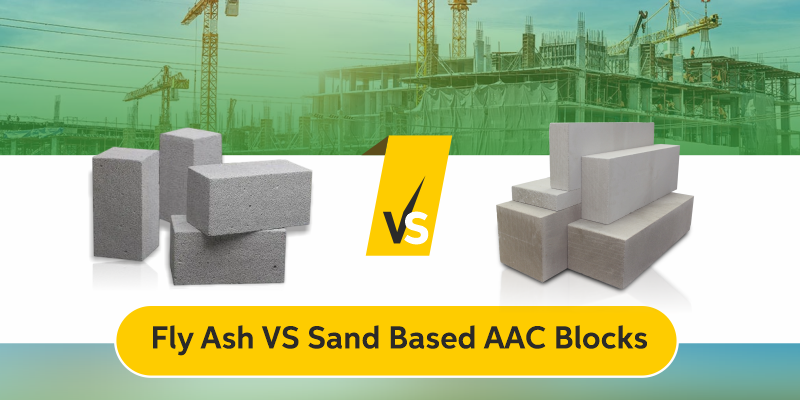
AAC is now a common material in construction.
The real question today is not whether to use AAC. The question is which type of AAC to use.
Fly Ash AAC Blocks and Sand-Based AAC Blocks both fall under Autoclaved Aerated Concrete. They are lightweight. They reduce structural load. They provide thermal insulation.
But the main silica source is different.
Fly ash AAC blocks use fly ash from thermal power plants. Sand-based AAC blocks use crushed quartz sand. This difference changes the internal composition of the block.
That change affects drying shrinkage, compressive strength, dimensional accuracy, crack formation, thermal conductivity, and long-term performance.
In current construction practice, engineers check drying shrinkage values as per ISO standards, compressive strength grades, and thermal conductivity before approving materials. Developers also assess sustainability factors such as industrial byproduct recycling and the carbon footprint of sand extraction.
The comparison of Fly ash vs sand-based AAC blocks is not about which is better in general. It is about what is suitable for a specific structure.
In high-rise buildings, shrinkage control and crack resistance are important. In green-certified projects, material sustainability matters. In premium residential construction, surface finish and precision are key factors.
To understand this difference clearly, it is important to first examine AAC blocks and how their quartz composition influences strength and crack control.
What are Sand-Based (Quartz) AAC Blocks? (The Premium Strength)
The Composition
Sand-based AAC blocks use crushed quartz sand as the primary silica source instead of fly ash. The sand is finely ground and mixed with cement, lime, gypsum, water, and a small quantity of aluminium powder.
The aluminium reacts within the mix, creating millions of tiny air pores. The blocks are then cured in an autoclave under high-pressure steam. This process forms a stable calcium silicate structure that gives strength and dimensional stability.
The key difference here is the silica source. Quartz sand is natural, uniform, and chemically stable. This helps create a more consistent internal matrix compared to fly ash-based variants.
Key Benefit: Lower Drying Shrinkage
One of the main technical advantages of sand-based AAC blocks is lower drying shrinkage. Typical shrinkage values are around 0.03 percent.
Lower shrinkage means reduced movement after installation. Reduced movement directly lowers the risk of hairline cracks on plastered or painted surfaces.
In high-rise buildings and premium residential projects, crack control is critical. Even small surface cracks can affect finish quality. Because of this stability, sand-based AAC blocks are often considered the preferred option for projects with high surface finish standards.
This is why many engineers treat sand-based blocks as the benchmark for dimensional control in AAC systems.
The Aesthetic
Sand-based AAC blocks usually have an off-white or cream colour. This comes from the natural quartz content.
In comparison, fly ash AAC blocks typically appear grey due to the presence of industrial byproducts.
The lighter tone of sand-based blocks supports a cleaner surface appearance and uniform plaster application. It also helps in projects where minimal plaster thickness or smooth wall finishes are required.
The visual difference may seem minor, but in premium construction, surface uniformity and finish quality matter.
What are Fly Ash AAC Blocks? (The Eco-Warrior)
The Composition
Fly Ash AAC Blocks use fly ash as the primary silica source. Fly ash is a byproduct generated from coal-based thermal power plants. Instead of being disposed in landfills, it is processed and used in construction materials.
In AAC manufacturing, fly ash is mixed with cement, lime, gypsum, water, and a small amount of aluminium powder. The aluminium creates air pores within the mix. The blocks are then cured in an autoclave under high-pressure steam, forming a lightweight and stable structure.
The use of fly ash replaces natural quartz sand. This reduces dependence on natural silica extraction and supports industrial waste utilization.
Key Benefit: Sustainability
The main advantage of Fly Ash AAC Blocks is sustainability.
Using fly ash supports industrial byproduct recycling in construction. It reduces landfill burden and promotes circular material use. This makes fly ash AAC blocks a preferred choice in environmentally focused projects.
Green building projects often evaluate materials based on recycled content and embodied impact. Fly ash AAC blocks can contribute to green building certification frameworks, including LEED, where recycled material content and resource efficiency are considered.
For developers aiming for sustainable construction targets, fly ash AAC blocks align well with environmental compliance requirements.
Thermal Performance
Fly ash AAC blocks often show slightly lower thermal conductivity compared to sand based variants. Typical thermal conductivity values range around 0.14 to 0.16 W/mK, depending on density.
Lower thermal conductivity means better insulation performance. This helps reduce heat transfer through walls and improves indoor temperature control.
In regions with high ambient temperatures, improved insulation can reduce cooling loads and energy consumption.
While the difference may not be large, in large-scale housing or climate-sensitive designs, this thermal edge can influence material selection.
Head-to-Head Comparison: Fly Ash AAC Blocks vs Sand Based AAC Blocks
|
Critical Factor |
Sand Based AAC Blocks |
Fly Ash AAC Blocks |
|
Primary Silica Source |
Crushed quartz sand |
Fly ash from thermal power plants |
|
Compressive Strength |
Typically 3–5 MPa with consistent strength distribution |
Typically 3–4 MPa depending on fly ash quality |
|
Drying Shrinkage |
Around 0.03% |
Around 0.04–0.05% |
|
Dimensional Precision |
Sharper edges and smoother finish |
Slight surface variation possible |
|
Crack Control |
Better shrinkage control reduces hairline cracks |
Slightly higher shrinkage may increase crack risk |
|
Thermal Conductivity (W/mK) |
Approx. 0.16–0.18 |
Approx. 0.14–0.16 |
|
Environmental Impact |
Uses natural silica; sand extraction has environmental impact |
Supports industrial byproduct recycling |
|
Color Appearance |
Off-white or cream |
Grey |
|
Best Use Case |
High-rise buildings, premium finishes, crack-sensitive projects |
Green-certified projects, mass housing, sustainability-focused developments |
|
Cost Factor |
Depends on proximity to silica sources |
Depends on proximity to thermal power plants |
Also Read: Benefits of Using AAC Blocks
The BigBloc Perspective: Offering the Best of Both Worlds
Material selection should depend on project requirement, not preference. That is why leading AAC blocks manufacturers focus on offering both silica options under controlled production systems.
NXTBLOC manufactures both Sand Based AAC Blocks and Fly Ash AAC Blocks to meet different architectural and structural needs. Each variant is produced under controlled autoclaving conditions with tested parameters for compressive strength, density, and drying shrinkage.
This allows architects, consultants, and contractors to choose the right material based on performance criteria rather than assumption.
Sand based AAC blocks are generally recommended for projects where dimensional stability and crack control are critical. In coastal high-rise buildings, external wall exposure and long wall spans demand lower drying shrinkage. Premium residential towers and commercial buildings that require smooth finishes also benefit from quartz-based blocks.
Fly ash AAC blocks are suitable for large-scale developments where sustainability targets are a priority. Massive housing townships, government infrastructure projects, and green-certified buildings often prefer fly ash variants due to recycled content and environmental compliance alignment.
Both systems work effectively with compatible construction materials such as block jointing mortar and ready mix plaster, ensuring uniform wall performance.
The decision is not about which block is superior. It is about matching technical properties with project demands. By manufacturing both types, NXTBLOC supports engineers and developers in making performance-based choices aligned with structural, environmental, and finishing requirements.
Also read: Standard AAC Block Sizes in India
Technical Specification Table (Quick Comparison)
Below is a simple and scannable comparison of the most important technical parameters engineers check before approval.
|
Parameter |
Sand Based AAC Blocks |
Fly Ash AAC Blocks |
|
Density |
550–650 kg/m³ |
550–650 kg/m³ |
|
Compressive Strength |
3–5 MPa (depending on grade) |
3–4 MPa (depending on grade) |
|
Drying Shrinkage |
~0.03% |
0.04–0.05% |
|
Color |
Off-white / Cream |
Grey |
What this means in practice:
- Density is similar in both types, so weight advantage remains the same.
- Sand based blocks usually offer slightly higher strength consistency.
- Lower shrinkage in sand based AAC helps reduce hairline cracks.
- Color difference reflects the raw material source — quartz sand vs fly ash.
This quick table helps consultants and contractors compare performance at a glance before final material selection.
Also Read: How Much Do AAC Blocks Cost?
Conclusion: Making the Right Choice with Confidence
The discussion around Fly ash vs sand based AAC blocks should not be reduced to a simple “which is better” debate.
Both materials are advanced walling solutions. Both reduce structural load. Both improve thermal insulation. Both help speed up construction compared to traditional bricks.
The difference depends on project needs.
Sand based AAC blocks offer lower drying shrinkage, better dimensional stability, and stronger crack control. They are suitable for high-rise buildings and projects where finish quality is important.
Fly ash AAC blocks support sustainability by using industrial byproducts. They are suitable for large housing projects and developments focused on green building goals.
Material selection should be based on clear technical data. Compressive strength, drying shrinkage, thermal conductivity, building height, and finish requirements must be checked before approval.
There is no single answer. The right block depends on the structure and its purpose.
BigBloc Construction manufactures both Sand Based AAC Blocks and Fly Ash AAC Blocks to match different project requirements. The technical team can help you review specifications and select the right solution.
Connect with BigBloc Construction to discuss your project and choose the AAC system that fits your needs.