
What Makes Polymer-Based Mortars Stick Better? A Complete Guide for 2026
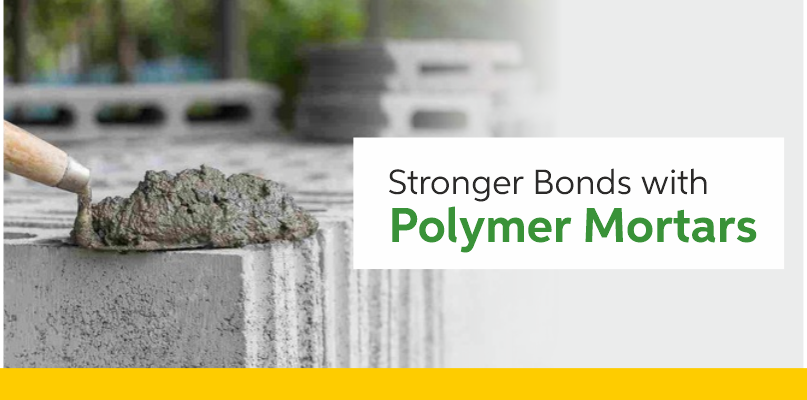
In any construction, strength is not only about how strong a block is. It is also about how well one block holds on to the next. This connection is created by mortar, and its quality decides whether a wall performs well for years or starts showing problems early.
With the growing use of AAC Blocks in India, bond strength has become even more important. AAC blocks are lighter and more precise than traditional bricks. While this improves speed and efficiency, it also means the mortar must work harder to maintain cohesion.
Traditional cement mortar was never designed for this kind of block. It is stiff, shrinks while drying, and struggles to bond properly with porous AAC surfaces. Over time, this results in cracks, weak joints, and uneven load transfer. To address this gap, the industry has moved toward Polymer Modified Mortar, a solution designed for modern masonry systems.
What Is Polymer-Based Mortar?
Polymer Based Mortar is a factory-made mortar where carefully selected polymers are blended with cement, fine aggregates, and performance additives. Unlike site-mixed mortar, the composition is controlled, consistent, and tested.
Polymers such as SBR latex, acrylic polymers, and EVA-based compounds play a key role. They do not replace cement. Instead, they enhance how cement behaves once the mortar is applied. These polymers act as an internal bonding agent, improving grip, flexibility, and durability. This is why Polymer Jointing Mortar is widely recommended for AAC block construction in India.
Leading Block Jointing Mortar Manufacturers in Gujarat use polymers to ensure the mortar performs the same way on every site, regardless of workmanship variations
How Polymers Increase Bond Strength?
Polymers change how mortar behaves after it is applied.
They do not just add strength. They improve the way mortar bonds, dries, and responds to movement over time. Below is how this happens, explained in simple terms.
3.1 Micro-Film Formation
When polymer-based mortar is mixed with water and applied, the polymers spread throughout the mortar and form a very thin, flexible film.
This film:
- Wraps around cement and sand particles
- Connects the mortar tightly to the block surface
- Acts like a glue layer at a microscopic level
Instead of sitting loosely between two blocks, the mortar actively grips both surfaces. This is one of the main reasons polymer-modified mortar achieves much higher bond strength than traditional cement mortar.
3.2 Increased Tensile and Flexural Strength
Normal cement mortar is strong when pressed but weak when pulled or bent. This makes it brittle.
Polymers change this behavior by:
- Allowing the mortar to stretch slightly under stress
- Absorbing small movements instead of cracking
As a result, the mortar can handle:
- Minor building movement
- Temperature changes
- Vibration and load shifts
This increase in tensile and flexural strength keeps joints intact for longer and reduces early cracking.
3.3 Improved Adhesion at the Interface Zone
The weakest part of any masonry wall is the contact zone where the block and mortar meet.
Polymers improve this zone by:
- Penetrating the tiny pores of AAC blocks
- Locking the mortar into the block surface
This creates a strong mechanical and chemical bond at the interface. Because of this, polymer mortar shows far better adhesion and much lower chances of joint separation or debonding.
3.4 Reduced Shrinkage and No Gap Formation
Traditional cement mortar loses water quickly as it dries. This causes shrinkage, which leads to fine cracks and small gaps between blocks.
Polymer mortar behaves differently:
- Polymers control the drying process
- Moisture loss happens more slowly and evenly
- Internal stress is reduced
Because shrinkage is controlled, the mortar does not pull away from the blocks. This is why polymer mortars maintain tight joints and prevent gap formation over time.
3.5 Water Retention for Better Hydration
For cement to gain full strength, it needs enough water for proper hydration.
Polymers help by:
- Holding moisture inside the mortar for longer
- Preventing rapid evaporation
- Allowing cement to hydrate fully
This results in:
- Better internal strength
- More durable joints
- Reduced dependence on heavy curing
Better hydration directly improves long-term bond strength and overall masonry performance.
You may also read: How to Choose the Right Mortar for AAC Block?
Benefits of Polymer Mortar for AAC Blocks
Ultra-high bond strength
Polymer additives create a strong grip between the AAC block and mortar, reducing chances of joint failure and long-term debonding.
Thin joint application (2–3 mm)
Polymer mortar works effectively in thin joints, improving wall alignment, reducing mortar consumption, and minimizing thermal bridges.
High crack resistance
The flexible nature of polymer mortar absorbs minor movements and prevents shrinkage cracks and micro-cracks in masonry joints.
Better load distribution
Strong and uniform bonding allows loads to transfer evenly across AAC blocks, improving overall wall stability and performance.
Reduced curing requirement
Polymers retain moisture within the mortar, enabling proper cement hydration with minimal water curing.
Improved water resistance
Polymer films reduce water absorption at joints, helping protect AAC block walls from dampness and moisture-related issues.
Comparison: Cement Mortar vs Polymer Modified Mortar
|
Parameter |
Cement Mortar |
Polymer Modified Mortar |
|
Joint thickness |
10–12 mm |
2–3 mm |
|
Bond strength |
Moderate |
High |
|
Crack resistance |
Low |
High |
|
Flexibility |
Rigid |
Flexible |
|
Shrinkage |
High |
Low |
|
Curing requirement |
High |
Reduced |
|
Water resistance |
Low |
Improved |
|
Suitability for AAC blocks |
Limited |
Ideal |
You may also read: Key Features of High-Performance Block Jointing Mortar
Conclusion: Why BigBloc Polymer Mortars Deliver Better Performance
AAC block construction demands precise bonding, controlled shrinkage, and long-term durability. These requirements cannot be met consistently with traditional cement mortar.
BigBloc’s polymer-based mortars are engineered specifically for AAC blocks. They deliver high bond strength, improved flexibility, and stable joints that perform reliably over time. With factory-controlled formulation and consistent quality, BigBloc mortars reduce on-site variability and support stronger, more durable masonry systems.
For projects that demand quality, speed, and long-term performance, Contact BigBloc Construction is a dependable choice.
Frequently Asked Questions
Yes. Polymer mortar is better suited for modern masonry, especially AAC blocks. Cement mortar is rigid and shrinks as it dries, which often leads to weak bonding and cracks. Polymer mortar is more flexible, bonds strongly to porous surfaces, and performs better over time.
Polymer mortar provides much higher bond strength than traditional cement mortar. The polymers create a thin bonding film that grips both the block and the mortar layer. This results in stronger adhesive and tensile bond strength, reducing the chances of joint failure during the building’s life.
Polymer mortar does not eliminate all cracks, but it significantly reduces them. Its flexibility helps absorb minor movements caused by temperature changes, shrinkage, or settlement. This prevents shrinkage cracks and micro-cracks that commonly appear in cement mortar joints.
Polymer mortar requires much less curing than cement mortar. Polymers help retain moisture within the mortar, allowing proper cement hydration. In most cases, only light curing is needed, especially in hot or dry conditions.
The ideal joint thickness is 2–3 mm. Polymer mortar is designed for thin joints, which improves bonding, ensures better load transfer, reduces material usage, and improves the overall quality of AAC block masonry.