
Building a house in India in 2026 requires technical planning, financial discipline, and regulatory awareness.
Residential buildings in India are generally designed for a service life of 50 years or more when constructed as per structural engineering standards and BIS guidelines. However, poor material selection and improper supervision reduce durability significantly.
Today’s construction environment includes:
- Frequent fluctuations in steel and cement prices
- Stricter municipal approvals
- RERA compliance requirements in many states
- Growing demand for energy-efficient homes
Many homeowners still make critical mistakes:
- Skipping soil testing before foundation design
- Relying only on contractor experience instead of structural calculations
- Ignoring waterproofing at plinth and terrace levels
- Underestimating hidden costs like approvals, temporary utilities, and finishing
These decisions lead to common home construction pitfalls such as:
- Structural cracks
- Damp walls
- Higher electricity consumption
- Repeated repair expenses
Understanding the mistakes to avoid when building a house in India is essential before starting construction.
In 2026, informed homeowners focus on:
- Soil testing and foundation matching
- Lightweight construction materials to reduce dead load
- Proper waterproofing systems
- Thermal-efficient wall materials
- 15–20% financial buffer for price variations
This article serves as a structured new home construction checklist 2026, helping you avoid serious home construction pitfalls and solutions that affect safety, cost, and long-term performance.
Because building once is expensive.
Repairing repeatedly is even more expensive.
1. The “Cheap Material” Trap: Why Initial Savings Lead to Lifetime Repairs
One of the biggest mistakes to avoid when building a house in India is choosing materials based only on the lowest quote.
Many homeowners compare price per brick.
Very few compare performance over 20 years.
That is where the real loss happens.
The Problem with Traditional Red Bricks
Traditional red bricks often:
- Absorb more water
- Require thicker mortar joints
- Increase plaster consumption
- Add higher dead load on structure
- Offer limited thermal insulation
Over time, this can lead to:
- Damp walls
- Paint peeling
- Plaster cracks
- Higher cooling costs
Initial savings disappear in maintenance.
The BigBloc Solution: NXTBLOC AAC Blocks vs Traditional Bricks
Modern AAC blocks like NXTBLOC offer:
- Lightweight construction (reduces structural load)
- Better thermal insulation
- Improved fire resistance
- Uniform size for thin joint application
- Reduced plaster thickness
Because AAC blocks are lighter, they reduce stress on beams and columns.
Because they insulate better, indoor temperatures remain more stable.
The Real Comparison
Red bricks may look cheaper at purchase.
AAC blocks improve:
- Structural efficiency
- Energy performance
- Construction speed
- Long-term durability
The real cost of a wall is not its purchase price.
It is the cost of maintaining it for the next 20–30 years.
2. Skipping the “Science”: Soil Testing & Structural Design Mistakes
Another major mistake to avoid when building a house in India is starting foundation work without proper soil testing and structural design.
Many homeowners rely only on contractor experience.
But foundations are designed using calculation, not assumption.
Why Contractor “Experience” Is Not Enough
A contractor may say:
- “We’ve built many houses like this.”
- “This depth is enough.”
- “This column size works.”
But every plot is different.
If structural load exceeds soil bearing capacity, it can cause:
- Uneven settlement
- Wall cracks
- Column stress
- Beam deflection
Cracks that appear after 2–3 years often begin at the foundation stage.
Soil Testing and Foundation Matching
Soil testing helps determine:
- Soil Bearing Capacity (SBC)
- Type of soil (clay, sandy, filled soil, expansive soil)
- Groundwater level
Foundation type must match soil condition:
- Strong soil → shallow footing
- Weak soil → raft or deeper foundation
- Expansive soil → special design considerations
Without soil testing, foundation depth is guesswork.
Role of a Structural Engineer
A structural engineer:
- Calculates total building load
- Designs column size and reinforcement
- Determines foundation type
- Applies safety factors as per standards
Never reduce column size or steel quantity to cut cost.
Structural changes must always be approved.
Quick Checklist Before Foundation Work
- Soil test report available
- SBC mentioned clearly
- Structural drawings approved
- Steel grade verified
- Concrete mix defined
Skipping this stage can create permanent structural issues.
A house stands on engineering, not on assumption.
3. Underestimating the “Invisible” Budget
Many homeowners plan construction cost per square foot.
Very few plan the full project cost.
This is one of the most common mistakes to avoid when building a house in India.
Keep a 15–20% Budget Buffer
Steel, cement, and labour costs fluctuate.
Without a buffer, you may:
- Compromise on quality
- Delay construction
- Reduce finishing standards
A financial cushion protects construction quality.
Hidden Costs in Home Construction
Apart from structure cost, include:
- Soil testing and structural design fees
- Architect and consultant charges
- Municipal approvals and permits
- Temporary electricity and water connection
- Boundary wall construction
- Plumbing and electrical fittings
- Interior finishing
- GST on materials
Many homeowners realise these costs only after construction begins.
Budgeting for Home Construction in India: Quick Checklist
- Land development cost included
- Professional fees accounted
- Approval charges estimated
- Material rate variation buffer added
- Interior budget separated
Underestimating the budget leads to rushed decisions.
Rushed decisions lead to poor quality.
A well-planned budget protects your structure and your peace of mind.
Also Read: What Permissions and Approvals Are Needed Before Starting Construction?
4. Poor Planning for Natural Light & Cross-Ventilation
A house can look beautiful from the outside and still feel uncomfortable inside.
Poor ventilation and weak natural lighting increase electricity bills and reduce indoor comfort. This is a common but ignored mistake to avoid when building a house in India.
The “Dark House” Problem
When window placement is random or poorly planned:
- Rooms feel dim even during the day
- Artificial lighting is used more often
- Air circulation becomes weak
- Moisture stays trapped indoors
Over time, this affects the wall condition and indoor air quality.
Natural Light and Cross-Ventilation Design
Proper planning includes:
- Window alignment on opposite walls for airflow
- Considering the sun direction before finalising the layout
- Adequate window size in living and bedroom areas
- Ventilation openings in the kitchen and bathrooms
Orientation planning reduces heat gain and improves comfort.
Role of Wall Material in Thermal Comfort
Wall material affects heat transfer.
Lightweight insulated materials like AAC blocks reduce external heat penetration compared to dense traditional masonry. This improves indoor temperature stability and reduces cooling demand.
Material choice and ventilation planning should work together.
Quick Design Checklist
- Window placement finalised during the planning stage
- The cross-ventilation path ensured
- Sun direction studied
- Thermally efficient wall material selected
A well-lit and well-ventilated house feels larger, healthier, and more energy-efficient.
5. Ignoring Waterproofing and Damp-Proofing (The Silent Killer)
Waterproofing mistakes usually appear during monsoon.
By the time you see damp patches or peeling paint, the damage has already started. This is one of the most expensive mistakes to avoid when building a house in India.
Where Most Homes Fail
Common weak areas:
- Plinth level (ground moisture rise)
- Bathrooms and kitchens
- Terrace slab
- External wall joints
- Window edges
If damp-proofing is ignored at foundation level, moisture travels upward through capillary action.
Waterproofing and Damp-Proofing Mistakes
- Skipping damp-proof course (DPC)
- Using poor-quality mortar
- Not sealing pipe penetrations
- Improper terrace slope
- No curing after waterproof layer
These issues lead to:
- Wall seepage
- Fungus growth
- Paint peeling
- Reinforcement corrosion
Importance of Proper Jointing and Plaster
Weak block joints allow water entry.
Using quality Block Jointing Mortar ensures:
- Thin, uniform joints
- Strong bonding
- Reduced water seepage
Similarly, Ready mix plaster reduces shrinkage cracks and surface leakage risk.
Waterproofing must be treated as a system, not as a last-minute fix.
Also Read: Step-by-Step House Construction Process in India
Quick Waterproofing Checklist
- Damp-proof course applied at plinth
- Terrace waterproofing layer tested
- Proper slope toward drainage outlets
- Bathroom waterproofing before tiling
- Joints sealed properly
Water damage spreads silently.
Prevention during construction is always cheaper than repair later.
6. Hiring the Lowest Bidder Contractor
Choosing the lowest quotation is one of the most risky mistakes to avoid when building a house in India.
A low quote may look attractive at the start.
But construction quality depends on supervision, skill, and accountability — not just labour cost.
Labour Contractor vs. Quality Contractor
A labour contractor:
- Provides workers
- Works on daily supervision
- Focuses on speed
A quality contractor:
- Understands structural drawings
- Follows mix ratios strictly
- Ensures proper curing
- Monitors alignment and finishing
- Maintains construction sequence
The difference shows after a few years in cracks, seepage, and structural durability.
Risks of Choosing Only on Price
- Reduced steel quantity
- Lower cement content in concrete
- Poor curing
- Compromised waterproofing
- Delayed timelines
Small shortcuts during construction create long-term structural and maintenance problems.
Checklist Before Signing a Construction Agreement
- Written contract with scope of work
- Timeline clearly defined
- Payment schedule linked to stages
- Material responsibility mentioned
- Defect liability clause included
- Past project references verified
Never finalize a contractor without documentation.
Quality construction needs accountability.
7. Forgetting Future-Proofing and Scalability
Many homeowners build for today’s needs.
Very few plan for the next 15–20 years.
This is a silent but serious mistake to avoid when building a house in India.
Plan for Future Electrical Needs
Modern homes require:
- Provision for EV charging points
- Solar panel conduit planning
- Extra power load capacity
- Dedicated wiring for home office
Adding these later means breaking walls and redoing wiring.
Planning during construction saves cost and damage.
Internal Partition Planning Mistake
Using thick traditional brick walls for internal partitions reduces usable carpet area.
Smarter planning includes:
- Optimized wall thickness
- Lightweight internal partitions
- Proper load distribution
Using thinner masonry for non-load-bearing walls increases usable space without affecting structural safety.
Think Beyond Present Layout
Before finalizing design, consider:
- Scope for vertical expansion
- Terrace load capacity for solar
- Space for future storage
- Plumbing access points
Future-proofing improves resale value and long-term functionality.
Quick Future-Proofing Checklist
- Electrical load capacity planned
- Solar conduit provided
- EV charging point space reserved
- Partition thickness optimized
- Structural provision for future floor (if required)
A well-planned home adapts to changing needs without structural modification
8. Lack of Regular Site Supervision
Even the best materials and drawings can fail without supervision.
One of the most overlooked mistakes to avoid when building a house in India is assuming that everything on site is being done correctly.
Construction quality depends heavily on daily monitoring.
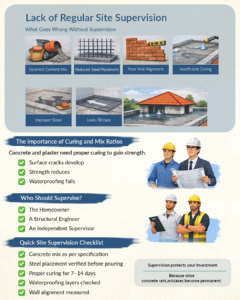
What Goes Wrong Without Supervision
- Incorrect cement-sand ratio
- Reduced steel placement
- Poor alignment of walls
- Insufficient curing
- Improper slope in bathrooms and terrace
These errors are small during execution.
But they become expensive after completion.
The Importance of Curing and Mix Ratios
Concrete and plaster need proper curing to gain strength.
If curing is stopped early:
- Surface cracks develop
- Strength reduces
- Waterproofing fails
Material ratios must match structural specifications.
Small deviations affect durability.
Who Should Supervise?
- The homeowner (regular visits)
- A structural engineer
- An independent site supervisor
Daily checking prevents long-term structural integrity mistakes in residential buildings.
Quick Site Supervision Checklist
- Concrete mix as per specification
- Steel placement verified before pouring
- Proper curing for 7–14 days
- Waterproofing layers checked
- Wall alignment measured
Supervision protects your investment.
Because once concrete sets, mistakes become permanent.
Also Read: How to Calculate Construction Cost per Square Foot in India?
Conclusion: Your Foundation for a Stress-Free Life
Building a house is one of the most important financial decisions you will make. In 2026, successful home construction in India is not about cutting costs at every stage. It is about making informed decisions that protect your structure for decades.
When soil testing is done properly, structural design follows engineering standards, materials are selected for durability, waterproofing is executed carefully, and construction is supervised consistently, your home performs the way it should. When shortcuts are taken, problems appear slowly in the form of cracks, seepage, repairs, and rising maintenance costs.
Understanding the real mistakes to avoid when building a house in India helps you avoid expensive corrections later. A well-built home improves comfort, reduces long-term expenses, and strengthens the value of your investment.
Choosing advanced materials like AAC blocks improves structural efficiency, thermal insulation, and overall durability. For high-quality AAC blocks and modern construction solutions, connect with Bigbloc Constructions and build your home with materials designed for long-term performance.
Build with planning.
Build with precision.
Build once and build it right.