
Step-by-Step Guide: How to Build Walls Using AAC Blocks?
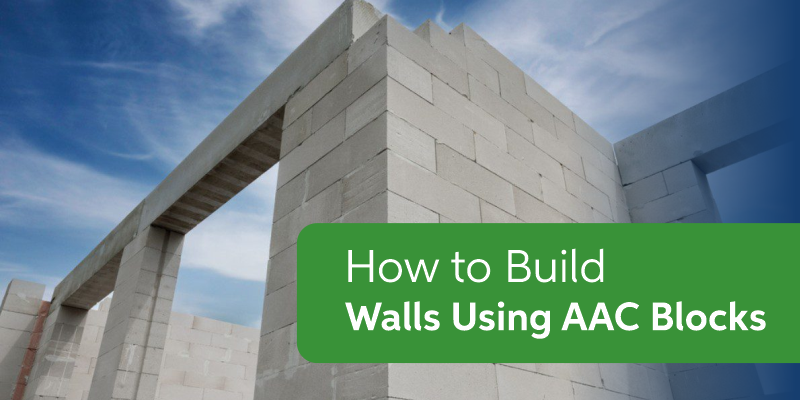
Before learning the construction steps, it is important to understand how AAC block masonry is different from brick masonry.
AAC blocks are factory-made with precise dimensions. This accuracy allows walls to be built using thin joints instead of thick mortar layers. Because of this, AAC block walls depend more on correct installation than on excess material. If the process is followed properly, the wall becomes straight, strong, and uniform. If shortcuts are taken, defects show up very quickly.
This blog is written as an educational guide, not a promotional one. It explains how to build AAC block walls step by step, why each step matters, and what mistakes should be avoided. The aim is to help contractors, site engineers, and decision-makers clearly understand the AAC block masonry process.
This is why preparation and method matter more than speed in AAC block construction.
Tools Required for AAC Block Wall Construction – Explained Clearly
AAC block wall construction depends heavily on accuracy. The blocks are factory-made with precise dimensions, so the tools used must help maintain straight lines, correct levels, and thin joints. Each tool has a specific role, and skipping any of them usually leads to alignment issues or weak bonding.
- Trowel is used to apply and spread block jointing mortar on the surface of the AAC blocks. Unlike brick masonry, where mortar is spread thickly, AAC construction requires controlled and even application. The trowel helps place the adhesive smoothly without wasting material.
- Rubber mallet is used to gently tap AAC blocks into position after placing them on the adhesive layer. AAC blocks are lighter and softer than red bricks, so using a hammer can damage the block edges. The rubber mallet allows small adjustments in level and alignment without cracking or chipping the block.
- Spirit level or laser level is essential to check whether the wall is straight, level, and plumb. In AAC block construction, even a small deviation can become visible as the wall grows taller. These tools help ensure that every row remains aligned and that the wall does not lean or curve.
- Notched trowel is specifically used to control the thickness of the adhesive layer. AAC blocks require a thin joint, usually around 2 to 3 mm. The notches ensure that the adhesive spreads evenly and maintains uniform thickness across the block surface. This improves bonding strength and reduces mortar consumption.
- Measuring tape is used to verify wall dimensions, block placement, and opening sizes for doors and windows. Since AAC blocks are modular, accurate measurements help reduce cutting, wastage, and misalignment during construction.
- Mixing bucket is used to prepare block jointing mortar in small, controlled batches. This ensures the adhesive remains fresh and workable. Mixing too much material at once often leads to wastage because jointing mortar has a limited working time.
- Jointing mortar mixer helps achieve a smooth and lump-free adhesive mix. Proper mixing is important because poorly mixed mortar reduces bonding strength. A consistent mix also makes application easier and improves overall wall quality.
Materials Required for AAC Block Wall Construction – Explained Clearly
The quality of materials used in AAC block masonry directly affects wall strength, durability, and finish. Using the correct materials ensures that the wall performs as intended over its life span.
- AAC blocks are the main building units. They are lightweight, uniform in size, and provide good thermal insulation. Because of their precise dimensions, AAC blocks allow walls to be built faster with thinner joints and better surface finish compared to traditional bricks.
- Block jointing mortar or adhesive is specially designed for AAC blocks. It replaces conventional cement-sand mortar and is applied in thin layers. This adhesive provides strong bonding, reduces cracks, and helps maintain straight wall lines. Using regular mortar is one of the most common mistakes in AAC block wall construction.
- Reinforcement bars or GI mesh are used in specific locations, not throughout the wall. They are placed in horizontal joints at areas such as long wall spans, window sills, and above door openings. Reinforcement improves crack control and adds structural stability where stress is higher.
- Curing equipment is used for light curing after wall construction. AAC block walls do not require heavy water curing like brick walls. Simple tools such as water spray cans or hoses are enough to provide light curing for a few days, which helps the adhesive gain strength without weakening the joints.
Step-by-Step Guide: How to Build AAC Block Walls
Step 1: Preparing the Base and Foundation Surface
Every AAC block wall starts at the base. The slab or beam on which the wall will be built must be clean, level, and stable. Dust, loose concrete, or uneven patches should be removed before work begins.
A damp-proof course is applied to prevent moisture from travelling upward into the wall. Once this is done, the surface level is checked carefully. Any unevenness at this stage will reflect throughout the height of the wall. Many alignment issues seen later are actually caused by ignoring this first step.
Step 2: Marking the Wall Layout Accurately
After preparing the base, the wall layout is marked according to drawings. This includes wall thickness, door and window positions, and corner locations.
Clear reference lines are important because AAC blocks are placed based on these lines. Corner blocks are fixed first, as they guide the alignment of the entire wall. Accurate marking reduces cutting, wastage, and on-site confusion.
Step 3: Mixing Block Jointing Mortar the Right Way
Block jointing mortar plays a critical role in AAC block wall strength. It is mixed with clean water in the ratio recommended by the manufacturer. Over-watering or under-mixing weakens the adhesive.
The mortar should be smooth and workable. When applied, it should form a thin layer of about 2 to 3 mm. This thin joint is what gives AAC walls their neat finish and strong bonding. Thick joints are one of the most common AAC block wall mistakes to avoid.
Step 4: Laying the First Course of AAC Blocks
The first course of blocks decides the quality of the entire wall. Blocks are placed gently on the prepared base and adjusted using a rubber mallet.
Each block is checked for level and alignment before the next one is placed. Any correction should be made immediately. Once the adhesive sets, changes become difficult. A properly laid first course makes the remaining construction smoother and faster.
Step 5: Building the Wall Row by Row
After the first course, blocks are laid one row at a time in a staggered pattern. This means vertical joints should not line up directly above each other. This pattern improves wall strength and reduces crack formation.
Adhesive is applied evenly using a notched trowel. Excess mortar should not be allowed to build up between joints. Alignment and plumb are checked regularly, not after the wall is complete.
Step 6: Providing Reinforcement Where Required
AAC block walls do not require reinforcement everywhere, but certain locations need extra support. Long wall spans, window sills, and areas above doors are common reinforcement zones.
GI mesh or steel bars are placed within the horizontal joints at these locations. This reinforcement improves load distribution and helps control cracks over time.
Step 7: Continuous Checking of Level and Alignment
AAC block wall alignment should be checked frequently. Waiting until the wall reaches full height often leads to costly corrections.
By checking plumb and level after every few rows, small deviations can be corrected early. This habit improves wall quality and reduces finishing problems later.
Step 8: Curing AAC Block Walls Correctly
AAC block wall curing is simple but often misunderstood. Unlike brick walls, AAC walls do not require heavy water curing.
Light water spraying after 24 hours is sufficient. Curing for two to three days is enough. Over-curing can weaken the jointing mortar instead of strengthening it.
Also Read: Benefits of Using AAC blocks
AAC Block Wall Thickness and Cost Understanding
AAC block wall thickness depends on its function. Internal partition walls are thinner, while external walls are thicker to improve insulation and strength.
When evaluating AAC block wall cost per sq ft, it is important to look beyond block price alone. AAC blocks reduce mortar usage, speed up construction, and lower labour costs. Compared to red brick masonry, the overall project cost often becomes more predictable and efficient.
This is why AAC blocks vs red bricks is no longer just a material comparison, but a construction system comparison.
Cost Estimation: AAC Block Wall Construction per sq ft – Explained Clearly
When people ask about the cost of AAC block wall construction per sq ft, they often look only at the price of the block. That gives an incomplete picture. The real cost of a wall comes from multiple components working together. AAC blocks change how each of these components behaves, which is why the overall cost structure is different from red brick masonry.
Material Cost
The material cost mainly includes AAC blocks and block jointing mortar.
At first glance, AAC blocks may appear more expensive than red bricks on a per-unit basis. However, AAC blocks are much larger in size. One AAC block replaces several red bricks. This means fewer units are required to build the same wall area.
Because AAC blocks are uniform and factory-made, there is also less wastage on site. Fewer broken blocks and less cutting contribute to better cost control. Over the full wall area, the block material cost becomes more predictable and stable.
Labour Cost
Labour cost is one of the biggest areas where AAC block walls create savings.
AAC blocks are lightweight and easy to handle. Masons can lay AAC blocks faster than red bricks because:
- Fewer blocks are required per sq ft
- Thin jointing mortar is easier and quicker to apply
- Walls reach height faster with fewer courses
This reduces the number of labour days required to complete the same wall. Faster construction also helps projects move ahead without delays, which indirectly saves money on supervision and site overheads.
Mortar Usage Cost
In traditional brick masonry, thick cement-sand mortar joints consume large quantities of material. AAC block construction works differently.
AAC blocks use block jointing mortar applied in a thin layer of about 2–3 mm. Because of this:
- Mortar consumption is significantly lower
- Mixing time and water usage are reduced
- Site storage and handling become easier
Even though block jointing mortar costs more per bag than regular cement mortar, the total quantity required is much less. This balances the cost and often results in savings at the wall level.
Also Read: How Much Do AAC Blocks Cost?
Comparison with Red Brick Wall Construction
When comparing AAC blocks vs red bricks, it is important to compare complete wall systems, not just individual materials.
Red brick walls:
- Are heavier and increase structural load
- Consume more mortar and water
- Take longer to construct
- Often require thicker plaster
AAC block walls:
- Reduce dead load on the structure
- Speed up wall construction
- Use less mortar and water
- Provide a smoother surface, reducing plaster thickness
Over the full project life cycle, AAC block walls often turn out to be more economical, especially in multi-storey buildings.
Conclusion: Why AAC Block Walls Are an Ideal Choice
AAC block walls are ideal because they combine efficiency, performance, and long-term value. They are not just a replacement for bricks, but a better wall-building system.
When installed correctly using proper block jointing mortar and finished with ready mix plaster, AAC block walls offer:
- Faster construction timelines
- Better dimensional accuracy
- Reduced structural load
- Cleaner and more controlled site work
For anyone planning modern construction, AAC block wall construction is a practical and future-ready solution.
To deepen your understanding, explore Bigbloc Construction’s Related Blog Page, where we explain wall finishing, plastering systems, and common site mistakes in detail.
Frequently Asked Questions
AAC block walls use block jointing mortar, also called thin-bed adhesive. It is specially designed for AAC blocks and works with very thin joints to provide strong bonding.
On average, one bag of block jointing mortar covers a much larger wall area than conventional mortar. Exact usage depends on block size and joint thickness, but consumption is significantly lower than brick masonry.
Yes, but only light curing is required. Gentle water spraying for two to three days is sufficient. Heavy or prolonged curing should be avoided.
AAC block walls have a high strength-to-weight ratio. When built correctly and reinforced where required, they perform very well and meet modern structural requirements.