
How to Cut AAC Blocks on Site: Manually and Mechanically
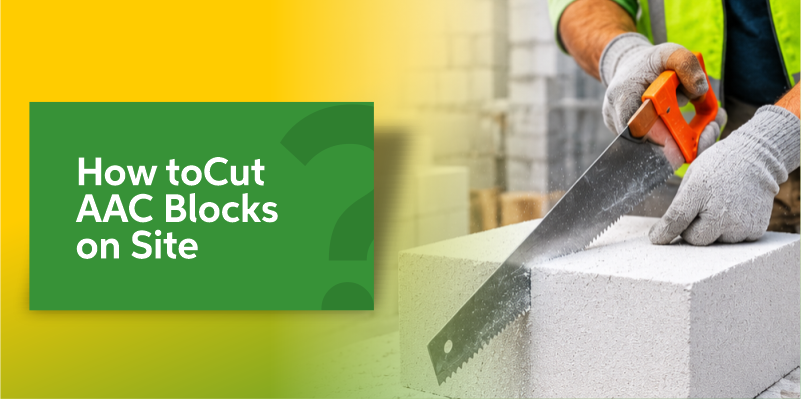
Cut AAC blocks with a saw made for AAC, not with a hammer and chisel. For a few cuts, mark the block, support it firmly and cut along the line with an AAC hand saw and an angle guide. For many repeated cuts, use an electric saw with a compatible blade, a band saw or a dedicated block-cutting machine, following the maker’s instructions. Wear a dust mask and eye protection with either method.
Even a well-planned AAC wall needs some blocks cut. A wall length may not match a whole number of blocks, a corner needs a closer, and a window opening needs a block trimmed to fit. How you cut those blocks decides how accurate the cut is, how clean the edges are and how much material ends up as waste.
AAC is soft enough to cut with simple tools, but it still needs the right tools and some care. This guide covers both ways of doing it on site, by hand and with machines, and helps you choose between them. If you are looking at cutting as part of the larger job, our guide on how to build walls using AAC blocks shows where it fits during masonry.
Key takeaways
- Use tools made for AAC. Breaking blocks with a hammer is not a substitute for cutting.
- Measure and mark every cut, and support the block so it cannot move.
- A hand saw suits occasional cuts. Power tools suit repetitive or larger-volume cutting.
- Neither method is always better, and neither guarantees zero wastage or perfect accuracy.
- Cutting makes dust that can contain crystalline silica, so dust masks and eye protection are essential.
- A cut block must keep its size and edges in good condition so it can be laid properly.
What tools are used to cut AAC blocks on site?
Cutting AAC needs a small set of tools, and each does a specific job. AAC is a light, aerated material, and our guide on what AAC blocks are explains why it is so easy to cut compared with brick.
|
Tool |
Typical purpose |
|
AAC hand saw |
Manual cutting of blocks |
|
Angle guide |
Keeping cuts straight and square |
|
Manual block cutter |
Repeated or controlled cutting |
|
Electric hand saw with a suitable blade |
Faster, powered cutting |
|
Band saw or dedicated block-cutting machine |
Repetitive and larger-volume cutting |
|
Measuring tape, marker and square |
Accurate measuring and marking |
The blade and the machine must be compatible with AAC and with the manufacturer’s tool instructions. A saw designed for wood or for dense masonry is not a safe assumption.
Two jobs are often confused. Cutting a block means sawing a full block to a shorter length or smaller size so it fits a gap in the wall. Chasing means cutting a narrow groove in a finished wall for pipes or conduits. They use different tools and techniques, and this guide is about the first. Chasing should be done with a chasing tool made for the purpose, and never with a hammer and chisel.
How do you cut AAC blocks manually using a hand saw?
A hand saw is the simplest way to cut AAC Block on site. It needs no electricity, it is easy to carry, and it works well for occasional cuts and small adjustments.
Step 1. Measure and mark the AAC block
Measure the length or width you need and mark the cutting line with a pencil or marker. Use a square or angle guide to carry the line across the faces of the block, and check the measurement again before you cut.
Block sizes vary by product and thickness, so know what you are starting with. The AAC block size chart shows the standard dimensions, which makes it easier to plan cuts that use the block well.
Step 2. Position the block securely
Place the block on a stable, level surface and support it so that it does not move while you cut. Make sure the cutting line is accessible. Avoid leaving a long unsupported overhang, because the offcut can break away early and chip the edge.
Step 3. Cut along the marked line
Use a hand saw suited to AAC, such as a saw with tipped teeth. Start with short, controlled strokes along the line, and keep the saw aligned throughout the cut. Let the saw do the work, and do not force the blade or press hard.
Step 4. Check the cut surface
Separate the offcut carefully and check that the cut is straight and square. Brush off loose particles. Keep any offcut that is still a usable size, if the masonry specification allows it.
Lay cut blocks like any other, with the joint mortar spread evenly on the cut face. Our guide on how to use block jointing mortar explains how to place them in the wall.
Slow, controlled cutting gives better results than fast cutting. A hand saw is not meant for high volumes, but for small quantities and occasional site adjustments, it is hard to beat.
How do you cut AAC blocks mechanically?
Mechanical cutting is an alternative when you have many cuts to make or need to cut several blocks to the same size. The choice of tool depends on the block dimensions, the volume of cutting, the equipment available and the manufacturer’s recommendations.
Which mechanical tools can be used for AAC block cutting?
Three types are common:
- Electric hand saw with a compatible blade, for quick cuts on or near the wall.
- A dedicated mechanical AAC block cutter for controlled, repeated cutting.
- A band saw or table-mounted cutting machine for larger volumes.
What is the correct process for mechanical AAC block cutting?
- Measure and mark the required dimensions.
- Place the block securely on the machine’s cutting support.
- Check the blade, the guard and the power connection.
- Align the cutting line with the blade.
- Operate the machine according to its instructions.
- Let the blade complete the cut without forcing the block through.
- Inspect the finished cut and collect the offcut safely.
Machines designed for AAC can make it easier to cut several blocks to similar dimensions, because the setup stays fixed from one cut to the next. Power tools also add their own hazards, so follow the operating instructions, keep guards in place and wear ear protection where the tool is loud.
What is the difference between manual and mechanical AAC block cutting?
|
Factor |
Manual cutting |
Mechanical cutting |
|
Equipment |
Hand saw and angle guide |
Electric saw, band saw or block cutter |
|
Best suited for |
Occasional cuts, small quantities |
Repetitive cuts, larger quantities |
|
Cutting speed |
Generally slower |
Generally faster |
|
Power requirement |
No electricity needed |
Depends on the machine |
|
Cutting consistency |
Depends on worker skill and alignment |
Depends on machine setup and operator |
|
Portability |
Easy to carry |
Varies by equipment |
|
Initial equipment cost |
Generally lower |
Generally higher |
Neither method is better in every case. The right choice depends on how many cuts you need, what equipment is on site, how accurate the cuts must be, and the site conditions. Many sites use both: a machine for repeated cuts and a hand saw for the odd adjustment.
Whichever you use, cutting produces dust, and handling and cutting are among the points to weigh before choosing any material. Our overview of AAC block disadvantages gives a balanced view.
How can you avoid mistakes while cutting AAC blocks?
Most cutting problems come down to a few habits:
- Cutting without measuring or marking properly
- Using a blunt or unsuitable blade
- Holding the block insecurely
- Applying too much force during manual cutting
- Forcing a mechanical saw through the block
- Ignoring the required block dimensions
- Breaking blocks with a hammer instead of using a suitable saw
- Throwing away offcuts that could be reused
Rough or damaged edges affect how well a cut block fits and the quality of the masonry joint. A chipped edge leaves a gap that the mortar has to fill, and a thick patch of mortar is a weak patch. Clean cuts keep joints thin and even.
Cutting damage is only one way AAC walls get cracks, but it is an easy one to prevent. Our guide on how to avoid cracks in AAC block walls covers the rest.
A little discipline on site helps, too. Keep the cutting area clean, store cut blocks off the ground, and check each one for chips before it goes into the wall.
Also brief the masons on which cuts are planned, such as closers and window returns, so that no block is cut by guesswork.
Careful planning also reduces how much you need to cut. If you work out the wall layout and block quantities before ordering, you can often arrange courses so that fewer blocks need cutting at all. Our guide on how to calculate AAC block quantity for a construction project shows how to account for cutting in the quantity.
The bottom line
Cutting AAC well is mostly about preparation and the right tool: measure and mark clearly, support the block, use a saw designed for AAC, and let the tool cut without forcing it. Use a hand saw for occasional cuts and a machine for many, and wear a dust mask and eye protection with both. Clean, square cuts and reused offcuts keep the wall neat and the wastage low.
Keep one thing in mind throughout: a cut is only as good as the measurement behind it. Re-measure on the wall, not from the drawing alone, because real openings can differ slightly.
Bigbloc’s NXTBLOC AAC blocks come in standard sizes so most of a wall can be laid with whole blocks, keeping cutting to the corners and openings.
Ask your supplier for blocks in the thicknesses your walls need, so that you are not trimming thickness on site.
And agree early who is responsible for cutting and for clearing the dust.
If you would like advice on planning a wall layout to reduce cutting on your site, talk to the Bigbloc team.
Recent Post:
Frequently Asked Questions
Yes, when the piece is large enough, its edges are sound and the masonry specification allows it. Offcuts are often used as closers at the end of a course. Follow the bonding rules in the project drawings or the manufacturer’s guidance.
Usually because the blade is blunt, the saw is forced, the block is not supported, or the cut is made too close to an edge. Controlled strokes and a sharp, suitable blade reduce crumbling.
Cutting does not change the material itself, but a smaller piece with damaged edges is not as good as a whole block. The cut piece should still have undamaged edges and be laid and bonded as the specification requires.
They are not recommended. Wood blades are not designed for mineral materials like AAC, so they blunt quickly and cut poorly. Use a saw or blade designed for AAC, and follow the tool manufacturer’s instructions.
Cut in an open, well-ventilated place, away from other workers, and use a saw with dust extraction where possible. Wear a suitable dust mask and eye protection, clean up with a vacuum or damp methods instead of dry sweeping, and keep dust from settling on freshly laid work.