
How to Stop Water Seepage in Brick Walls: A Complete Guide
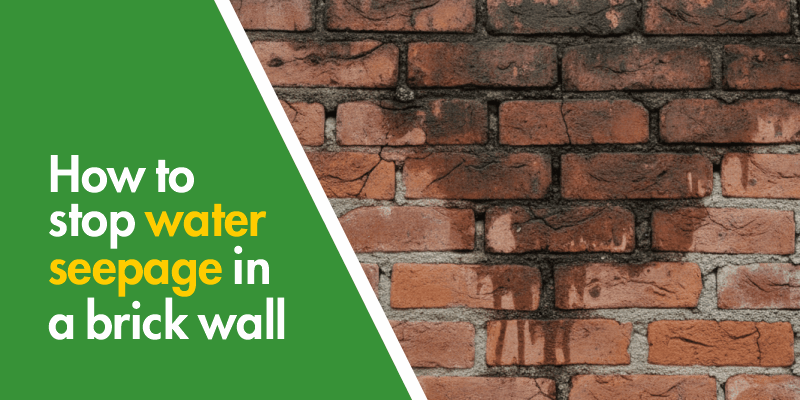
Every monsoon, thousands of Indian homeowners spend again on repainting the same damp wall, only to watch the stains return within months.
The dark patches return. The paint bubbles again. The white salt marks spread further. And the musty smell never really leaves.
Most people think waterproofing paint is the solution. It is not.
Water seepage is rarely a paint problem. It is a wall system problem. If the actual source of water is not identified, no coating, no paint, and no quick repair will last. Water seepage is not a surface issue. It is often the first warning sign of deeper structural and material failure.
Fixing seepage permanently means understanding where the water is entering, why it is entering, and treating that exact cause.
This guide covers all three real Causes of Dampness and Water Leakage in Buildings, practical repair methods for existing brick walls, and why modern AAC block systems are becoming the long-term solution for seepage-resistant construction across India.
What Is Actually Causing the Seepage in Your Wall?
Before you buy a single product, you need to know which type of seepage you are dealing with. There are three. They look similar. The fixes are completely different.
The External Attack: Rainwater Through Porous Brick or Cracked Plaster
This is the most common problem during monsoon.
Red clay bricks are naturally porous. As per IS 1077 standards, common burnt clay bricks can absorb up to 20 percent of their dry weight in water. In prolonged rainfall conditions, this makes them highly vulnerable to seepage, plaster failure, and repeated repainting costs.
Water enters through micro-cracks in plaster, damaged mortar joints, weak external plaster coating, and directly through exposed brick surfaces.
This usually appears as damp patches on interior walls during or immediately after rain. Once the rain stops, the wall may dry temporarily, but the problem returns every season.
The Internal Leak: Plumbing Failure Inside the Wall
Not all damp patches come from rain. A hairline crack in a supply pipe, a slow leak at a bathroom fitting, or a waterproofing failure in the wet area directly above can all create moisture inside the wall. This moisture spreads into the brick over time.
The key difference from external seepage: internal leaks create damp patches even in dry weather. If your wall stays wet whether it rains or not, check the plumbing before treating the wall surface. Waterproofing an externally dry surface with a plumbing leak behind it will not work.
Rising Damp: Groundwater Climbing Up Through Capillary Action
This is the most ignored and most misdiagnosed problem. Brick and mortar are porous materials. When they stay in contact with the ground, groundwater travels upward through capillary action, just like a sponge pulling water upward.
This is called rising damp.
Signs include dampness near skirting level, white powder deposits called efflorescence, crumbling plaster at the bottom, and visible tide marks on walls.
Rising damp usually stays within the first 1 metre of wall height. This problem cannot be solved with paint. It requires Damp Proof Course treatment.
How Do You Stop Water Seepage in Brick Walls?
Once you know which type you are dealing with, apply the solution that matches it. Using the wrong method is the reason most repairs do not last.
Crack Injection: Small cracks are primary entry points. Clean them with a wire brush and fill with a high-grade polymer sealant. Why wall cracks appear and how to fix them is a critical topic to understand here, as structural cracks require different fillers than superficial ones.
Fill with a high-grade polymer sealant or a polyurethane-based crack-injection compound, which expands slightly as it cures to form a waterproof seal. For hairline cracks in plaster, use a cement-based waterproof filler. For wider mortar joint failures, rake out the old mortar to a depth of 15 to 20mm and repoint with fresh polymer-modified mortar. Do not use plain cement. It shrinks as it dries and cracks again.
Exterior Waterproof Coating: After cracks are sealed, the entire external face of the wall needs protection. Elastomeric or acrylic-based exterior waterproof coatings form a flexible membrane on the wall surface. Unlike standard exterior paint, these coatings stretch slightly when the wall expands and contracts with temperature, so they do not crack. They are permeable to water vapour, which means moisture already inside the wall can escape, but liquid water cannot enter from outside. Apply in two coats on a clean, dry surface. Do not apply during rain or in direct sun.
Siliconization: For brick walls where the brick face itself is absorbing water, a clear silicone-based water repellent can be applied directly to the brick and mortar surface. It penetrates the pores and makes the surface hydrophobic, meaning water beads off instead of being absorbed. It does not change the appearance of the wall. It is breathable. It is most effective on walls where the brick is sound but porous, and should be reapplied every 5 to 8 years depending on weather exposure.
Damp Proof Course (DPC) Repair: For rising damp, surface treatments do not work because the water is coming from below. The correct fix is chemical DPC injection. A series of holes are drilled at skirting level, 150mm above the ground, at regular intervals along the base of the wall. A silane or silicone-based waterproofing chemical is injected under pressure into the holes. It spreads through the mortar bed and creates a horizontal moisture barrier. The holes are sealed after injection. This stops capillary rise at its source. After DPC treatment, damaged plaster at the base of the wall must be removed and replaced with a sand and cement mix that contains a waterproofing additive, as the old plaster will be contaminated with salts from the rising damp.
How Do You Stop Seepage Specifically from Outside Walls?
Outside walls face a different challenge than internal walls. They take direct rain, temperature swings, and UV exposure every single day. A solution that lasts on an interior surface will not necessarily hold on an exterior one.
The sequence matters. Do not apply any coating to a wet wall. Wait until the wall is fully dry after rain. Clean the surface to remove dust, algae, and any efflorescence with a stiff brush and clean water. Let it dry completely. Then seal all visible cracks using polymer sealant or fresh mortar. Only after the surface is crack-free and dry should the waterproof coating go on.
Check window frames and parapet joints separately. These are common points where water enters behind the plaster and travels down inside the wall before appearing on an interior surface that looks completely unrelated to the actual leak. Seal all window frame edges with a good quality exterior sealant. Check that the parapet or terrace slab above has functional waterproofing and that drainage is working.
Once the wall is treated and cracks are sealed, the replastering coat determines how long the repair holds. A polymer-modified ready mix plaster bonds better to AAC and brick surfaces than site-mixed cement plaster, and its water-retention additives reduce the surface micro-cracking that gives water its entry points. That is why polymer-modified ready-mix plaster is now the preferred specification for exterior wall finishing on Indian construction sites.
If you are replastering an external wall after seepage repair, the application method matters as much as the material. The detailed steps are in how to apply ready mix plaster, which covers surface preparation, mixing ratio, thickness, and curing for both AAC and brick substrates.
Why Is AAC Naturally More Resistant to Seepage Than Red Brick?
If you are building new or are tired of recurring repairs, your material choice is the most powerful long-term solution. When comparing AAC blocks and red bricks, AAC offers stronger protection against moisture and seepage for several practical reasons.
Everything above focuses on fixing seepage in an existing brick wall. But if you are starting fresh, or if you are exhausted from repairing the same damp patches every two years, the right wall material can decide whether seepage becomes a permanent headache or a problem you never face again.
Discontinuous Pores: Why AAC Does Not Behave Like a Sponge
The cellular structure of AAC is made up of millions of tiny, closed, non-interconnected air pockets. Unlike red brick, which has open, continuous pores that form pathways for water to travel through the material, AAC’s air cells are sealed. Water cannot travel from one cell to the next through the block.
This is why AAC has low capillary action. Red clay bricks, as per IS 1077, can absorb up to 20% of their weight in water. AAC blocks, as per IS 2185 Part 3, have a maximum water absorption of 10% by mass. In practice, well-manufactured AAC blocks absorb 5 to 10%. The closed-cell structure that limits capillary rise is the same reason rising damp is far less common in AAC walls than in red brick construction.
Fewer Joints: Removing the Primary Entry Points for Water
In a standard brick wall, every mortar joint is a potential entry point for water. A red brick is approximately 230mm x 115mm x 75mm in face area. An AAC block is typically 600mm x 200mm. That means one AAC block replaces approximately 8 to 12 red bricks, with 8 to 12 times fewer mortar joints per square metre of wall.
Mortar joints are where water most commonly penetrates a wall, whether from poor original workmanship, mortar shrinkage, or weathering over time. Fewer joints means fewer entry points. When AAC wall panels are used instead of individual blocks, the joint count drops even further, by up to 80%.
Thin-Bed Mortar: How the Joint Itself Becomes a Water Barrier
The mortar joint in an AAC block wall is not just smaller, it is a fundamentally different type of joint. Conventional cement sand mortar at 12 to 18mm is porous, prone to shrinkage cracks, and does not bond well with AAC’s smooth surface. Block jointing mortar, applied at 2 to 3mm, contains polymer additives that bond chemically with AAC’s surface and fill every micro-pore at the contact face. The result is a joint that is effectively monolithic with the block on both sides.
Understanding what block jointing mortar is and how it differs from conventional mortar explains why an AAC wall with the right jointing system has significantly fewer moisture entry points than any brick wall, regardless of how well the brickwork was laid.
How Do Red Bricks and AAC Blocks Compare on Seepage Resistance?
|
Feature |
Red Clay Bricks |
BigBloc AAC Blocks |
|
Water Absorption (IS standard) |
Up to 20% by mass (IS 1077) |
Max 10% by mass (IS 2185 Part 3) |
|
Pore Structure |
Open, continuous pores. High capillary action. |
Closed-cell, non-interconnected. Low capillary action. |
|
Rising Damp Risk |
High. Open pores allow groundwater to climb. |
Low. Closed-cell structure limits capillary rise. |
|
Mortar Joints per sq. metre |
High. 8 to 12 bricks per sq. metre of wall. |
Low. One block replaces 8 to 12 bricks. Up to 80% fewer joints with panels. |
|
Mortar Type |
Thick-bed cement mortar (12 to 18mm). Prone to shrinkage cracks. |
Thin-bed polymer mortar (2 to 3mm). Bonds chemically with block surface. |
|
External Plaster Required? |
Yes. Mandatory to protect porous brick surface. |
Yes for external walls. Smoother surface requires less plaster thickness. |
|
Seepage Risk Without Plaster |
Very high. Open pores absorb rain directly. |
Moderate. Closed cells reduce absorption but external protection still required. |
Do Not Just Fix It. Upgrade It.
Seepage in a brick wall is fixable. Crack injection, exterior waterproof coating, siliconization, and DPC repair all work when applied correctly to the right type of problem. Most homeowners who spend money every two years on repairs are either treating the wrong cause or treating only the surface while the actual entry point remains open.
But there is a longer answer here. Red clay bricks absorb up to 20% of their weight in water. They have open, continuous pores that carry water through the wall by capillary action. Every mortar joint is an entry point. You can manage this with regular maintenance, but you cannot change the material’s fundamental behaviour.
AAC blocks absorb a maximum of 10% by mass, have a closed-cell structure that resists capillary action, and when laid with polymer-modified thin-bed mortar, produce a wall with far fewer joints and a far better moisture barrier than any brick wall of the same thickness.
If you are patching an existing wall, this guide gives you what you need. If you are building new, the material you choose now is the seepage problem you either have or do not have for the next 30 years.
For product recommendations on AAC blocks and ready mix plaster suited to your project in Surat, Gujarat, or anywhere across India, connect with BigBloc Construction.
Frequently Asked Questions
The simplest test is timing. If the damp patch appears only during or after rain and then dries out completely in dry weather, the source is external. If the wall stays damp regardless of weather, or if the dampness appears in a location directly below or beside a bathroom, kitchen, or pipe chase, the source is almost certainly plumbing. A moisture meter can confirm this without opening the wall. Before treating any seepage, trace whether it is weather-dependent or not. Treating an external surface while a pipe leaks behind it is money wasted.
Yes, for two specific reasons. First, ready mix plaster is factory-proportioned with consistent cement-to-sand ratios and polymer additives that improve water retention and bonding. Site-mixed plaster varies batch to batch depending on who is mixing and the moisture content of the sand on that day. Inconsistent mixing produces weak spots in the plaster coat where micro-cracks form and water enters. Second, ready mix plaster’s polymer content reduces shrinkage cracking as the coat dries, which is the primary way a new plaster coat develops entry points for water in its first monsoon season. For external walls in high-rainfall areas across India, ready mix plaster with a waterproof additive is the correct specification.
Yes, significantly. Rising damp travels upward through continuous pores in brick and mortar by capillary action. The smaller and more interconnected the pores, the higher and faster water rises. Red clay bricks have open, interconnected pores with high capillary action. AAC blocks have a closed-cell structure with non-interconnected air pockets that limits capillary rise. Research on building materials confirms that brick is among the most vulnerable materials to capillary water absorption. However, AAC blocks should not be left in direct contact with soil or used in below-grade applications without proper DPC and waterproofing treatment. Even with better inherent resistance, no walling material should rely on the block alone for moisture protection in areas with high water tables or poor drainage.