
Why Builders in India Prefer AAC Blocks Over Red Bricks: Cost, Strength and Performance Guide
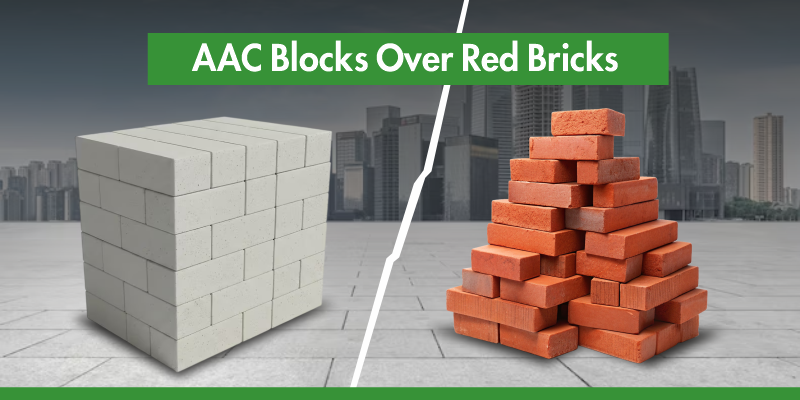
Red bricks have been the default walling material in India for over a century. They are familiar. Every mason knows how to lay them. They are available in almost every town and city.
But familiarity is not the same as being the best option. And over the last five years, builders across India have started running the numbers properly. Not just the cost per brick, but the cost per completed wall. Not just the material price, but what that material does to the steel requirement, the labour time, the plaster consumption, and the project timeline.
When you look at it that way, the gap between red bricks and AAC blocks becomes very clear. This guide covers exactly why builders are making that switch, with verified data from 2025 and 2026.
The Shift From Material Cost to System Cost
For years, the conversation about building materials started and ended with the per-unit price. A red brick costs Rs. 4 to Rs. 12 per piece. An AAC block costs Rs. 45 to Rs. 110 per piece, depending on size. On that comparison alone, bricks look cheaper.
But that comparison is incomplete. It is the cost of one unit. It is not the cost of building a wall.
When you calculate system cost, which includes the material, the mortar, the plaster, the labour, the time, and the structural impact on steel and foundations, the picture changes. One AAC block covers the area of 8 to 12 red bricks. That means fewer units to procure, transport, handle, and lay. Less mortar because the joint is 2 to 3mm instead of 12 to 15mm. Less plaster because the surface is dimensionally accurate. And a lighter wall that reduces dead load on the structure, which directly reduces how much steel and concrete the foundation needs.
The shift happening in Indian construction in 2025 and 2026 is not about builders suddenly preferring a more expensive product. It is about builders finally doing the full calculation.
There is a second driver. Labour. Skilled brick masons are harder to find and more expensive than they were five years ago. India faces a growing shortage of construction labour, and the trades that require the most skill and the most man-hours per square metre are the ones that most affect project budgets. AAC blocks need less skilled labour per wall because the blocks are larger, more precise, and faster to lay. A mason laying AAC blocks covers 20 to 25 square metres per day, compared to 12 to 15 square metres with brick.. On a 50,000 square foot residential project, that difference is significant.
5 Reasons Builders Are Switching to AAC Blocks
1. Dead Load Reduction Saves Money Before the First Wall Goes Up
Red clay bricks weigh 1800 to 2000 kg per cubic metre. AAC blocks weigh 550 to 650 kg per cubic metre. That is roughly 65% lighter. In a framed structure, every kilogram of wall load is carried by columns, beams, slabs, and foundations. When you replace brick walls with AAC block walls across an entire building, the cumulative dead load reduction is substantial.
Structural engineers who work with AAC blocks regularly report that this weight reduction allows them to reduce column and beam sizes and reduce the steel specification for foundations. On a mid-size residential project, this can save lakhs of rupees in structural cost before a single wall is laid.
If you are planning your budget, understanding how to calculate construction cost per sq. ft. in India helps visualize these structural savings.
2. Faster Construction Helps Developers Meet RERA Deadlines
RERA introduced delivery deadlines with real financial penalties for delay. For a developer, every week overrun is both a penalty liability and a financing cost that continues accumulating. Construction speed matters more now than it did a decade ago.
AAC blocks are 30 to 40% faster to lay than red bricks. A mason covers 20 to 25 square metres per day with AAC versus 12 to 15 square metres with brick. The thin-bed mortar sets faster than conventional cement mortar. There is no curing wait between courses. And because the blocks are dimensionally accurate, there is less alignment correction and rework.
On a large residential project, this speed difference can compress the walling and plastering schedule by several weeks, which directly reduces financing cost and penalty exposure.
3. Dimensional Accuracy Reduces Plaster Waste
Red bricks vary in size. They come from kilns where temperature control is not always consistent. A slightly oversized or undersized brick means the mason uses more mortar to compensate, and the wall surface is uneven. The plaster coat needed to produce a flat wall on a brick surface is typically 18 to 20mm externally and 12 to 15mm internally.
AAC blocks are factory-manufactured to tight dimensional tolerances. The surface that comes off the production line is consistent. The plaster coat needed to achieve the same flat finish is 8 to 10mm internally and 12 to 15mm externally, as per IS 2185 Part 3. That 10mm difference in plaster thickness across thousands of square metres of wall is a significant cement and sand saving.
A standard AAC block size chart shows they are perfectly rectangular, meaning you only need 8-10mm of internal plaster.
Detailed pricing on block sizes and how that affects your material planning is in How Much Do AAC Blocks Cost in India.
4. Interior Stays 3 to 5 Degrees Cooler
This is one of the most marketable features of AAC blocks for residential developers in India, and it is backed by verified data.
Red clay bricks have a thermal conductivity of 0.60 to 0.90 W/mK. AAC blocks have a thermal conductivity of 0.24 to 0.30 W/mK. This means AAC walls transfer significantly less heat from the outside to the inside. Studies and builder data consistently show that buildings with AAC block walls maintain interior temperatures 3 to 5 degrees Celsius cooler than equivalent brick-walled buildings during Indian summers.
For a homeowner in Gujarat, Rajasthan, or anywhere in North India where summer temperatures regularly cross 42 degrees, a 3 to 5 degree cooler interior means the air conditioning runs less. That translates to 10 to 30% lower electricity bills annually. For a developer marketing a residential project, that is a concrete selling point, not just a specification.
The thermal performance is one part of the picture. AAC blocks also provide 4 hours of fire resistance and significantly better sound insulation than red bricks. The full performance comparison across all parameters is covered in the benefits of AAC blocks.
5. Environmental Compliance Is Becoming Non-Negotiable
Red brick production burns coal and destroys topsoil. India’s National Green Tribunal has issued directives in multiple states restricting or regulating brick kiln operations. UP, MP, and Delhi NCR have already introduced emission caps on kilns. As these restrictions tighten, the supply of red bricks in many regions is becoming less reliable and more expensive.
AAC blocks are manufactured using fly ash, an industrial waste product from thermal power plants. The manufacturing process consumes 30% less energy than brick kilns. AAC block projects can earn points toward IGBC, GRIHA, and LEED green building certifications. For commercial developers and housing projects under government schemes, these certifications are increasingly required, not optional.
BigBloc Construction’s fly ash-based AAC blocks directly support this compliance requirement.
The Real Cost Comparison Between Red Bricks and AAC Blocks in 2026
The table below shows what the cost comparison actually looks like when all factors are counted, not just the per-unit price.
|
Parameter |
Red Clay Bricks |
AAC Blocks |
|
Unit price (2025) |
Rs. 4 to Rs. 7 per piece |
Rs. 45 to Rs. 110 per piece (size dependent) |
|
Units per sq. metre of wall |
Approx. 55 to 65 units at 115mm thickness |
Approx. 8 units at 200mm thickness. One block replaces 8 to 12 bricks |
|
Wall cost per sq. ft. |
Rs. 30 to Rs. 45 approx. |
Rs. 40 to Rs. 60 approx. (higher material, lower labour) |
|
Mortar joint thickness |
12 to 15mm. High mortar consumption. |
2 to 3mm thin-bed mortar. Uses 3x less mortar volume. |
|
Plaster thickness needed |
18 to 20mm external. 12 to 15mm internal. |
12 to 15mm external. 8 to 10mm internal. |
|
Mason’s productivity per day |
12 to 15 sq. metres |
20 to 25 sq. metres |
|
Dead load on the structure |
1800 to 2000 kg per cubic metre |
550 to 650 kg per cubic metre. Up to 65% lighter. |
|
Thermal conductivity |
0.60 to 0.90 W/mK |
0.24 to 0.30 W/mK. Keeps rooms 3 to 5 degrees cooler. |
|
Water absorption |
Up to 20% by mass (IS 1077) |
Max 10% by mass (IS 2185 Part 3) |
|
Green certification support |
None. Kiln firing contributes to emissions. |
Supports IGBC, GRIHA, LEED certification. |
|
Fire resistance |
Moderate. Dense brick handles heat but mortar joints fail early. |
4 hours at 100mm thickness. Non-combustible. |
The table above covers the primary parameters. For a more detailed technical breakdown including compressive strength testing, seismic zone performance, and region-specific recommendations, the AAC block vs red brick comparison covers all of it.
Why Some Contractors Still Recommend Bricks, and What Engineering Actually Says
Ask a traditional mason or an older contractor which is stronger, bricks or AAC blocks, and most will say bricks. That answer comes from decades of experience with one material and limited hands-on work with the other. It is not wrong based on their experience. But it is incomplete based on current engineering data.
Red bricks have a compressive strength of 3.5 to 7 MPa depending on quality. AAC blocks have a compressive strength of 3.5 to 5 N/mm² as per IS 2185 Part 3. On that comparison, high-quality bricks test slightly stronger in compression.
But compressive strength is not the only load that matters in an earthquake zone. Seismic loading is lateral. When a building sways during an earthquake, the inertial forces acting on the walls are proportional to their weight. A heavier wall generates more force. A red brick wall at 1800 to 2000 kg per cubic metre generates significantly more seismic force than an AAC block wall at 550 to 650 kg per cubic metre.
This is why structural engineers working on buildings in IS 1893 seismic zones increasingly specify AAC blocks for infill walling. Not because the block is stronger in compression, but because the lighter wall reduces the seismic force the frame must resist. Reduced seismic force means the RCC frame can be designed more efficiently, which reduces steel consumption.
The trust in bricks comes from familiarity. The engineering case for AAC in modern framed construction in seismically active regions of India is well established and growing stronger as more data comes from completed projects.
The Future of Walling in India Is Already Here
Choosing red bricks in 2026 for a residential or commercial project in India is not a wrong decision. It is a habit decision. Bricks work. They are available. Contractors know them.
But habit has a cost. Higher dead load means more steel and more concrete in the structure. Slower laying means more labour and more time. Thicker mortar means more material waste. Poorer thermal performance means higher electricity bills for the occupant for the life of the building.
AAC blocks do not eliminate all of these costs individually. But they reduce each one. And when you add those reductions across an entire project, the system cost of AAC construction is competitive with or lower than brick construction for most residential and commercial builds in India today.
The builders switching to AAC blocks are not paying more to get a better product. They are paying the same or less when the whole picture is counted, and getting a faster build, a lighter structure, a cooler interior, and a material that meets the environmental standards the market is moving toward.
To get a quote on AAC blocks for your project or to discuss which grade and size suits your building type, connect with BigBloc Construction, a trusted AAC block manufacturer and supplier in Surat, Gujarat, and across India.
Frequently Asked Questions
Per piece, no. A red brick costs Rs. 4 to Rs. 7. An AAC block costs Rs. 45 to Rs. 110 depending on size. But one AAC block replaces 8 to 12 red bricks, the mortar joint is 3 times thinner, the plaster coat is thinner, and the mason lays 20 to 25 square metres per day instead of 12 to 15. When total project cost is calculated, AAC blocks are competitive or lower for most projects in India. The per-unit comparison is not the right metric.
High-quality red bricks test at 3.5 to 7 MPa in compression. AAC blocks test at 3.5 to 5 N/mm² as per IS 2185 Part 3. In compression, a good quality brick is slightly stronger. However, in modern RCC framed construction, walls do not carry vertical structural load. The frame carries the load. The wall is infill. In that context, the strength advantage of brick is irrelevant. What matters for seismic performance is wall weight, and AAC blocks are 65% lighter, which reduces the seismic force on the structure.
AAC blocks are suitable as infill walling in any RCC framed structure, from single storey houses to high-rise towers. For load-bearing wall construction without a frame, they are appropriate for buildings up to 2 storeys when the correct grade is specified as per IS 2185 Part 3. They are not suitable for retaining walls, below-grade construction, or as structural floor slabs. For the vast majority of residential and commercial construction in India, which uses RCC frames, AAC blocks are a fully suitable walling solution.
In a high-rise building, the structural weight is carried by the RCC frame: columns, beams, slabs, and foundations. AAC blocks are used as non-load-bearing infill walls between the structural members. They carry only their own weight. A high-rise building with AAC infill walls actually has a structural advantage over a brick-walled equivalent because the cumulative dead load of lighter AAC walls across 15 to 25 floors reduces the load the frame must carry, which can reduce structural steel consumption. AAC blocks are widely used in high-rise residential and commercial buildings across India.