
Conventional Mortar vs Block Jointing Mortar: A Clear Comparison Guide
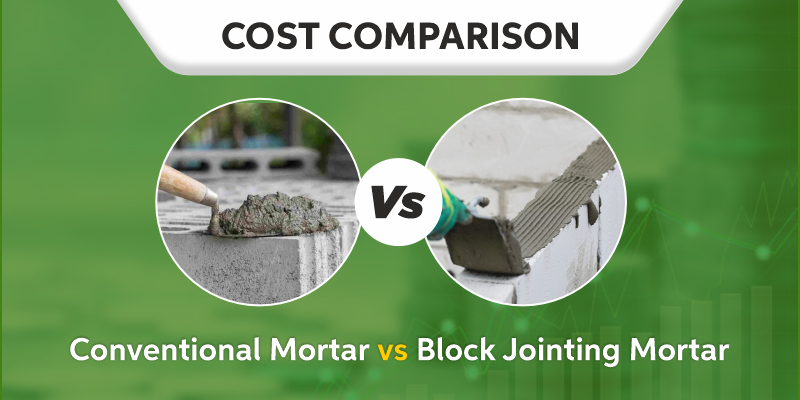
Mortar is often treated as a basic binding material in masonry, but its impact goes far beyond simply holding blocks together. It directly affects material consumption, labour efficiency, construction speed, and even the long-term performance of walls.
For decades, construction relied on conventional cement-sand mortar. It worked well with clay bricks, where thicker joints helped compensate for uneven surfaces. However, as the use of AAC blocks increases, this approach is no longer optimal.
AAC blocks are dimensionally accurate, lightweight, and have a different surface structure compared to traditional bricks. Conventional mortar, which depends on thick application and mechanical bonding, does not interact efficiently with these blocks.
Block jointing mortar, also known as thin-bed mortar, was developed specifically for such materials. It allows thinner joints, more consistent bonding, and improved efficiency. The real question today is not just which mortar works better, but which one delivers better overall cost efficiency.
What Are the Key Differences Between Conventional Mortar and Block Jointing Mortar?
|
Parameter |
Conventional Mortar |
Block Jointing Mortar |
|
Composition |
Cement + Sand (site mixed) |
Factory-made dry mix |
|
Joint Thickness |
10–12 mm (can vary) |
2–3 mm |
|
Application |
Manual, variable |
Controlled and uniform |
|
Material Consumption |
High due to thick joints |
Significantly lower |
|
Bonding |
Mechanical bond |
More uniform, consistent adhesion |
|
Curing |
Requires 7–10 days curing |
Minimal curing required |
|
Wastage |
15–30% depending on site practices |
Typically below 2–5% |
The most important difference is joint thickness. Thicker joints increase material usage and variability, while thinner joints improve precision, reduce shrinkage, and enhance overall efficiency.
How Does the Cost Compare Between Conventional Mortar and Block Jointing Mortar?
A fair comparison should not be based on the price per bag, but on the cost per square foot of completed wall. This includes material consumption, labour effort, and time.
Material Cost
Conventional mortar appears economical at first because cement and sand are widely available. However, the thickness of joints increases overall consumption. In addition, sand introduces variability in both cost and quality, depending on sourcing conditions.
Block jointing mortar has a higher per-bag cost, but because it is applied in thin layers, the total material required is much lower. In most practical scenarios, this results in a reduction in overall material consumption by around 60–75%.
Labour Cost
Labour plays a significant role in the actual cost of masonry.
Conventional mortar requires multiple on-site steps such as sand handling, proportioning, mixing, and application. The quality of the mix depends on the workers’ skill, and inconsistencies often lead to rework.
Block jointing mortar simplifies the process. It is a ready-mix material that requires only water and minimal preparation time. The application is faster and more consistent, reducing dependency on skilled labour and improving productivity.
In addition, the reduced need for curing lowers ongoing labour requirements after wall construction.
Construction Time
Time is a major cost factor, especially in large projects.
With conventional mortar, curing cycles of 7 to 10 days slow down construction and delay subsequent activities. This affects the overall project timeline.
Block jointing mortar requires minimal curing and allows faster progression of masonry work. Combined with easier application and better alignment, this can improve construction speed by approximately 15–20%, depending on site conditions.
Faster construction reduces indirect costs such as supervision, equipment usage, and financing overheads.
You may also read: How to Use Block Jointing Mortar?
How Does Construction Speed Compare Between Conventional Mortar and Block Jointing Mortar?
The impact of block jointing mortar on speed is not limited to the application. It improves the entire workflow on-site.
In conventional construction, time is spent on preparing mortar, managing inconsistencies, and handling curing cycles. These steps create interruptions and reduce efficiency.
With block jointing mortar:
- On-site mixing is eliminated
- Application is faster and more uniform
- Better alignment reduces the need for corrections
As a result, masonry work becomes more predictable and streamlined. Over the course of a project, even small improvements in daily productivity can lead to significant time savings.
What Are the Hidden Costs of Conventional Mortar Nobody Talks About?
The true cost of conventional mortar often becomes visible only during execution.
1. Sand Procurement and Sifting
River sand must be sourced, transported to the site, stored, and sifted before use. On urban sites in Surat, Ahmedabad, and other cities, this logistics chain adds cost and space pressure. Block jointing mortar uses factory-graded sand already in the bag. No procurement. No sifting. No storage pile.
2. Water Curing
Conventional cement mortar needs 7 to 14 days of continuous water curing to reach full strength. During this period, labour must water the wall; the water cost runs daily, and the plastering trade cannot begin. NXTFIX eliminates this. The water-retention polymers in NXTFIX keep the mortar hydrated internally as it sets, with no external curing needed.
3. Site Wastage
Conventional cement-sand mortar results in 20 to 30% material wastage from excess mixing, rebound during application, and spillage. Block jointing mortar produces near-zero wastage. It is pre-measured, applied in a thin controlled layer, and the leftover mixed quantity is minimal.
On a large project with hundreds of square metres of wall, 20 to 30% mortar wastage adds up to a significant material cost that is invisible in the initial estimate.
Also Read: How to Calculate Block Jointing Mortar Consumption for AAC Blocks?
What Are the Advantages of Block Jointing Mortar in Simple Terms?
Block jointing mortar improves both construction efficiency and final wall quality. Its advantages are not limited to one stage of construction but impact the entire process from material handling to finishing.
Thinner joints (2–3 mm vs 12–18 mm)
Because the joints are much thinner, significantly less material is required per square metre of wall. This not only reduces consumption but also improves alignment and reduces uneven surfaces that usually occur with thick mortar layers.
More consistent and reliable bonding
Block jointing mortar contains additives that improve adhesion with AAC blocks. Instead of relying only on a mechanical grip like traditional mortar, it creates a more uniform bond across the surface, reducing the chances of joint failure or cracks over time.
Minimal curing requirement
Unlike conventional mortar, which requires continuous water curing for 7 to 14 days, block jointing mortar retains moisture more effectively. This reduces the need for curing, saving both labor and water while allowing faster progression to the next stage of work.
Significantly lower wastage
Since it is a pre-mixed product applied in controlled thickness, material wastage is minimal. In contrast, site-mixed mortar often leads to losses due to over-preparation, spillage, and handling inefficiencies.
Faster construction progress
The ready-mix nature eliminates on-site mixing, and thin-layer application speeds up block placement. Combined with reduced curing time, this can improve overall construction speed by around 15–20%, depending on site conditions.
No dependency on sand procurement
Conventional mortar requires continuous supply and quality control of sand, which can be inconsistent and costly. Block jointing mortar eliminates this dependency, simplifying logistics and reducing site complexity.
Cleaner and more organised construction sites
With no sand piles, less debris, and minimal spillage, the site remains cleaner. This is especially beneficial in urban projects where space is limited and site management is critical.
Better surface finish and reduced plaster requirement
Due to improved alignment and uniform joints, walls require less correction during plastering. This can reduce plaster thickness and contribute to additional cost savings in finishing.
You may also read: Key Features of High-Performance Block Jointing Mortar
Conclusion
The comparison between conventional mortar and block jointing mortar is not just about initial material cost. It is about total project efficiency.
Conventional mortar may appear cost-effective at the purchase stage, but higher material consumption, labour intensity, curing requirements, and wastage increase the overall cost.
Block jointing mortar provides a more optimised approach. It reduces material usage, improves construction speed, and delivers better consistency in masonry.
When evaluated at the project level, it offers clear advantages in both cost and performance, making it a more suitable choice for modern AAC block construction. Also, visit the Bigbloc Construction Website to know more about Block Jointing Mortar.
Frequently Asked Questions
A 40kg bag of block jointing mortar covers 8 to 10 sq. metres of AAC block wall at 3mm joint thickness, at a consumption rate of approximately 4 to 6 kg per sq. metre. For a 100 sq. ft. wall, 1 to 2 bags are typically enough.
Per bag, block jointing mortar costs more. But the total project cost is lower because it uses 3 times less volume per joint, cuts wastage from 20 to 30% to near zero, and removes 7 to 14 days of curing labour per floor. On any AAC block project, block jointing mortar is more cost-effective overall.
For AAC blocks, yes. Block jointing mortar is specifically designed for AAC and outperforms conventional mortar in every relevant metric: bonding strength, thermal performance, speed, and cost. Conventional mortar remains appropriate for clay brick masonry. Using it with AAC blocks reduces wall quality and adds unnecessary cost and time.
Block jointing mortar in India (2024 to 2025) ranges from Rs. 500 to Rs. 800 per 40kg bag, depending on brand, quality, and location. For bulk project pricing, contact BigBloc Construction directly for a quote on NXTFIX for your project in Gujarat, Surat, or anywhere in India.