
Gypsum Plaster vs Ready Mix Plaster - Which Is Better?
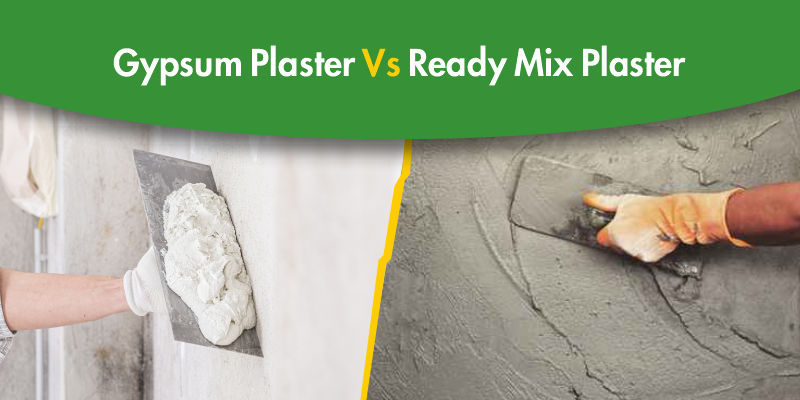
For interior dry walls and ceilings, gypsum plaster is often the better choice because it provides a smooth finish, dries quickly, and does not require water curing. For exterior walls, wet areas, and AAC block construction, polymer-modified ready-mix cement plaster is the preferred option due to its greater moisture resistance and durability. The right choice depends on the wall location, climate, and the type of building, not just the initial cost.
Introduction
Imagine speaking to two different contractors before starting construction on your house.
One recommends gypsum plaster, saying it gives a smoother finish and speeds up interior work. The other insists on ready mix plaster, claiming it is stronger, lasts longer, and performs better in Indian weather. Both recommendations sound reasonable, but neither explains why one plaster is better than the other in a particular situation.
This is exactly why gypsum plaster vs ready mix plaster has become one of the most common questions among homeowners, builders, architects, and contractors in India.
Before comparing the two, one important clarification is necessary. This guide compares gypsum plaster, a calcium sulphate-based plaster, with polymer-modified ready mix cement plaster, which is manufactured using cement, graded sand, polymer additives, and water-retention agents. It is not a comparison with traditional site-mixed cement plaster, which differs significantly in consistency, quality control, and application.
Although both products are factory-manufactured and supplied as ready-to-use materials, they are designed for different purposes. Gypsum plaster is primarily used for smooth interior finishes, while polymer-modified ready mix plaster is engineered to withstand moisture, weather exposure, and demanding site conditions.
If you’re unfamiliar with modern cement-based plasters, it’s useful to first understand what ready-mix plaster is and how it differs from traditional site-mixed plaster before comparing it with gypsum plaster.
By the end of this guide, you’ll know exactly which plaster is better for interior walls, exterior walls, bathrooms, kitchens, AAC block surfaces, humid coastal cities, and different climatic conditions across India. We’ll also compare their composition, drying time, durability, application, maintenance, and overall cost to help you choose the right plaster for your project—not just the most popular one.
What Is Gypsum Plaster? Quick Overview
Gypsum plaster is a factory-manufactured interior finishing material made primarily from calcium sulphate hemihydrate (CaSO₄·½H₂O). When mixed with clean water, it undergoes a chemical reaction that allows it to set quickly, producing a smooth and uniform surface without the need for sand.
It is supplied as a white or off-white powder and is typically applied at a thickness of 8–11 mm for walls and 6–8 mm for ceilings. Under normal site conditions, gypsum plaster begins setting within 25–40 minutes, is generally paint-ready in 3–5 days, and does not require water curing, making it a popular choice for fast-track interior finishing.
In India, gypsum plaster is recommended only for interior walls and ceilings. It should not be used on exterior walls, bathrooms, continuously wet areas, balconies, terraces, or below the damp-proof course (DPC), where prolonged moisture exposure can affect its performance and durability.
Some of the most widely used gypsum plaster brands in India include Saint-Gobain Gyproc, Birla White, JK Cement, and Walplast GypEx, all of which offer products designed for interior plastering applications.
What Is Ready Mix Plaster? Quick Overview
Ready mix plaster is a factory-manufactured cement-based plaster made from cement, graded sand, polymer additives, and water-retention agents, all blended in precise proportions under controlled conditions. Unlike traditional site-mixed cement plaster, it requires only the addition of measured water at the construction site, eliminating the need for manual sand measurement and on-site proportioning.
If you’re comparing modern plaster systems with conventional methods, it’s worth understanding how ready mix plaster is different from traditional site-mixed cement plaster. You can also explore how ready mix plaster compares to site-mixed cement plaster on cost and quality before selecting a plastering system.
It is supplied as a grey powder and is typically applied in a single coat of 6–15 mm for interior walls and 12–20 mm for exterior walls, depending on the substrate and surface condition. It generally begins setting within 30–60 minutes, requires water curing for at least 7 days, and is usually paint-ready after 14–21 days once it has cured completely.
Polymer-modified ready mix plaster is suitable for interior and exterior walls, bathrooms, kitchens, balconies, AAC block masonry, and RCC surfaces. Compared to traditional cement plaster, it offers better bonding, improved crack resistance, more consistent quality, and lower material wastage because every batch is factory-controlled. Products such as NXTPLAST by BigBloc Construction are examples of polymer-modified ready mix plaster developed for modern masonry systems.
Gypsum Plaster vs Ready Mix Plaster — Head-to-Head Comparison
Choosing between gypsum plaster and polymer-modified ready mix cement plaster depends on where the plaster will be used, the type of substrate, exposure to moisture, project timeline, and long-term durability requirements. While both are factory-manufactured products, they are engineered for different applications.
The table below provides a quick comparison of the two across the parameters that matter most to homeowners, builders, architects, and contractors.
|
Parameter |
Gypsum Plaster |
Ready Mix Cement Plaster (Polymer-Modified) |
|
Composition |
Calcium sulphate hemihydrate (CaSO₄·½H₂O) with performance additives |
Cement, graded sand, polymer additives, water-retention agents and performance modifiers |
|
Suitable Surfaces |
Interior walls and ceilings only |
Interior walls, exterior walls, bathrooms, kitchens, balconies, terraces, AAC blocks and RCC surfaces |
|
Thickness per Coat |
8–11 mm (walls), 6–8 mm (ceilings) |
6–15 mm (interior), 12–20 mm (exterior), depending on substrate |
|
Setting Time |
Approximately 25–40 minutes |
Approximately 30–60 minutes |
|
Water Curing Required |
No |
Yes, typically 7 days for optimum strength and durability |
|
Paint-Ready Time |
Generally 3–5 days |
Typically 14–21 days after complete curing |
|
Finish Quality |
Very smooth surface with minimal finishing required |
Smooth and uniform finish; suitable for direct painting after proper curing, though texture depends on application quality |
|
Water & Moisture Resistance |
Suitable only for dry interior environments; not recommended for continuous moisture exposure |
Excellent resistance to moisture and weathering; suitable for wet areas and exterior applications |
|
Approximate Cost (India 2026) |
₹35–₹60 per sq ft* |
₹30–₹55 per sq ft* |
|
Best For |
Apartments, villas, offices, and commercial interiors requiring a premium smooth finish and faster completion |
Residential, commercial, and industrial projects requiring durability, weather resistance, and compatibility with AAC block and RCC construction |
*Indicative installed cost for 2026. Actual costs vary depending on city, project size, labour rates, plaster thickness, brand, and site conditions.
Although both products are supplied as ready-to-use materials, they should not be considered interchangeable. Gypsum plaster is designed primarily for fast, high-quality interior finishing, whereas polymer-modified ready mix cement plaster is intended for applications where durability, moisture resistance, and long-term structural performance are equally important.
The following sections examine each parameter in greater detail to help you choose the right plaster for your project.
While the installed cost of gypsum plaster and polymer-modified ready mix cement plaster may be similar for some projects, comparing them with conventional site-mixed cement plaster provides a more complete picture of overall value. Factors such as material consistency, labour productivity, wastage, curing time, and long-term maintenance all influence the total project cost. For a detailed analysis, explore how ready mix plaster compares to site-mixed cement plaster.
Which Plaster Should You Choose? — Room-by-Room Guide for Indian Homes
There is no single plaster that is ideal for every part of a building. The right choice depends on factors such as moisture exposure, ventilation, substrate type, and the expected service life of the surface. While gypsum plaster performs exceptionally well in dry interior spaces, polymer-modified ready mix cement plaster is better suited for areas exposed to moisture, weather, or higher mechanical stress.
The table below provides practical recommendations for the most common areas in an Indian home.
|
Room / Area |
Recommended Plaster |
Why It Is Recommended |
|
Bedrooms and Living Rooms (Air-Conditioned) |
Gypsum Plaster |
Produces a smooth, paint-ready finish, dries quickly, requires no water curing, and is ideal for dry indoor environments. |
|
Bedrooms and Living Rooms (Humid or Non-AC Homes) |
Ready Mix Cement Plaster |
Better moisture resistance makes it more suitable for homes in coastal and high-humidity regions where walls are exposed to higher moisture levels. |
|
Kitchen Walls (Above Wall Tiles) |
Ready Mix Cement Plaster |
Performs better under continuous exposure to cooking steam, humidity, and occasional water splashes. |
|
Bathrooms and Toilets |
Ready Mix Cement Plaster |
Recommended because of its superior resistance to moisture. Gypsum plaster should not be used in wet areas. |
|
Exterior Walls |
Ready Mix Cement Plaster |
Designed to withstand rain, sunlight, temperature changes, and long-term weather exposure. Gypsum plaster is unsuitable for exterior applications. |
|
Balconies and Terraces |
Ready Mix Cement Plaster |
Provides better durability against direct rain, humidity, and thermal expansion caused by outdoor conditions. |
|
Ceilings in Dry Interior Rooms |
Gypsum Plaster |
Lightweight, smooth, and easy to finish. Its quick setting time also reduces the overall construction schedule. |
|
Staircases, Corridors, and Common Areas |
Ready Mix Cement Plaster |
Offers higher impact resistance and better long-term durability in areas with frequent movement and accidental contact. |
|
AAC Block Walls |
Ready Mix Cement Plaster |
Polymer-modified plaster bonds effectively with AAC block surfaces and forms part of a compatible walling system. |
|
Below Damp Proof Course (DPC) |
Ready Mix Cement Plaster |
Areas below DPC are susceptible to rising damp. Cement-based plaster is more suitable than gypsum under these conditions. |
Every room has different performance requirements. If you’re still unsure which cement-based plaster should be used in different parts of a building, this guide explains which ready mix plaster is right for interior vs exterior walls in greater detail.
Practical Recommendation for Most Indian Homes
For many residential projects, the most effective solution is not choosing one plaster for the entire house but using both materials where they perform best.
- Use gypsum plaster for dry interior rooms where a premium finish and faster project completion are the priorities.
- Use polymer-modified ready mix cement plaster for bathrooms, kitchens, balconies, exterior walls, staircases, AAC block masonry, and all moisture-prone areas where long-term durability is more important.
Selecting plaster according to the function of each space rather than using a single material throughout the building helps improve performance, reduce maintenance, and extend the life of the finished walls.
Can You Use Both Gypsum and Ready Mix Plaster in the Same House?
Yes. In fact, using both gypsum plaster and polymer-modified ready mix cement plaster in the same house is the approach followed in many modern residential and commercial projects across India. Each material is used where it performs best, helping achieve the right balance between finish quality, durability, and cost.
Rather than selecting one plaster for the entire building, experienced builders often specify different plaster systems based on the function and exposure of each area.
A common approach is:
- Ready mix cement plaster for exterior walls, bathrooms, kitchens, balconies, terraces, staircases, and other moisture-prone areas.
- Ready mix cement plaster as the base plaster over AAC block masonry, where its cement-based composition and polymer additives provide strong adhesion and long-term durability.
- Gypsum plaster for interior bedrooms, living rooms, dining rooms, and ceilings where a smooth, paint-ready finish and faster completion are the primary objectives.
This combination allows homeowners to benefit from the strengths of both materials instead of compromising by using a single plaster throughout the building.
Choosing the right plaster is only part of the job. Proper application and curing are equally important because poor workmanship can lead to cracks or debonding. Learn what causes ready mix plaster to fail and how to fix it.
Plan the Plaster System Before Construction Begins
One of the most common planning mistakes is deciding the plaster type after masonry work has already started.
The plaster schedule should ideally be finalised during the design or material planning stage so that contractors, procurement teams, and site engineers know exactly which product will be used in each room.
Changing the plaster system midway through construction can lead to:
- Delays in material procurement
- Additional labour costs
- Changes in construction sequencing
- Budget overruns
- Inconsistent wall finishes across different areas of the building
A well-planned plaster strategy helps avoid these issues and keeps the project on schedule.
Check the BOQ Carefully Before Awarding the Contract
Many homeowners focus only on the total plastering cost without checking what material has actually been quoted.
Contractors sometimes use a single line item such as “Plastering Work” in the Bill of Quantities (BOQ), without specifying whether it includes gypsum plaster, polymer-modified ready mix cement plaster, or conventional site-mixed plaster.
Before approving the quotation, make sure the BOQ clearly mentions:
- The type of plaster to be used in each room or area
- Plaster thickness
- Brand or product specification (where applicable)
- Whether the plaster is suitable for interior, exterior, or wet areas
- Curing and finishing requirements
Clear material specifications help prevent product substitution during construction and make it easier to compare quotations from different contractors on an equal basis.
Choosing the right plaster is important, but planning where each plaster will be used is equally important. A room-by-room approach usually delivers better performance, lower maintenance, and greater long-term value than applying the same material throughout the entire house.
The BigBloc Perspective — Why NXTPLAST Is a Strong Choice for Indian Buildings
NXTPLAST by BigBloc Construction is a polymer-modified ready mix cement plaster developed for modern masonry systems, including AAC block construction. Unlike gypsum plaster, which is intended primarily for dry interior applications, NXTPLAST is suitable for both interior and exterior walls, making it a versatile solution for residential, commercial, and industrial projects.
The product is designed as a single-coat plaster system, eliminating the need for separate base and finish coats in many standard applications. This helps reduce labour requirements, simplify site execution, and shorten the overall plastering timeline.
NXTPLAST is specifically formulated for AAC block surfaces, allowing it to achieve strong adhesion without the need for an additional bonding agent under recommended application conditions. For best results, follow this step-by-step guide to applying ready mix plaster on AAC block walls.
Its polymer-modified, water-resistant formulation also provides reliable performance in India’s diverse climatic conditions, including regions that experience heavy monsoon rainfall and high humidity.
Because NXTPLAST is manufactured under controlled factory conditions, every batch contains accurately proportioned cement, graded sand, and performance additives. This eliminates the inconsistencies associated with on-site mixing and helps deliver more uniform quality, predictable workability, and reduced material wastage across the project.
These manufacturing controls explain what makes ready mix plaster durable in Indian construction conditions.
Conclusion
Choosing between gypsum plaster and polymer-modified ready mix cement plaster is not about finding a universally better material, it is about selecting the right plaster for the right application.
Gypsum plaster is an excellent choice for dry interior walls and ceilings, where a smooth finish, faster completion, and no water curing are the main priorities. Polymer-modified ready mix cement plaster is better suited for exterior walls, bathrooms, kitchens, balconies, humid climates, and AAC block construction, where durability, moisture resistance, and long-term performance are essential.
For most Indian homes, the most practical solution is to use both systems strategically. Gypsum plaster can be used in bedrooms and living spaces, while ready mix cement plaster should be used in moisture-prone and exterior areas. This approach combines the advantages of both materials while improving long-term performance and reducing future maintenance.
Frequently Asked Questions
No. Gypsum plaster is intended only for interior applications. Continuous exposure to rain, humidity, and weather can reduce its durability. For exterior walls, polymer-modified ready mix cement plaster is the recommended choice because it offers better weather resistance and long-term performance.
For AAC block walls, polymer-modified ready mix cement plaster is generally the preferred option. It is designed to bond effectively with AAC block surfaces, offers better moisture resistance, and is suitable for both interior and exterior applications. Gypsum plaster may be used only on dry interior AAC walls where recommended by the project specification.
Gypsum plaster should not be used in bathrooms or areas exposed to continuous moisture. Kitchens may also experience high humidity and cooking steam, making polymer-modified ready mix cement plaster a more reliable choice, particularly around wet zones and service areas.
Gypsum plaster dries considerably faster. It generally sets within 25–40 minutes, requires no water curing, and is usually ready for painting in 3–5 days. Ready mix cement plaster typically requires 7 days of curing and becomes paint-ready after approximately 14–21 days, depending on site conditions.
In coastal cities such as Mumbai, Chennai, Kochi, and Visakhapatnam, where humidity levels remain high for much of the year, polymer-modified ready mix cement plaster is generally the better option for exterior walls, wet areas, and moisture-prone spaces. Gypsum plaster can still be used successfully for dry, well-ventilated interior rooms, but it should not be applied in areas exposed to persistent moisture or water.