
How Much Does Block Jointing Mortar Cost in India?
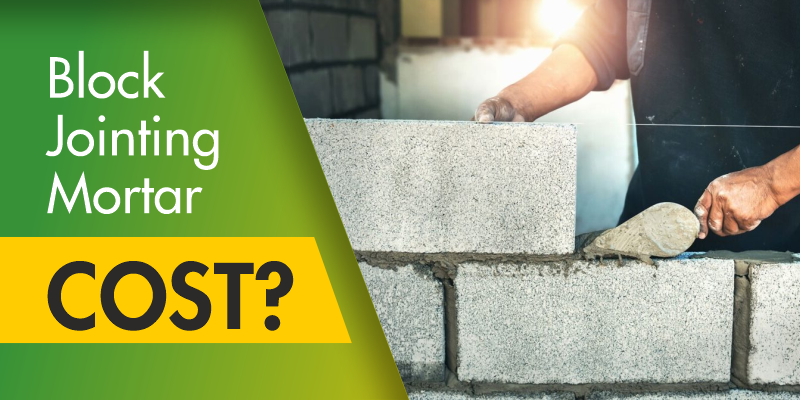
If you’re building a house or commercial project with AAC blocks, you’ve probably already compared block prices, labour charges, steel, cement, and plaster. But there is one material that often gets overlooked during budgeting: the mortar that bonds every block together.
This is why many builders and homeowners ask how much block jointing mortar costs in India before placing their material orders. Although jointing mortar represents a relatively small portion of the overall walling budget, it plays a major role in the strength, alignment, and durability of the finished masonry.
Unlike traditional cement-sand mortar, block jointing mortar is a factory-manufactured, polymer-modified adhesive designed specifically for AAC blocks. It is applied in thin joints of around 2–3 mm, reducing material consumption while helping achieve stronger and more uniform joints. If you’re unfamiliar with the product, it’s worth understanding what block jointing mortar is and why it is used for AAC block walls before comparing prices.
One of the biggest misconceptions is that the cheapest bag always delivers the lowest construction cost. In reality, the cost of jointing mortar depends on much more than the printed bag price. Coverage per bag, joint thickness, block dimensions, application quality, transportation costs, and on-site wastage all influence the actual cost per square foot of wall construction.
For example, a mortar that costs ₹150 more per bag may still reduce your overall walling cost if it provides better coverage, requires thinner joints, and minimises material wastage. On a large residential or commercial project, these differences can translate into significant savings in both material and labour.
In this guide, we’ll break down block jointing mortar cost in India from every practical angle. You’ll learn the average price per bag, cost per square foot, city-wise price variations, estimated mortar cost for a complete house, and the factors that influence pricing in 2026. We’ll also explain when paying more for a branded mortar makes financial sense and when an economy-grade product may be sufficient.
Block Jointing Mortar Cost in India 2026 – Quick Answer
The average block jointing mortar cost in India depends on the brand, bag size, polymer content, and transportation distance from the manufacturing plant. For most residential and commercial projects, 40 kg bags are the most commonly supplied and used, making them the best benchmark for comparing prices across brands.
Block Jointing Mortar Price in India (2026)
|
Bag Size |
Economy / Local Brand |
Standard Branded |
Premium Branded |
|
25 kg |
₹250–₹350 |
₹350–₹450 |
Not commonly available |
|
30 kg |
₹350–₹450 |
₹450–₹600 |
₹550–₹700 |
|
40 kg (Most Common) |
₹350–₹500 |
₹500–₹750 |
₹750–₹1,100 |
|
50 kg |
₹450–₹600 |
₹600–₹800 |
₹750–₹950 |
The 40 kg bag is the most widely used size on Indian construction sites because it offers a practical balance between handling, coverage, and transportation. Throughout this guide, we will use the 40 kg bag as the reference point when calculating block jointing mortar cost per square foot, city-wise prices, and the total mortar requirement for a house.
It is also important to compare more than just the bag price. Two mortars with the same weight can have very different coverage depending on their polymer formulation, recommended joint thickness, and application quality. A slightly more expensive mortar may require fewer bags for the same wall area, making it more economical over the entire project.
Price Disclaimer: All prices are indicative for 2026 and are based on prevailing market ranges. Actual prices vary depending on the city, order quantity, freight charges, supplier, and manufacturer. Always obtain a project-specific quotation before placing an order.
How Much Does Block Jointing Mortar Cost Per Sq Ft?
The cost of block jointing mortar per square foot depends on three key factors: joint thickness, block size, and mortar coverage per bag. A thinner, uniform joint uses less mortar and delivers better bonding, while thicker joints increase material consumption and project cost.
Step 1: How Much Area Does One Bag Cover?
A common misconception is that one bag of jointing mortar always covers the same wall area. In reality, coverage varies depending on how the mortar is applied.
For a 40 kg bag used with 100 mm AAC blocks, the typical coverage is:
|
Joint Thickness |
Approximate Coverage per 40 kg Bag |
Typical Site Condition |
|
2 mm |
55–65 sq ft |
Accurate block laying with experienced masons |
|
3 mm |
40–55 sq ft |
Standard construction practice |
|
5 mm |
25–35 sq ft |
Uneven blockwork or excessive mortar application |
The thinner the mortar joint, the greater the coverage from each bag. This is one reason AAC blocks are designed to be installed with 2–3 mm thin-bed joints rather than the 10–12 mm joints commonly used with conventional cement-sand mortar.
If joints become thicker because of poor workmanship or uneven blocks, mortar consumption can increase by more than 40%, directly increasing the walling cost.
Step 2: What Is the Cost Per Sq Ft?
Using a standard 3 mm joint thickness, the approximate mortar cost works out as follows:
|
Mortar Type |
Typical Bag Price |
Approximate Cost per Sq Ft of Wall |
|
Economy / Local Brand |
₹400 |
₹7–₹10 |
|
Standard Branded |
₹600 |
₹11–₹15 |
|
Premium Branded |
₹900 |
₹16–₹22 |
These figures are based on normal site conditions. Actual costs may vary depending on block dimensions, application quality, wastage, and local market prices.
Why Cost Per Sq Ft Matters More Than Cost Per Bag
Many buyers compare only the price printed on the bag, but that doesn’t tell the full story.
For example, a mortar costing ₹600 per bag may initially seem expensive compared to one priced at ₹400. However, if the higher-quality mortar provides better coverage, stronger bonding, and lower wastage, the difference in total walling cost may be much smaller than expected.
When evaluating mortar, the cost per square foot of completed wall is far more useful than the cost per bag.
A Practical Perspective
Mortar is one of the lowest-cost components of an AAC block wall. In most residential projects, the AAC blocks themselves cost 8–10 times more per square foot than the mortar used to bond them.
Trying to save ₹3–₹5 per sq ft by choosing a lower-quality mortar may seem attractive initially, but poor bonding, excessive shrinkage, or uneven joints can result in rework costing ₹50–₹100 per sq ft or even more once labour, plaster removal, and material replacement are included.
Before ordering materials, it’s also worth understanding how to calculate exactly how much jointing mortar your project needs. Estimating the correct quantity helps avoid both material shortages and unnecessary over-ordering, improving cost control across the entire project.
Coverage Disclaimer: The coverage figures above are indicative for 2026 and assume proper application on level AAC block masonry. Actual coverage depends on block dimensions, surface quality, mason skill, joint thickness, and on-site practices.
Another factor that influences the actual cost is material storage. Even a high-quality jointing mortar can lose its performance if bags are exposed to moisture, stored directly on the ground, or used after their recommended shelf life. Poor storage often results in hardened material, reduced bond strength, and unnecessary wastage, increasing the overall project cost. Contractors should understand how to store block jointing mortar to avoid cost from wastage and expiry before ordering materials in bulk.
How Much Does Block Jointing Mortar Cost by City in India (2026)?
The price of block jointing mortar does not remain the same across India. While the ex-factory price may be similar, the landed cost varies depending on freight charges, distance from the manufacturing plant, local demand, dealer network, and unloading costs.
For this reason, contractors should always compare the delivered cost at site, not just the ex-factory price quoted by a supplier.
Approximate Price of Standard Branded Block Jointing Mortar (40 kg Bag)
|
City / Region |
Approximate Price per 40 kg Bag |
Why the Price Varies |
|
Surat / Ahmedabad / Vadodara |
₹500–₹600 |
Close to manufacturing plants with the lowest freight cost |
|
Mumbai / Pune / Nashik |
₹550–₹650 |
Moderate transportation cost from Gujarat with strong dealer availability |
|
Delhi NCR / Jaipur |
₹600–₹700 |
Higher freight, but competitive pricing due to multiple suppliers |
|
Bengaluru / Chennai / Hyderabad |
₹650–₹800 |
Longer transportation distances and comparatively fewer local manufacturers |
|
Kolkata / Bhubaneswar |
₹700–₹850 |
Highest freight addition because of longer logistics routes and limited regional supply |
Price Disclaimer: These prices are indicative market ranges for 2026. Actual prices depend on order quantity, freight charges, dealer margins, taxes, and local market conditions. Always request a project-specific quotation before placing an order.
Why Does the Price Change from City to City?
Several factors influence the final price of block jointing mortar delivered to a construction site:
- Distance from the manufacturing plant
- Freight and fuel costs
- Order quantity
- Local dealer margins
- Regional competition
- Availability of nearby manufacturers
- Loading and unloading charges
For bulk residential and commercial projects, freight alone can significantly influence the landed cost, particularly in cities located far from manufacturing hubs.
Always Compare the Landed Cost
One of the most common mistakes builders make is comparing only the ex-factory price.
A mortar quoted at ₹540 per bag from one supplier may actually cost more than a ₹580 bag from another supplier once transportation, unloading, and handling charges are added.
When requesting quotations, always ask for the landed cost, which includes:
- Product price
- Freight
- Delivery to site
- Unloading charges (if applicable)
- Applicable taxes
This provides a much more accurate comparison of the actual project cost.
Gujarat Buyers Often Benefit from Lower Freight Costs
NXTFIX block jointing mortar is manufactured by BigBloc Construction in Gujarat. As a result, projects located in Gujarat and neighbouring Maharashtra generally benefit from lower transportation costs and faster deliveries compared to regions farther away.
For projects in cities such as Ahmedabad, Surat, Vadodara, Rajkot, Mumbai, Pune, and Nashik, lower freight costs can improve the overall economics of AAC wall construction, particularly for large residential, commercial, and industrial developments where material volumes are substantial.
How Much Does Block Jointing Mortar Cost for a Full House in India?
For most homeowners, the real question is not “How much does one bag cost?” but “How much should I budget for the entire house?”
The answer depends on the total wall area, block thickness, joint thickness, mortar coverage, and application quality. Although block jointing mortar represents a relatively small portion of the construction budget, it is essential for creating strong, durable, and well-aligned masonry walls.
Step 1: Estimate the Total Wall Area
Mortar is applied to wall joints, not the floor area of the house. As a result, a home’s wall area is significantly larger than its built-up area.
The following figures provide a practical estimate for standard residential construction.
|
House Size (Built-up Area) |
Approximate Wall Area* |
|
1,000 sq ft |
1,800–2,200 sq ft |
|
1,500 sq ft |
2,700–3,200 sq ft |
|
2,000 sq ft |
3,500–4,200 sq ft |
*Approximate wall area includes both sides of internal and external walls. Actual values vary depending on the floor plan, ceiling height, wall thickness, and number of rooms.
Step 2: Estimate the Total Mortar Cost
Assuming a standard branded block jointing mortar costing approximately ₹12 per sq ft of wall area, the estimated material cost is:
|
House Size |
Estimated Mortar Cost |
|
1,000 sq ft house |
₹22,000–₹26,000 |
|
1,500 sq ft house |
₹32,000–₹38,000 |
|
2,000 sq ft house |
₹42,000–₹50,000 |
These estimates assume standard AAC block construction using recommended 2–3 mm mortar joints under normal site conditions. Actual costs may vary depending on the mortar brand, coverage per bag, local labour practices, and material wastage.
Step 3: Put the Cost into Perspective
Many homeowners are surprised to learn that block jointing mortar is one of the smallest material costs in wall construction.
Typically:
- Mortar accounts for only 4–6% of the total wall construction cost.
- The remaining cost comes from AAC blocks, labour, reinforcement (where applicable), lintels, and finishing materials.
- For a standard 2,000 sq ft house, the total walling package (AAC blocks, jointing mortar, and masonry labour) generally falls in the range of ₹8 lakh to ₹12 lakh, depending on the project specifications and location.
Although mortar represents a relatively small share of the budget, it performs a critical function by bonding every block together. Poor-quality mortar or incorrect application can lead to weak joints, uneven walls, plaster cracks, and expensive repairs that far outweigh the initial savings on material.
Practical Budgeting Tip
Always add approximately 10% extra to your estimated mortar requirement to account for site wastage, cutting losses, application variations, and minor coverage differences.
Ordering slightly more material at the beginning of the project is generally more economical than arranging multiple small deliveries later, which often increase transportation costs and may delay construction.
Before finalising your material budget, it’s also useful to understand how construction cost is calculated per square foot in India, as mortar is only one component of the overall construction cost and should be evaluated alongside masonry, labour, structural work, and finishing materials.
Cost Disclaimer: The figures above are indicative estimates for 2026 based on standard residential AAC block construction. Actual material quantities and project costs vary depending on building design, wall thickness, mortar consumption, workmanship, and local market prices.
Is the Extra Cost of Branded Jointing Mortar Worth It?
In many projects, branded block jointing mortar costs more than locally manufactured alternatives. The important question, however, is not “Which mortar is cheaper?” but “Which mortar delivers better value over the entire project?”
The answer depends on the size of the project, the quality requirements, and the level of site supervision. While a branded mortar is not necessary for every application, it often provides greater consistency and reduces execution risks on larger or technically demanding projects.
When Branded Jointing Mortar Is Worth the Extra Cost
Investing in a branded block jointing mortar is generally recommended when:
- The project is larger than 1,500 sq ft. Large projects consume hundreds of bags of mortar. Consistent quality and predictable coverage become more important as project size increases.
- You are constructing a high-rise, commercial, or institutional building. Repairing weak joints or masonry defects after completion is expensive and disruptive, making quality assurance a priority.
- The project requires material compliance. Government, RERA-regulated, institutional, and many commercial developments often require documented product specifications and quality reports.
- Site supervision is limited. Branded mortars usually come with clear application guidelines, recommended mixing ratios, and technical support, helping reduce application errors and material wastage.
- Long-term durability is important. Better quality control during manufacturing can improve bonding performance and reduce the likelihood of joint failures caused by inconsistent material quality.
When an Economy or Local Mortar May Be Acceptable
A lower-cost mortar can be a practical choice in certain situations, provided the product quality is verified.
Economy or local mortar may be suitable for:
- Small projects below 500 sq ft
- Internal non-load-bearing partition walls
- Temporary or short-life structures
- Remote locations where transporting branded products significantly increases the overall project cost
Even in these cases, buyers should not assume that all locally manufactured mortars perform the same. Product quality varies considerably between manufacturers.
Compare Performance, Not Just Price
The difference between two mortars may be only ₹100–₹200 per bag, but the actual project impact depends on much more than the purchase price.
Many buyers also compare block jointing mortar with traditional cement-sand mortar, assuming the lower material cost automatically makes it the better option. In reality, factors such as joint thickness, labour productivity, material wastage, bond strength, and long-term durability often have a greater impact on the overall walling cost. For a deeper understanding, read a detailed comparison of block jointing mortar and cement mortar costs.
Before making a decision, compare:
- Coverage per bag
- Bond strength
- Recommended joint thickness
- Compressive strength
- Shelf life
- Manufacturer’s technical support
- Availability of test reports and quality documentation
A mortar with a slightly higher purchase price may reduce overall project costs if it delivers better coverage, minimises wastage, and lowers the risk of repairs or rework.
Always Ask for Technical Documentation
Whether you choose a branded or local product, always request:
- Technical Data Sheet (TDS)
- Product Test Report
- Batch identification details
- Manufacturing date and shelf life
- Recommended application method
These documents help verify that the mortar is suitable for your project and has been manufactured under consistent quality standards.
If you’re unsure what to evaluate before purchasing, review what quality checks to do before choosing a block jointing mortar brand. Understanding the technical specifications is often more valuable than comparing prices alone, especially for projects where long-term durability and workmanship are priorities.
How NXTFIX by BigBloc Is Priced and What It Covers
NXTFIX is a polymer-modified AAC block jointing mortar manufactured by BigBloc Construction in Gujarat. It has been developed specifically for laying NXTBLOC AAC Blocks, creating a compatible walling system designed to improve bond strength, reduce mortar consumption, and simplify installation.
NXTFIX is available in standard bag sizes suitable for residential, commercial, and industrial construction projects. The exact 2026 bag size and current market price should be confirmed with the BigBloc sales team before publication.
When applied at the recommended 2–3 mm joint thickness, each bag provides consistent coverage under normal site conditions. The exact coverage per bag should be verified with the BigBloc technical team, as it depends on block dimensions, workmanship, and application practices.
Because NXTFIX is manufactured in Gujarat, projects located in Gujarat and neighbouring Maharashtra generally benefit from competitive landed costs due to shorter transportation distances and lower freight charges.
For the best performance, NXTFIX should be used with NXTBLOC AAC Blocks and applied according to the recommended installation procedure. Builders new to thin-bed masonry systems can also learn how to correctly apply NXTFIX jointing mortar on site to maximise coverage, minimise wastage, and achieve stronger masonry joints.
Conclusion
Block jointing mortar typically costs ₹11–₹22 per sq ft of wall area under standard application conditions, making it one of the smallest material costs in an AAC walling system. However, every block in the wall depends on these mortar joints for strength, stability, and long-term durability.
Instead of choosing a product based only on the lowest bag price, compare the total system cost. Factors such as coverage per bag, joint thickness, labour productivity, material wastage, and the potential cost of repairs have a much greater impact on your overall construction budget than the price difference between two mortar brands.
If you’re planning an AAC block project and need help estimating mortar quantities or selecting the right jointing mortar, the BigBloc team can provide technical guidance based on your project size, wall specifications, and construction requirements.
Frequently Asked Questions
For a standard AAC block wall with a recommended 2–3 mm joint thickness, block jointing mortar generally costs ₹7–₹22 per sq ft, depending on the mortar brand, bag price, coverage, and application quality. Standard branded mortars typically fall in the ₹11–₹15 per sq ft range under normal site conditions.
The exact quantity depends on the total wall area rather than the built-up area. A typical 2,000 sq ft house has approximately 3,500–4,200 sq ft of wall area. The number of bags required depends on block thickness, joint thickness, and coverage per bag. As a practical guideline, always add around 10% extra to your estimated quantity to account for site wastage and cutting losses.
Prices vary mainly because of freight and transportation costs. In Gujarat, where several manufacturers operate, standard branded mortars generally have the lowest landed cost. Mumbai prices are usually slightly higher due to transportation, while Delhi NCR prices may increase further depending on freight, local demand, and supplier availability. Always compare the landed cost, including delivery and unloading charges, rather than only the ex-factory price.
Coverage depends on the joint thickness and workmanship. Under normal conditions with 100 mm AAC blocks, a 40 kg bag typically covers 55–65 sq ft at a 2 mm joint, 40–55 sq ft at a 3 mm joint, and 25–35 sq ft at a 5 mm joint. Proper block alignment and correct application help maximise coverage and reduce material consumption.
Yes. Joint thickness has a direct impact on material consumption and overall project cost. Thin joints of 2–3 mm, as recommended for AAC blocks, provide better coverage and reduce mortar usage. Increasing the joint thickness to 5 mm or more can significantly increase mortar consumption, leading to higher material costs without improving wall performance.